 Skip to main content
Skip to footer

Marketing Strategy, Marketing Tips
The Accidental Marketer’s Guide to Creating a Growth Strategy

The Accidental Marketer’s Blueprint for Sustainable Business Growth
Many business owners and managers find themselves managing marketing without ever planning to. These “accidental marketers” are individuals who have taken responsibility for marketing within a company because no one else was available or because it fell naturally into their role. For SMEs, this is a common scenario, as resources are often limited and hiring a full-time marketing professional may not be financially viable.
The challenge is that marketing without training or structure can become frustrating. Budgets are spent on activities that do not generate results, campaigns are inconsistent, and decision-making is reactive rather than strategic. Yet with the right approach, accidental marketers can transform ad hoc activity into a growth strategy that drives results.
Opportunity marketing helps accidental marketers transform ad hoc activity into a structured growth strategy that delivers measurable results. We provide SMEs with the clarity, confidence, and direction to make smarter marketing decisions, aligning every action with business objectives. Through our strategy-first consultancy, mentoring, and tailored plans, we support business owners and managers in turning marketing into a reliable driver of sustainable growth. Contact Us: 0333 320 4108 or info@opportunitymarketing.co.uk. Website: www.https://opportunitymarketing.co.uk
Understanding the Role of the Accidental Marketer
The accidental marketer is often a business owner, director, office manager, or junior employee who has marketing responsibility added to their existing workload. While this can seem manageable at first, it quickly becomes overwhelming when faced with the complexity of marketing channels, advertising options, customer behaviour, and reporting.
One of the biggest risks is defaulting to tactics without a strategy. For example, a company might spend money on Facebook ads because a competitor does or run events because they “seem like a good idea”. Without a plan, these actions rarely generate a consistent return on investment.
Accidental marketers often face three recurring problems:
Wasted spend – money is allocated to campaigns without knowing if they work. This can involve repeated payments for advertising subscriptions or agency retainers that deliver little or no measurable results. It is particularly damaging for SMEs because every marketing pound must work as hard as possible.
Inconsistent branding – messages and design vary depending on who is handling the activity. This inconsistency confuses potential customers and can reduce confidence in the business. It might mean one email looks professional while the next appears rushed and poorly presented. Over time, inconsistent branding undermines the credibility of the company.
Lack of measurement – results are not tracked, so decision-making is based on guesswork. Without data, accidental marketers cannot tell which campaigns perform well or which should be stopped. This creates a cycle of repeated mistakes and poor allocation of resources.
Recognising these pitfalls is the first step toward becoming more structured. The next step is understanding why growth strategy matters and how it can change the trajectory of the business.

Why a Growth Strategy Matters for SMEs
A growth strategy is the structured plan that outlines how a business will achieve expansion and sustainability over time. For SMEs, where budgets are limited, having this roadmap is vital. It gives clarity, prevents wasted activity, and provides a framework for decision-making.
Operating without a growth strategy usually results in:
Stagnant sales – growth stalls because marketing activity is inconsistent. This leaves the business struggling to attract new customers and relying too heavily on a small base of existing clients. It also limits opportunities to scale, making the business vulnerable during economic downturns.
Unclear direction – businesses try multiple approaches but lack a clear identity or position in the market. They may launch campaigns on social media, attend trade shows, or run online ads without knowing how these fit together. This creates confusion both internally and externally, with customers unsure what the business actually stands for.
Financial risk – spending continues without knowing which activities work. SMEs cannot afford to waste budget on poorly targeted marketing. A lack of structure can mean investing in tactics that look appealing on the surface but fail to deliver meaningful results.
By contrast, a growth strategy provides:
Clarity – a defined target audience, clear objectives, and measurable outcomes. Everyone involved in marketing knows what the company is trying to achieve and how success will be evaluated. This avoids the risk of pursuing disconnected or low-value activities.
Confidence – decision-makers know why they are investing in specific marketing actions. Rather than guessing or copying competitors, they allocate budget and resources based on strategy. This provides reassurance that marketing spend is not wasted.
Sustainability – strategies are designed for long-term impact, not short-term gains. This allows SMEs to build consistent pipelines of leads, strengthen their brand reputation, and grow at a steady and manageable pace rather than experiencing spikes and slumps.
For an accidental marketer, this shift is transformational. Instead of guessing, they operate with a structured framework that aligns marketing spend with business objectives.
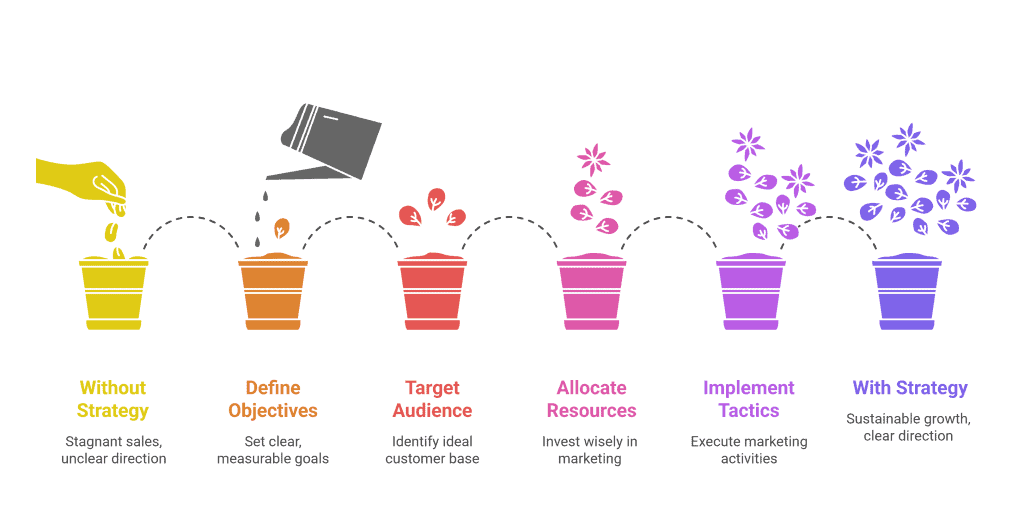
Core Foundations of a Successful Growth Strategy
Every successful strategy is built on solid foundations. Before creating a marketing plan, the business must define its purpose, objectives, and positioning.
1. Vision and Objectives
A clear vision describes where the business wants to be in the future. Objectives make that vision measurable. For example, a company might aim to increase turnover by 30 per cent in the next three years. Objectives should be specific, measurable, achievable, relevant, and time-bound (SMART). Setting objectives in this way makes it easier to review progress and identify whether marketing activities are contributing to the overall business goals.
2. Market Positioning
Positioning defines how a business wants to be perceived in the market. It requires identifying what makes the business unique and why customers should choose it over competitors. Positioning could be based on price, service, expertise, or innovation. Strong positioning helps a business stand out and prevents it from being lost in a crowded marketplace.
3. Audience Understanding
Knowing the customer is the foundation of all effective marketing. This involves creating buyer personas that describe customer demographics, behaviours, pain points, and purchasing drivers. For SMEs, personas might include details such as job titles, typical challenges faced, decision-making authority, and preferred communication channels. Understanding customer motivations makes it easier to design campaigns that attract and convert.

4. Competitive Analysis
Studying competitors helps identify opportunities and threats. Accidental marketers can analyse competitor websites, social media, advertising, and customer reviews to learn what works and what gaps exist. For example, if competitors rarely publish helpful content, creating valuable guides could position your business as an authority. Equally, analysing competitors’ weaknesses can highlight areas where your company can differentiate itself.
5. Strategic Roadmap
A roadmap pulls all of these foundations together. It sets the direction for the business, linking objectives, audience, and positioning to marketing actions that will drive growth. A roadmap should provide clarity on what needs to happen first, which activities should follow, and how progress will be monitored. For accidental marketers, it acts as both a guide and a reference point, reducing the risk of drifting back into ad-hoc decision-making.
Strategy Development – Turning Foundations into Action
Once the foundations are set, the next step is to develop the strategy itself. This involves turning broad objectives into actionable plans.
Step 1: Clarify Vision and Goals
Confirm long-term goals such as revenue targets, customer growth, or new market entry. Then break them into shorter-term objectives that can be tracked more easily. For instance, increasing website enquiries by 15% in six months could be one milestone that supports the longer-term goal of doubling customer numbers.
Step 2: Define the Offer and Pricing
Accidental marketers must confirm what they are selling and at what price. Is the offer premium, mid-range, or budget? Does the pricing align with the target audience’s expectations? A premium service needs to justify its price with clear value, while a budget offering must demonstrate efficiency and cost savings. This stage is critical for avoiding positioning errors that make it difficult to compete.
Step 3: Identify the Audience
Use research and customer feedback to create detailed personas. For SMEs, this might involve interviewing existing customers, reviewing sales data, or analysing website analytics. The more detail available about who the customer is, what they care about, and how they make decisions, the more precise marketing campaigns can be.
Step 4: Differentiate Against Competitors
Highlight what makes the business unique. This could be service quality, product innovation, customer experience, or pricing structure. For example, if a local competitor focuses on low prices, your business might stand out by emphasising superior customer service and long-term support. Differentiation makes the business memorable and gives customers a clear reason to choose it.

Step 5: Craft Messaging
Messaging should speak directly to the audience’s needs and pain points. For example, a small accountancy firm might focus on “taking the stress out of compliance” rather than promoting technical skills. Effective messaging uses the customer’s language, focuses on their problems, and positions the business as the solution. Creating a messaging framework can help maintain consistency across websites, social media, emails, and presentations.
Accidental marketers who follow these steps create a strategy that is not just theoretical but practical and actionable.
Marketing Planning: Creating a Practical Roadmap
Planning translates strategy into a structured plan of activity. Without a plan, marketing remains reactive and inconsistent.
Elements of a Strong Marketing Plan
Objectives and KPIs
Define what success looks like. This could include lead generation targets, revenue growth, website traffic, or brand awareness metrics. Each KPI should link directly back to the business objectives. For example, if the goal is to grow by 30%, then lead generation targets must align with that figure rather than being arbitrary.
Routes to Market
Identify which channels are most effective for the target audience. For B2B companies, this may include LinkedIn, email campaigns, and industry events. For B2C, it might involve social media platforms such as Facebook or Instagram, as well as local advertising. Each route to market should be justified with evidence that it reaches the right customers.
Content Planning
Map out content themes, topics, and formats that will engage customers. A three-month content calendar can be a good starting point, covering blogs, email newsletters, videos, and social posts. Each piece of content should have a purpose, such as educating customers, generating leads, or building trust.
Resource Allocation
Confirm budget, time, and staff available for marketing. SMEs often need to prioritise low-cost, high-impact activities such as referral programmes or organic content marketing. Allocating resources effectively also means deciding which tasks can be handled in-house and which should be outsourced.
Timeline
Plan when each activity will take place, with milestones for review. A timeline creates accountability and avoids marketing being left until “when there is time”. It also makes it easier to monitor whether activities are on track.

Why Planning Matters
Planning provides clarity, prevents wasted spending, and makes it easier to coordinate activities. For accidental marketers, a plan acts as a safety net, guiding activity week by week. It reduces the risk of last-minute, poorly thought-out campaigns and helps the business