 Skip to main content
Skip to footer
Skip to main content
Skip to footer

Marketing Strategy
Mastering Strategy Marketing, Planning and Execution for Growth
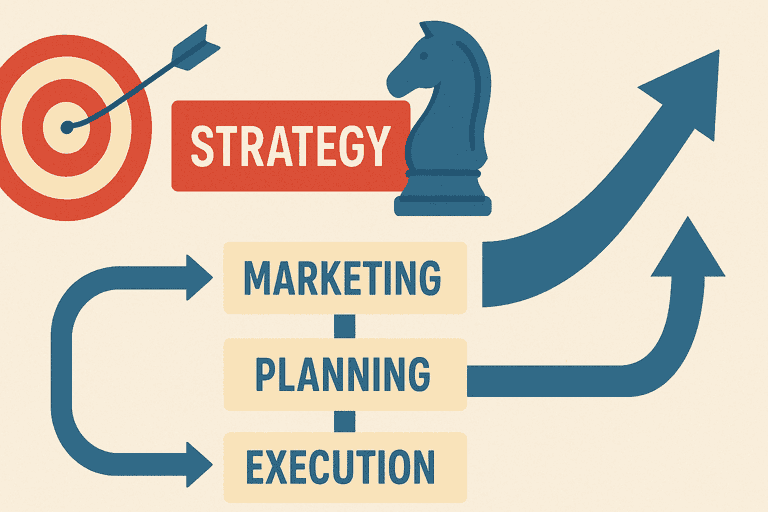
Why Growth Needs Strategy, Not Guesswork
Growth is the ambition of every business, but growth without structure can easily lead to wasted resources, poor decision-making, and short-lived results. Many SMEs fall into the trap of chasing tactical marketing activities without first clarifying their strategic direction. This often results in campaigns that generate little return, inconsistent sales pipelines, and uncertainty about which activities genuinely contribute to profitability.
Opportunity Marketing’s strategy-first approach addresses this issue directly. Rather than starting with tactics such as social media campaigns or pay-per-click advertising, the process begins with defining a clear growth strategy, building a roadmap, and aligning execution with measurable business objectives.
Strategic Marketing Mastery Course
The Strategic Marketing Mastery course has been designed to give both individuals and businesses the clarity, structure, and confidence needed to approach marketing with purpose.
For individuals, such as junior marketers, apprentices, or accidental marketers, it provides step-by-step guidance on how to develop a complete marketing strategy, supported by tools, exercises, and a workbook that builds practical skills and knowledge.
For businesses, the course delivers a ready-to-use strategic framework that links vision, objectives, positioning, and market opportunities to a clear action plan, helping owners and managers move away from guesswork and ineffective spending towards measurable growth and stronger returns on investment.
The Strategic Marketing Mastery course equips SME business owners, start-ups, and junior marketers with the clarity and structure needed to create a marketing strategy that drives measurable growth. Through ten comprehensive modules, it guides learners step by step in developing objectives, defining positioning, identifying target audiences, building messaging, and creating an actionable marketing plan tailored to their business. Once you complete the course, participants gain the confidence, tools, and practical knowledge to move away from guesswork and make strategic marketing decisions that deliver long-term success. Contact Us: 0333 320 4108 or info@opportunitymarketing.co.uk.
Defining Growth Strategy: Foundations for Sustainable Success
What is a Growth Strategy?
A growth strategy is a structured plan that sets out how a business will expand, increase revenue, and achieve long-term objectives. Unlike short-term marketing campaigns or sales promotions, a growth strategy addresses the fundamental drivers of business performance, such as positioning, customer acquisition, retention, and market expansion. It provides clarity on where the business is heading and the steps required to get there.
Why SMEs Need a Growth Strategy
SMEs often lack the internal marketing resources or strategic expertise found in larger companies. This makes a structured growth strategy even more critical. Without it, SMEs risk relying on guesswork, reacting to short-term pressures, or copying competitors without understanding whether those actions align with their own objectives. A growth strategy provides focus, allowing business owners to prioritise investments and avoid scattergun marketing.
Linking Vision, Values, and Objectives
At the heart of any growth strategy lies a business’s vision and values. Vision sets out what the business aspires to achieve, while values define the principles guiding decisions. These elements should align directly with measurable objectives. For example, a professional services firm with a vision to be recognised as a trusted advisor in its sector must translate that aspiration into objectives such as building brand authority, increasing client retention, and expanding into new industries.

Strategy Development: Laying the Groundwork
Research and Analysis
Effective strategy development begins with a comprehensive understanding of your market, competitors, and audience. SMEs should start by identifying market trends, customer pain points, and competitor positioning. Tools such as SWOT (strengths, weaknesses, opportunities, and threats) and PESTLE (political, economic, social, technological, legal, and environmental) analysis help build a structured picture.
Competitor analysis is equally important. Businesses should assess what competitors are doing well, where they are failing, and how they position themselves; businesses can identify gaps to exploit. For instance, if competitors are heavily focused on digital channels but neglect personal service, an SME could position itself as the provider of a more personalised experience.
Establishing Business Objectives
Objectives form the backbone of the strategy. They need to be specific, measurable, and aligned with overall business ambitions. For example, “increase revenue” is too vague, whereas “grow turnover by 20 per cent within 12 months through targeting mid-sized B2B clients in the legal sector” is precise and actionable. SMEs should set both short-term milestones and long-term goals, making sure each can be measured against performance data.
Defining Positioning and Differentiation
Positioning answers the question: why should customers choose you over a competitor? Differentiation focuses on what makes your business unique. These concepts are often confused with branding, but they go much deeper. Effective positioning identifies where you sit in the market and how your offering meets the needs of your ideal customers better than anyone else.
For example, a technology startup may differentiate through superior customer support or flexible contracts, while a manufacturer might highlight reliability and speed of delivery. Clear positioning avoids price wars, attracts the right customers, and creates loyalty that competitors cannot easily replicate.
Developing a Strategy: Transforming Insights into a Roadmap
Translating Strategy into Action
The next step is to transform the defined research, objectives, and positioning into a structured roadmap. This roadmap should outline what needs to be done, when it should be done, and how progress will be tracked. Unlike a high-level vision statement, the roadmap provides day-to-day guidance, helping SMEs allocate resources effectively and avoid distraction from activities that do not contribute to their goals.
Marketing Planning for SMEs
A marketing plan is an essential tool that translates the growth strategy into practical marketing actions. It should include:
- Objectives: what outcomes the business wants to achieve.
- Target Audience: detailed profiles of the customers you want to attract.
- Channels: the platforms and methods used to reach those customers.
- Budget and Resources: the financial and human investment required.
- Timeline: when activities will be executed.
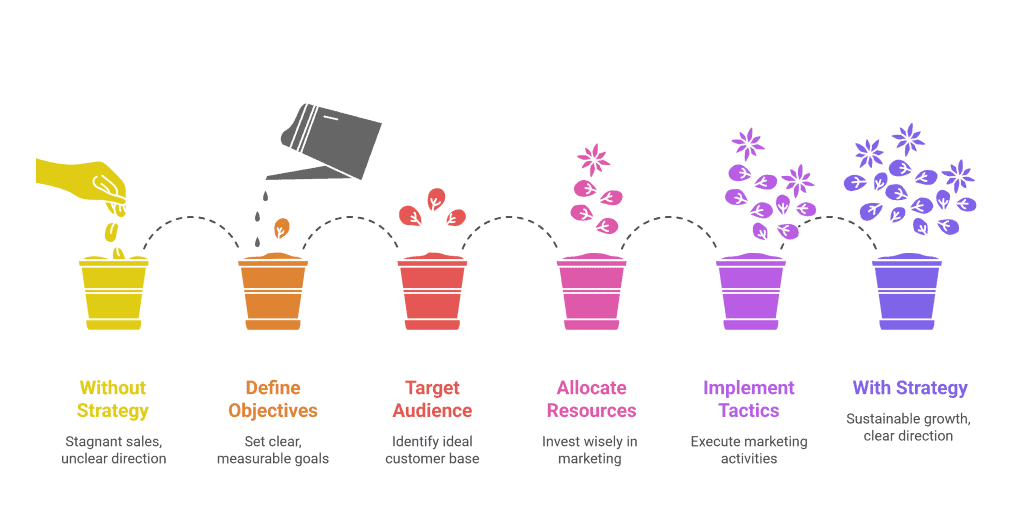
For SMEs, the challenge is often balancing ambition with limited resources. A practical marketing plan should prioritise activities with the highest likelihood of ROI, rather than attempting to cover every available channel.
Setting the Right Metrics
Without measurable outcomes, even the most detailed plan is ineffective. SMEs should define key performance indicators (KPIs) that align with business objectives. Examples include lead generation volumes, conversion rates, average customer lifetime value, and ROI on marketing spend. These metrics should not just track activity but also clarify whether the strategy is contributing to sustainable growth.
Execution: Putting the Plan into Motion
Building an Execution Framework
Execution is where many strategies fail. Businesses may have a detailed plan but lack the structure to deliver it consistently. An execution framework specifies who does what, when, and how success is measured.
For SMEs, this framework may involve a mix of in-house staff, outsourced marketing consultants, and specialist agencies. What matters is coordination. A fragmented execution wastes resources and reduces impact, whereas a coordinated framework maximises efficiency.
Marketing Channels in Execution
Execution requires choosing the right channels to engage your audience. Options include content marketing, SEO, email campaigns, PPC, social media, events, and referral programmes. SMEs should avoid spreading themselves too thin and instead focus on channels that match their audience’s preferences and buying behaviour.
For example, B2B professional services firms may see stronger results from LinkedIn and webinars than from Instagram or TikTok. Similarly, a retail SME may prioritise social media advertising and influencer partnerships. The correct mix depends on audience insights developed during the strategy phase.
Aligning Teams and Operations
Marketing execution does not exist in isolation. Sales, operations, and leadership must all align with the strategy to deliver consistent results. Sales teams need clear messaging and propositions, while operations must be able to deliver on promises made by marketing. Misalignment leads to poor customer experience and wasted investment. SMEs should make alignment a deliberate part of their execution framework.

Testing, Measuring, and Reporting
Why Measurement Matters
Testing and measurement are critical because no strategy is perfect from the outset. Data provides feedback on what is working, what needs adjusting, and where resources should be reallocated. Without measurement, businesses operate blindly, making decisions based on assumptions rather than evidence.
Testing and Experimentation
Testing allows SMEs to make improvements in real time. A/B testing email subject lines, experimenting with different ad creatives, or piloting new offers before scaling are all effective methods. These approaches reduce risk and help identify which tactics produce the highest ROI.
Reporting for Growth
Reporting should move beyond vanity metrics such as social media likes or website visits. Meaningful reports track performance against objectives and KPIs, providing actionable insight. For example, a monthly report might analyse lead generation by channel, conversion rates by segment, and customer acquisition costs. Quarterly reviews should focus on strategic outcomes such as revenue growth and customer retention.
Continuous Review and Adaptation
Markets change, customer expectations evolve, and competitors adapt. For this reason, strategy must be reviewed regularly. Quarterly reviews allow SMEs to make timely adjustments, while annual reviews provide an opportunity to re-examine broader positioning and long-term objectives.
Adaptation is not about abandoning strategy but about refining it. A business might discover that a new customer segment is more profitable than expected or that certain marketing channels are underperforming. Continuous review ensures that strategies remain relevant, resilient, and capable of delivering growth over time.
Common Challenges SMEs Face in Strategy Execution
- Lack of Clarity: Many SMEs begin execution without a clear roadmap, leading to fragmented activities and poor results.
- Overreliance on Agencies: Working with multiple agencies often creates disjointed marketing efforts.
- Budget Misalignment: Ambitious strategies are sometimes paired with inadequate resources.
- Capability Gaps: SMEs may lack internal expertise to manage execution effectively.
Recognising these challenges is the first step towards addressing them. SMEs that take a structured, strategy-first approach are better positioned to overcome them.
Solutions and Support Options for SMEs
Fast Track Marketing Plan
We offer a structured consultation process that delivers a clear, actionable marketing strategy within four weeks. This service provides SMEs with clarity, focus, and a roadmap tailored to their business.
Outsourced Marketing
An alternative to hiring in-house staff, outsourced marketing provides SMEs with access to senior-level expertise at a fraction of the cost. It ensures execution aligns with strategy while reducing the burden on business owners.

Marketing Mentoring
Mentoring supports SME owners and junior marketers by providing guidance, structured learning, and strategic oversight. This option helps businesses build in-house capability while remaining aligned with their overall growth strategy.
Marketing Health Check Audit
The report provides an independent assessm