 Skip to main content
Skip to footer
Skip to main content
Skip to footer

Marketing Strategy
Step-by-Step Marketing Strategy Training for Business Owners

Why Business Owners Need Structured Marketing Training
Many business owners find themselves struggling with marketing because they never had formal training in strategic planning. Marketing often becomes a matter of trial and error: spending on social media ads one month, printing brochures the next, and sponsoring local events without understanding whether these efforts are actually working. This lack of structure wastes valuable time and money, leaving owners frustrated and uncertain about where their growth will come from.
Structured marketing training provides clarity and confidence. It gives business leaders the tools to evaluate opportunities, make informed choices, and build consistent revenue growth. The Strategic Marketing Mastery course from Opportunity Marketing is built around this principle, equipping owners with a proven framework to create a comprehensive marketing strategy that aligns with their business goals.
The Strategic Marketing Mastery course from Opportunity Marketing provides business owners with a structured, step-by-step framework to build a marketing strategy that delivers measurable growth. Through ten comprehensive modules, participants learn how to define clear goals, understand their audience, refine their offer, and create a practical action plan tailored to their business. This training equips owners with the clarity, confidence, and tools to take control of their marketing, reduce wasted spending, and achieve sustainable profitability. Contact Us: 0333 320 4108 or info@opportunitymarketing.co.uk.
The Importance of Strategy Before Execution
Business leaders often jump into marketing execution without a clear strategy because it feels tangible. Placing an advert, posting on LinkedIn, or paying for Google Ads provides immediate activity. Yet activity without direction rarely leads to sustainable outcomes. When there is no strategy, it is almost impossible to measure success, allocate resources effectively, or understand whether results are worth the investment.
A strategy-first approach puts structure in place before a single tactic is implemented. It involves asking fundamental questions, such as;
- ‘What are we trying to achieve?’
- Who are we trying to reach?
- Why should customers choose us?

Once these questions are answered, the right activities naturally follow. Traditional agencies often push businesses towards individual services like SEO or social media because those are their specialities. A consultancy such as Opportunity Marketing operates differently: strategy comes before execution, which means every marketing pound is directed towards activities that contribute to growth.
The benefit of training in strategic thinking is that owners can avoid being sold to by execution-focused providers and instead lead the conversation. By understanding how to create their own strategy, they retain control, reduce wasted spend, and have the confidence to make better commercial decisions.
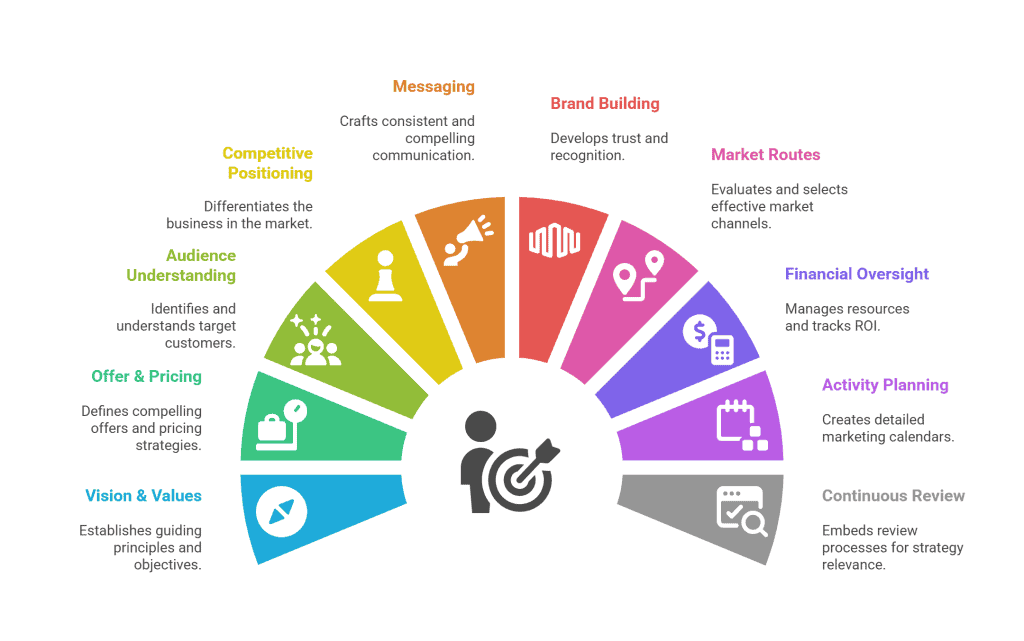
Step One: Defining Vision, Values, Objectives, and Goals
Every effective marketing strategy begins with a clear sense of direction. A vision articulates what the business wants to achieve long-term, while values define the principles guiding behaviour and customer interaction. Objectives and goals provide measurable milestones that show whether the business is on track. Without them, marketing activities are disconnected from the broader purpose of the organisation.
For example, a business might want to grow turnover by 20 per cent within two years. To achieve this, objectives could include increasing brand awareness among decision-makers in a specific sector, improving lead generation, and raising customer retention rates. Goals should always be specific, measurable, achievable, relevant, and time-bound.
Training equips business owners with exercises to clarify vision and values, align marketing objectives with commercial outcomes, and set realistic performance targets. The benefit of starting here is that it prevents the business from being distracted by short-term tactics that do not support the bigger picture. Ignoring this step results in inconsistency, which could lead to the brand looking different across channels, messaging not resonating, and resource waste.

Step Two: Crafting Your Offer and Pricing Strategy
A business offer is more than the products or services being sold; it is the total value presented to the customer. It includes the benefits, unique features, and the way it is packaged. Pricing plays a crucial role because it influences perception. Set prices too low, and the offer may appear cheap or unreliable; set them too high, and customers may not see the value.
Strategic training teaches owners how to assess the strength of their offer, identify whether it meets customer needs, and position prices to maximise both profitability and competitiveness. Exercises include reviewing competitor pricing, calculating margins, and evaluating what customers are willing to pay.
The advantage of a clear pricing strategy is that it provides confidence when selling. Staff are not forced into discounting simply to win business, and customers understand the value of what they are buying. Without it, businesses risk inconsistency, confusion, and reduced profitability.
Step Three: Knowing Your Audience
Many SMEs make assumptions about their audience rather than building detailed profiles. A broad statement such as, “our audience is anyone needing accounting services” is unhelpful because it ignores the reality that different segments have different needs.
Training helps owners create buyer personas, which are fictional but evidence-based representations of the ideal customer. Each persona captures demographics, motivations, pain points, decision-making factors, and preferred communication channels. For example, a start-up founder might value flexibility and cost-effectiveness, whereas a larger SME might prioritise compliance and scalability.
Market research supports these personas. Tools such as surveys, competitor reviews, and Google Analytics can reveal patterns about customer behaviour. Without this work, marketing activities are often misaligned, targeting the wrong people with the wrong message. With training, owners learn how to confirm assumptions with data and then design marketing campaigns that resonate with real customer needs.

Step Four: Understanding Competitive Positioning
Every business operates in a competitive environment. Even if no direct competitor offers the exact same product, customers always have alternatives. Understanding competitive positioning involves identifying what makes your business distinct and why customers should choose you.
Strategic Marketing Mastery provides frameworks for analysing direct and indirect competitors, assessing their strengths, and identifying gaps in the market. This analysis helps owners define their unique selling proposition (USP). For example, a consultancy might differentiate itself not based based on price but on speed of delivery and personalised service.
The advantage of clear positioning is that it prevents businesses from blending into the market. Without it, they risk competing solely on price, which reduces margins and makes long-term growth difficult. With training, owners can confidently communicate what sets them apart, leading to stronger customer loyalty and improved profitability.
Step Five: Messaging That Resonates
Messaging is the bridge between strategy and execution. It communicates the business’s value to the customer in a way that is simple, compelling, and persuasive. Poor messaging confuses potential buyers; strong messaging motivates them to act.
Business owners can adapt core messages for websites, social media, or sales presentations with the help of training. This involves identifying key benefits, addressing customer pain points, and using language that resonates with the target audience.
The benefit of structured messaging is consistency. Customers encounter the same themes and values across all touchpoints, reinforcing credibility and trust. Without it, businesses may appear disjointed, with different employees or channels presenting conflicting narratives.
Step Six: Building a Strong Brand
A brand is not simply a logo or colour scheme; it is a perception held by customers. It includes the values, identity, and reputation of the business. Training equips owners to understand how every aspect of communication, from website design to customer service, contributes to brand strength.
For SMEs, brand building provides a long-term advantage. A strong brand creates recognition, loyalty, and the ability to charge premium prices. A weak brand leaves the business vulnerable to competitors who can copy products or undercut prices.
Strategic Marketing Mastery provides guidance on how to align brand identity with customer expectations, create consistency across channels, and reinforce values in every interaction. The benefit is a brand that customers trust and return to.

Step Seven: Choosing the Right Routes to Market
There are countless marketing channels available, from traditional advertising to digital platforms, events, and partnerships. The challenge for business owners is choosing which one will deliver the best return. Attempting to do everything spreads resources too thin and often produces little impact.
Training provides a structured approach to selecting routes to market based on audience preferences and business goals. For example, LinkedIn may be highly effective for B2B services, while Instagram may work better for consumer products. Offline methods such as networking and trade shows may still play a valuable role in specific sectors.
The benefit of prioritisation is that it maximises impact without overextending budgets. Following a structured approach avoids wasted spending on activities that fail to reach the intended audience.
Step Eight: Financials and ROI Tracking
Marketing should be viewed as an investment rather than a cost. To confirm whether it delivers value, business owners need to track key metrics such as cost per lead, customer lifetime value, and conversion rates.
Training introduces simple methods for setting budgets and measuring ROI. Owners learn how to allocate resources between brand-building activities and lead generation, track performance, and adjust spending where necessary.
The advantage of this approach is that decisions are based on evidence rather than guesswork. Without it, businesses often continue investing in tactics that feel comfortable but deliver little measurable return.

Step Nine: Activity Planning
Once the strategy is defined, activity planning translates it into a practical roadmap. This involves creating a marketing calendar that outlines specific actions, deadlines, and responsibilities. For example, the plan might schedule monthly blogs, quarterly campaigns, and weekly social media updates.
Strategic Marketing Mastery provides templates that help owners structure these activities. The benefit is that everyone in the business understands what needs to be done and when, creating accountability and momentum. Without an activity plan, marketing becomes sporadic, with bursts of activity followed by periods of neglect.
Step Ten: Continuous Review and Improvement
Marketing is never finished. Customer needs change, competitors adjust, and technology evolves. Continuous review allows businesses to refine their strategy over time.
Training helps owners create feedback loops using analytics, customer surveys, and performance data. This allows them to identify what works, stop what does not, and introduce new tactics with confidence.
The benefit is agility. Businesses that review and adapt are better placed to respond to change and seize new opportunities. Without it, strategies quickly become outdated and ineffective.
Overcoming Common SME Marketing Challenges
SMEs face recurring challenges when managing marketing. Many waste resources on tactics without strategy, leading to limited results. Others suffer from stagnant growth because they cannot identify new opportunities. Inconsistent sales also present risks, creating cash flow uncertainty.
Training addresses these challenges directly by providing a structured framework. It teaches owners how to prioritise resources, develop sustainable growth plans, and create consistent revenue streams. The advantage is confidence: owners no longer feel like marketing is guesswork but see it as a planned investment that delivers results.
Case Studies: How SMEs Benefited from Strategic Marketing Training
Consider a start-up in the technology sector that struggled to gain traction despite strong products. After completing structured training, the business clarified its audience, refined its messaging, and focused on LinkedIn as its main channel. Within six months, leads doubled, and conversion rates improved significantly.
A professional services firm had stagnated, with revenue flat for two years. Through its training, it identified weaknesses in its brand and repositioned itself to emphasise expertise and reliability. The outcome was a 25 per cent increase in new contracts within a year.
An accidental marketer in a small retail business felt overwhelmed by responsibility. Training provided the structure and tools to build a coherent plan, boosting c