 Skip to main content
Skip to footer
Skip to main content
Skip to footer

How To:, Marketing Strategy
How Strategic Marketing Training Drives Business and Career Success

The Growing Importance of Marketing Strategy Training
Modern marketing has evolved far beyond promotional campaigns and advertising budgets. Success now depends on how effectively an organisation develops and executes a well-defined marketing strategy. Without this foundation, even the most creative marketing campaigns fail to generate consistent growth. Many businesses, especially small and medium-sized enterprises (SMEs), find themselves investing heavily in marketing activities that yield little return. The underlying reason often lies in the absence of strategic clarity rather than poor tactical execution.
Marketing strategy training addresses this issue by helping individuals and organisations build structured, measurable, and goal-orientated marketing plans. Whether you are a business owner trying to drive profitability or a marketing professional seeking career advancement, understanding the principles of strategy development is critical. Strategic training strengthens analytical thinking, improves decision-making, and empowers professionals to align marketing activity with broader business objectives.
The Strategic Marketing Mastery course from Opportunity Marketing provides business owners, managers, and marketing professionals with the practical tools and structured approach needed to create a results-driven marketing strategy. Through ten comprehensive modules, participants learn how to define clear goals, identify target audiences, craft compelling messages, and build actionable plans that drive measurable growth. The course empowers learners to make confident, informed marketing decisions that reduce waste, improve ROI, and deliver long-term business success. Contact Us: 0333 320 4108 or email at info@opportunitymarketing.co.uk.
Understanding What Marketing Strategy Really Means
Many businesses confuse marketing strategies with marketing tactics. Strategy is the overall plan that defines the business’s goals, target audience, and competitive approach. Tactics, on the other hand, are the specific actions or campaigns designed to deliver that strategy.
A well-structured marketing strategy aligns all departments and activities with the business’s vision, ensuring that every pound of marketing spend contributes to measurable objectives. Training provides the knowledge to develop this strategic discipline. Participants learn to set clear goals, understand their audience, assess competitors, and allocate resources effectively.
A strong marketing strategy gives direction, reduces wasted expenditure, and helps businesses stay agile in changing markets. Training equips professionals to make decisions based on evidence and analysis, rather than assumptions or short-term trends.
How Marketing Strategy Training Transforms Businesses
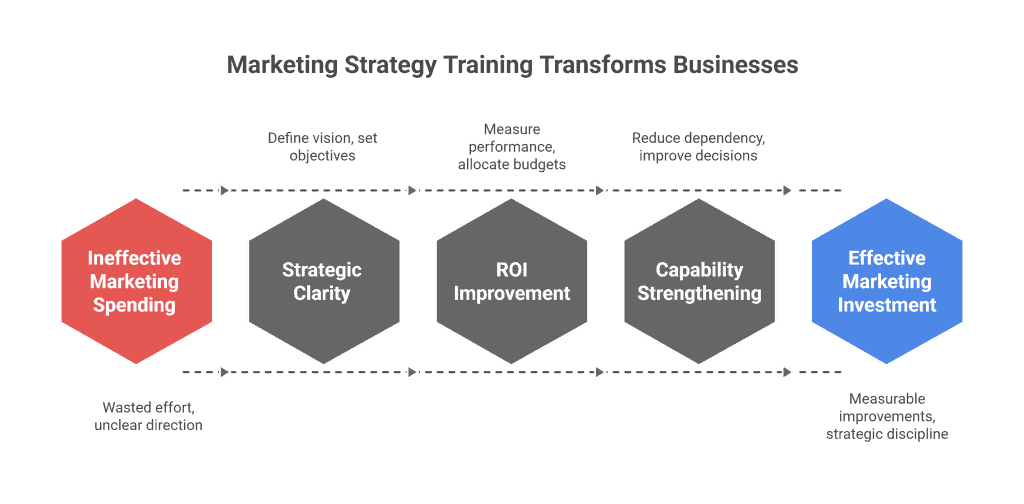
1. Creating Strategic Clarity and Direction
Marketing strategy training provides business leaders with the ability to clarify their goals and translate them into actionable plans. Many organisations struggle because they either do not have a documented marketing strategy or rely on fragmented tactics. Through structured training, managers learn to identify what their business stands for, who their ideal customers are, and what differentiates them from competitors.
For example, Opportunity Marketing’s Strategic Marketing Mastery course walks participants through the process of developing a step-by-step marketing plan. It covers everything from defining a vision and setting measurable objectives to building brand positioning and identifying routes to market. This clarity helps prevent wasted effort and ensures all marketing activity is purposeful.
Strategic clarity also builds confidence. When everyone in an organisation understands the marketing direction, internal communication improves, and teams work cohesively towards shared goals. Training provides the framework for developing that unified focus.
2. Improving Return on Investment and Reducing Waste
One of the most common challenges SMEs face is ineffective marketing spending. Without a structured strategy, businesses often spend on advertising, digital campaigns, or social media without understanding how these activities contribute to profit. Marketing strategy training teaches professionals to measure performance and focus on activities that generate the highest return.
Trainees learn to set clear objectives, identify performance indicators, and use data to make informed decisions. This knowledge allows businesses to allocate budgets wisely, test campaigns effectively, and refine them based on measurable outcomes.
Opportunity Marketing’s ROI-driven methodology highlights this principle. Businesses that approach marketing with strategic discipline see measurable improvements in lead generation, conversion rates, and profitability. Training ensures that marketing becomes an investment in growth rather than an expense.
3. Strengthening Internal Capability
Marketing strategy training is not just about knowledge; it’s about developing internal capability. Businesses that invest in training their teams reduce dependency on external agencies and consultants. When employees understand strategy, they make better decisions, communicate more effectively, and can execute campaigns with greater confidence.
Trained professionals can assess agency proposals, negotiate better contracts, and identify which marketing channels deliver value. This internal competence not only saves money but also improves accountability. For smaller businesses without dedicated marketing departments, strategy training helps leaders and managers build the expertise needed to effectively oversee their marketing.
Over time, the business develops a culture of continuous learning and improvement. Training acts as the catalyst for developing that mindset.
How Marketing Strategy Training Empowers Individuals
1. Developing Commercial and Strategic Thinking
Professionals who undertake marketing strategy training gain more than technical knowledge; they learn to think strategically. This means understanding the commercial context of every marketing decision. Rather than focusing solely on creative execution, trained marketers learn to analyse the broader business environment, assess risks, and identify opportunities.
Courses like “Strategic Marketing Mastery” teach individuals how to evaluate market trends, analyse competitors, and determine what drives customer behaviour. These skills transform marketing professionals into business strategists capable of contributing to company-wide growth initiatives.
Strategic thinkers are highly valuable in any organisation because they can connect marketing activity with business performance. They understand how to use research, data, and analysis to influence decision-making and drive results.
2. Expanding Career Opportunities
Marketing strategy training provides individuals with a competitive edge in their careers. As businesses increasingly prioritise measurable results and strategic accountability, employers value marketers who can combine creativity with analytical thinking.
Professionals who complete strategic training are well-positioned to move into senior roles such as marketing manager, head of marketing, or marketing consultant. For freelancers or those seeking self-employment, strategy training offers a pathway to building a consultancy. Opportunity Marketing’s Become a Marketing Consultant course is specifically designed for experienced marketers who want to transition into independent consultancy work.
Participants learn not only how to create marketing strategies for clients but also how to establish their own business model, manage pricing, and attract clients. This blend of strategy and entrepreneurship opens up new career possibilities and provides long-term financial security.
3. Increasing Earning Potential and Flexibility
A more profound understanding of marketing strategy allows individuals to command higher fees or salaries. Businesses value expertise that translates directly into growth, and professionals who can demonstrate strategic competence are in high demand.
Moreover, strategic training empowers individuals to explore flexible career paths, including consulting, mentoring, and freelance project work. Those with the confidence to apply structured methodologies and frameworks can build sustainable, independent careers.
Opportunity Marketing’s training approach provides the tools, templates, and guidance needed to set up a consultancy that operates with professionalism and credibility. The benefits extend beyond financial gain; participants gain freedom, flexibility, and the satisfaction of using their expertise to help others succeed.
Core Skills Developed Through Marketing Strategy Training
A robust marketing strategy requires a range of complementary skills. Comprehensive training equips professionals and business owners with the knowledge to build and implement effective strategies across multiple disciplines.

1. Defining Vision, Values, and Objectives
The starting point of any successful marketing plan is a clear vision. Training teaches participants to articulate what their business stands for, what success looks like, and how to measure progress. Defining values helps shape messaging, culture, and brand perception.
Participants learn to set SMART objectives: specific, measurable, achievable, relevant, and time-bound. These objectives form the benchmark for evaluating marketing effectiveness and guide decision-making throughout the business.
2. Building a Compelling Offer and Pricing Model
A strong marketing strategy is built around a clear product or service offer. Training helps businesses define their product or service in a way that highlights its value to customers. Participants learn how to develop pricing models that reflect both value and profitability, striking the right balance between competitiveness and margin.
Understanding how to construct a persuasive value proposition also enhances sales performance. Trainees learn to communicate benefits clearly and demonstrate the return customers can expect by choosing their business.
3. Identifying and Understanding Target Audiences
Successful marketing depends on a profound understanding of the audience. Training provides frameworks for researching customer behaviour, segmenting markets, and developing buyer personas.
Participants learn how to analyse demographic, geographic, and psychographic data to create detailed profiles of their ideal customers. They then use these insights to tailor messages, select appropriate channels, and design marketing campaigns that resonate.
Businesses reduce guesswork and focus on activities that directly influence purchase decisions by learning audience analysis.
4. Competitive Positioning and Differentiation
One of the central elements of marketing strategy training is understanding competition. Participants learn how to assess competitors’ strengths and weaknesses and identify opportunities for differentiation.
Training explains how to articulate a unique selling proposition (USP) that positions the business distinctly in the marketplace. Businesses that master this skill avoid competing solely on price and instead focus on value, expertise, or service quality.
Effective positioning gives a business credibility and makes it easier for customers to choose them over competitors.
5. Crafting Messaging and Brand Consistency
Training teaches professionals how to translate strategy into communication. This involves developing messages that express the organization’s values, vision, and personality while addressing customers’ needs.
Participants learn how to maintain brand consistency across all touchpoints, from websites and emails to social media and printed materials. The outcome is a coherent, recognisable brand identity that builds trust and loyalty.
Businesses can influence perception and strengthen customer relationships when they strategically align their brand messaging.
6. Identifying Routes to Market
Marketing strategy training helps businesses determine the most effective ways to reach their target audience. Trainees explore different sales and marketing channels: digital, direct, social, and traditional, and learn how to evaluate their suitability.
Rather than relying on a single channel, strategic marketers develop multi-channel plans that integrate online and offline methods. They evaluate cost-effectiveness, scalability, and audience engagement to create an optimised approach that delivers measurable results.
This process reduces wasted effort and allows businesses to allocate resources to the channels that drive the most value.
7. Measuring Performance and Continuous Improvement
Effective strategy requires ongoing measurement. Training equips professionals with the skills to track performance using analytics, financial data, and key performance indicators (KPIs).
Participants learn how to interpret data, draw insights, and adjust strategies in response to results. This continuous improvement cycle allows businesses to stay agile, competitive, and focused on long-term goals.
Regular review and refinement transform marketing from guesswork into a structured, evidence-based discipline.
The Impact on Business Growth
1. Better Decision-Making
Trained marketers make data-led decisions that support profitability. They know how to assess risks, test ideas, and prioritise activities based on evidence. This approach minimises trial-and-error spending and builds confidence among leadership teams.
2. Stronger Team Alignment
When everyone understands the strategy, collaboration improves across departments. Sales, marketing, and operations work toward shared goals, reducing conflict and duplication. Strategic training creates a common language and shared purpose throughout the organisation.
3. Sustainable Growth
Marketing strategy training promotes long-term success. Businesses with strategic foundations are better equipped to adapt to market changes, identify new opportunities, and maintain steady growth. Rather than relying on short-term campaigns, they build scalable systems for continuous improvement and profitability.