Skip to main content
Skip to footer
Skip to main content
Skip to footer

How To:, Uncategorized
How to Build a Strategic Messaging Framework

Creating a Strategic Messaging Framework That Connects with Customers
A strategic messaging framework is a structured document that defines how a business communicates its value, market position and customer benefits. It normally includes the target audience, customer problems, positioning statement, value proposition, primary message, supporting message pillars, proof points, objection responses, tone of voice and calls to action.
Clear business messaging helps prospective customers understand what you offer, who you serve and why they should choose you. Weak messaging creates uncertainty, particularly when a website, sales proposal, social media account and marketing campaign each describe the business differently. Prospective customers may struggle to recognise the value of the offer, while employees and external agencies may present conflicting versions of the same proposition.
Which can solve this problem by connecting your target audience, competitive positioning, value proposition and supporting evidence within one structured document. It gives business owners, directors, marketing managers, sales teams and external partners a shared foundation for communication. Used correctly, the framework can improve marketing consistency, lead quality, sales conversations and return on marketing investment.
Opportunity Marketing’s Strategic Marketing Mastery course helps SME owners and junior marketing professionals develop the strategic knowledge needed to define their target audience, competitive positioning and core value proposition. Participants learn how to create clearer, more consistent messages that connect customer needs with credible business benefits across websites, campaigns, content and sales communications. The structured course provides practical guidance for turning a strategic messaging framework into a focused marketing strategy that supports stronger decisions, better-quality leads and sustainable business growth. Contact Us: 0333 320 4108 or info@opportunitymarketing.co.uk.
What Is a Strategic Messaging Framework?
A strategic messaging framework is a structured reference document that defines the principal messages a business communicates to its audiences. It establishes what the business wants to be known for, which customer problems it addresses, how its offer creates value and why its claims should be believed.
The framework usually contains a positioning statement, primary message, value proposition, supporting message pillars, proof points, objection responses, tone-of-voice guidance and calls to action. These components create a clear message hierarchy, allowing marketing and sales teams to communicate the same strategic meaning without repeating identical wording.
Messaging Framework Versus Brand Messaging
Brand messaging covers the ideas, values and promises an organisation communicates. A messaging framework organises those messages, explains their purpose and shows how they should be applied. It acts as the bridge between marketing strategy and customer-facing content.
Visual branding, campaign slogans and advertising copy serve different purposes. A logo helps people recognise a brand, while a slogan may support a specific campaign. Neither can replace the strategic clarity provided by a well-developed messaging framework.

Why Your Business Needs a Messaging Framework
Prospective customers need to recognise quickly whether an offer is relevant to them. Clear messaging answers three immediate questions: What does the business provide? Who is it intended for? Why should the customer care?
Creating Clarity for Prospective Customers
Many businesses describe themselves through services, features or internal terminology. Customers tend to think differently. They want to know whether the organisation understands their problem and can help them achieve a worthwhile outcome.
A messaging framework shifts communication towards customer needs without ignoring the expertise behind the offer. That change can make website pages easier to understand, sales discussions more focused and marketing campaigns more relevant.
Strengthening Competitive Positioning
Generic statements such as “high-quality service”, “trusted partner” and “customer focused” rarely communicate meaningful differentiation. Competitors can make the same claims, leaving customers with no credible reason to favour one provider.
Effective positioning identifies a difference that matters to the intended audience. That difference might involve specialist experience, a distinctive process, sector knowledge, service flexibility or a measurable commercial benefit. Strong messaging expresses that advantage clearly and supports it with evidence.
Improving Marketing and Sales Consistency
Mixed messages often appear when several people create content or communicate with prospective customers. A shared framework aligns website copy, proposals, email campaigns, presentations, social content and sales conversations.
Consistency does not mean using the same sentence everywhere. It means preserving the same strategic meaning while adapting the language to the channel, audience and buying stage. This approach gives content creators useful direction without restricting creativity.
Research Before Writing Your Messages
Strong messaging begins with research rather than a brainstorming session. Internal opinions can be useful, but they do not always reflect how customers think, what competitors communicate or why sales opportunities are lost.
Revisit Your Business and Marketing Objectives
Start by defining the commercial result the framework should support. Your priority might be attracting larger clients, improving lead quality, entering a new market, launching a service or repositioning the business.
Message development becomes unfocused when it is disconnected from business strategy. Agree the target market, offer, growth objective and desired market position before attempting to write polished statements.
Understand Your Priority Audiences
Identify the decision-makers, influencers and users involved in purchasing your product or service. Explore their objectives, frustrations, objections, buying triggers and preferred terminology. A business-to-business purchase may involve a managing director, finance lead, department manager and end user, each of whom views value differently.
Useful evidence can come from customer interviews, sales calls, reviews, search behaviour, enquiry forms and feedback from lost opportunities. Speak with existing customers about what prompted them to seek help, why they selected your business and what almost prevented the purchase.

Analyse Competitor Messaging
Review how direct and indirect competitors describe their services, audiences, benefits and differences. Look for repeated claims, neglected customer concerns and market positions that are already overcrowded.
Competitor analysis should expose opportunities rather than produce imitation. Copying familiar language may make your business sound credible at first, but it can also make the offer indistinguishable.
Audit Existing Communications
Compare your website, brochures, proposals, advertisements, social channels and sales scripts. Record conflicting descriptions, outdated claims, unexplained terminology and statements that lack supporting evidence.
The audit will reveal whether the problem is poor wording or a deeper strategic disagreement. No copywriter can create lasting clarity when internal stakeholders have different views about the audience, offer or competitive advantage.
The Core Components of a Strategic Messaging Framework
A practical framework should give employees enough direction to create consistent communications without becoming an unwieldy brand manual. The following components provide a suitable foundation for most UK SMEs.
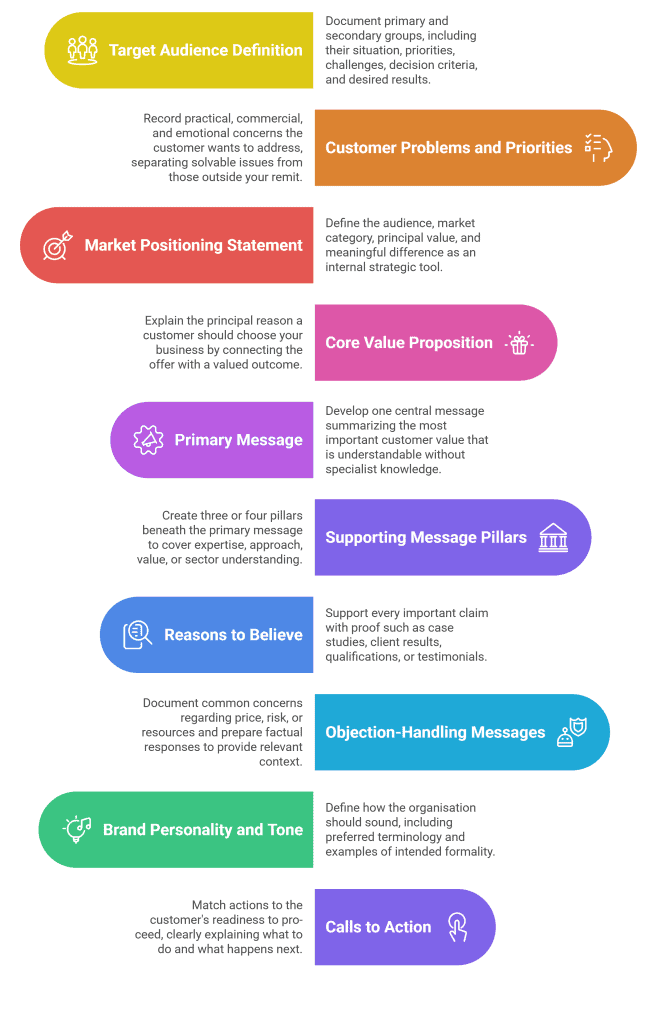
1. Target Audience Definition
Document the primary audience and any important secondary groups. Describe their situation, priorities, challenges, decision criteria and desired results.
Avoid broad definitions such as “small businesses” unless the offer genuinely applies to almost every small business. Messaging becomes stronger when it speaks to a recognisable type of customer facing a specific commercial problem.
2. Customer Problems and Priorities
Record the practical, commercial and emotional concerns the customer wants to address. A weak lead pipeline may be the visible symptom, while unclear positioning, unsuitable targeting or fragmented marketing could be the underlying cause.
Separate problems your business can solve from issues that sit outside its remit. Honest boundaries protect credibility and help sales teams qualify opportunities more effectively.
3. Market Positioning Statement
Your positioning statement should define the audience, market category, principal value and meaningful difference. It is primarily an internal strategic tool, not necessarily a sentence that will appear on your homepage.
A useful structure is: “For [priority audience] that needs [problem or objective], we provide [category or offer], which delivers [principal value], because [credible difference].” Treat this as a thinking framework rather than a rigid copywriting formula.
4. Core Value Proposition
The value proposition explains the principal reason a suitable customer should choose your business. It should connect the offer with an outcome the audience values, rather than simply listing features.
Strong value propositions are relevant, specific, credible and distinct. Claims such as “save time and money” require greater detail because they say little about how the value is created or why the business is qualified to deliver it.
5. Primary Message
Develop one central message that summarises the most important customer value. A reader should understand it without specialist knowledge or lengthy explanation.
Trying to include every service and benefit usually weakens the primary message. Lead with the value most closely connected to the customer’s central priority, then use supporting messages to develop the story.
6. Supporting Message Pillars
Create three or four message pillars beneath the primary message. These may cover expertise, service approach, commercial value, sector understanding, flexibility or customer support.
Each pillar should communicate one clear idea and answer a genuine customer question. Too many pillars create a catalogue of claims rather than a memorable message hierarchy.
7. Reasons to Believe
Support every important claim with proof. Useful evidence can include case studies, client results, qualifications, testimonials, specialist experience, recognised processes and transparent service data.
Evidence exposes a common messaging weakness: the business wants to make a claim but cannot yet substantiate it. The responsible response is to moderate the statement or develop the required evidence, not exaggerate.
8. Objection-Handling Messages
Document the concerns that regularly delay or prevent a purchase. Common objections relate to price, risk, implementation time, internal resources, switching suppliers and expected return.
Prepare factual responses that acknowledge the concern and provide relevant context. Dismissing an objection can damage trust, while a considered response may help the customer make a more informed decision.
9. Brand Personality and Tone of Voice
Define how the organisation should sound. Practical characteristics might include authoritative, direct, approachable, supportive or commercially focused.
Tone should adapt to context. A compliance notice will sound different from a social media post, but both should remain recognisably connected to the same organisation. Include preferred terminology, language to avoid and examples showing the intended level of formality.
10. Calls to Action
Match calls to action to the customer’s readiness to proceed. Early-stage prospects may prefer to read a guide or review a case study, while sales-ready prospects may want to book a consultation or request a proposal.
Clear calls to action explain what the customer should do and what will happen next. Vague phrases such as “learn more” can create unnecessary uncertainty.
How to Build the Framework Step by Step
Step 1: Agree the Strategic Foundation
Bring the relevant decision-makers together to confirm the audience, offer, business objective and desired market position. Resolve competing internal views before copy development begins.
Step 2: Draft the Message Hierarchy
Write the positioning statement first, followed by the value proposition, primary message, supporting pillars and proof points. Focus initially on strategic meaning, then improve clarity, rhythm and tone.
Step 3: Test Messages with Real Customers
Use customer interviews, sales conversations, landing pages and email tests to assess whether people understand the message. Ask readers what they believe the business offers, who it serves and why it differs.
Testing provides real-world evidence, although customers should not be expected to write the final wording. Their role is to reveal what resonates, confuses or lacks credibility.
Step 4: Refine for Clarity and Credibility
Remove jargon, vague superlatives and claims that cannot be defended. Replace internal terminology with language customers use and understand.
Clarity may sound less creative, but it generally offers greater commercial value. Clever wording becomes a liability when prospective customers cannot interpret it.
Step 5: Approve and Document the Framework
Assign one person to manage approval, ownership and version control. Record the final hierarchy, proof points, examples and application guidance in a document that employees can access easily.
Applying Messages Across Marketing and Sales Channels
A framework becomes valuable only when people use it. Adapt the depth and wording for each channel while preserving the underlying meaning.
Website pages can explain the complete proposition, while social posts may focus on one customer problem or message pillar. Sales proposals should emphasise the prospect’s priorities and supporting evidence. Email campaigns can move gradually from problem awareness towards consideration and action.
Map messages to the customer journey. Early communications should help prospects recognise the problem. Consideration-stage content can explain the solution and differentiation, while decision-stage communications should provide proof, address objections and present a clear next step.
Training is equally important. Business owners, marketing employees, sales teams, copywriters and agencies should understand why the messages were selected, not simply receive a document without explanation.

UK Compliance and Responsible Marketing Communications
Marketing claims must be accurate, clear and capable of substantiation. Build a review process for comparative statements, performance figures, testimonials and claims about customer results. Relevant communications should also follow the applicable CAP Code requirements.
Customer data used for segmentation, personalisation or direct marketing requires careful handling. UK GDPR, the Data Protection Act 2018 and the Privacy and Electronic Communications Regulations may apply, with requirements varying according to the communication method and recipient. The Information Commissioner’s Office guidance provides specific information about business-to-business marketing.
Check distinctive names, phrases and brand assets before investing heavily in their promotion. UK trade mark registration may protect qualifying brand elements, but availability and existing rights should be researched through the Intellectual Property Office.
Measuring Whether Your Messaging Works
Record a baseline before introducing the new framework. Relevant measures may include website conversion rates, qualified enquiries, proposal success rates, sales-cycle length, common objections and customer acquisition cost.
Quantitative results should be considered alongside qualitative evidence. Review sales feedback, customer interviews, enquiry language and reasons for lost opportunities. Stronger messaging should help suitable prospects understand the offer and describe its value in terms similar to those the business intended.
Schedule a structured review when the offer, audience, competitive position or business strategy changes. Avoid altering central messages simply because a new phrase sounds more appealing. Consistency needs time to create recognition and meaningful performance evidence.
Common Messaging Framework Mistakes
Frequent mistakes include making the message primarily about the business, targeting everyone, confusing clever wording with clarity and publishing claims without proof. Another serious failure occurs when leaders approve the framework but do not train employees or apply it across marketing and sales.
A messaging framework cannot repair an unsuitable offer, poor customer experience or weak marketing strategy. Its purpose is to communicate genuine value clearly. Businesses should address underlying commercial problems rather than using stronger language to disguise them.
Turn Your Messaging into a Commercial Asset
A strategic messaging framework connects customer insight, competitive positioning, value, evidence and consistent communication. It gives UK businesses a practical foundation for producing clearer marketing, supporting sales teams and making more disciplined decisions about content and campaigns.
Start by auditing how your business currently describes itself across customer touchpoints. Conflicting explanations, generic claims and unclear differences indicate that a structured framework is needed. Where internal teams cannot agree on the audience, positioning or value proposition, independent marketing consultancy can provide the research, challenge and strategic direction required to move forward.
Work With Opportunity Marketing
Unclear or inconsistent messaging can weaken your positioning, confuse prospective customers and reduce marketing performance. Opportunity Marketing helps UK SMEs define their target audience, value proposition, competitive position and core messages through an independent, strategy-first approach.
Speak to Opportunity Marketing about building a strategic messaging framework that gives your marketing and sales communications greater clarity, consistency and commercial focus.
📩 Request a Free Consultation
Let’s talk about how we can help you stop reacting to agency ideas and start driving your marketing with purpose. Complete our quick inquiry form or give us a call; we’ll walk you through what’s possible and how to get started.
📍 Visit: opportunitymarketing.co.uk
📞 Call: 0333 320 4108
📧 Email: info@opportunitymarketing.co.uk


Ian Kirk
Founder at Opportunity Marketing
Ian is the founder of Opportunity Marketing marketing, with over 18 years of experience in successfully setting up marketing departments, creating marketing strategies and implementing these strategies across a wide number of SME companies in both the B2B and B2C sectors through a variety of channels.

A-Z OF MARKETING
A complete guide that simplifies the wonderful world of marketing.
 Download Now