 Skip to main content
Skip to footer

Become a Marketing Consultant, How To:
How to Hire the Right Marketing Consultant for Your SME
Why the Right Marketing Consultant is Critical for SME Success
Hiring the right marketing consultant can be one of the most commercially significant decisions an SME makes. Marketing spend is often a substantial part of the budget for growing businesses, but without the right strategic oversight, much of it risks being wasted on disjointed, ineffective, or misaligned activities. A marketing consultant’s job isn’t simply to advise on promotional channels; it’s to help a business define where it sits in the market, who it should speak to, what it should say, and how to generate measurable growth.
SMEs rarely have the luxury of large in-house marketing teams, making this external expertise not just valuable but necessary. With hundreds of consultants offering varying levels of service and many blurring the lines between strategy and execution, it’s essential to know how to choose wisely.
Opportunity Marketing helps ambitious SME business owners make smarter, more confident marketing decisions through structured, impartial, and commercially focused consultancy. Our strategy-first approach delivers clear, actionable marketing plans that eliminate waste, improve ROI, and align every activity with your business goals. Whether you need a full marketing strategy, outsourced support, or mentoring to develop internal capability, we provide the expertise and clarity your business needs to grow sustainably. Contact Us: 0333 320 4108 or info@opportunitymarketing.co.uk
Understanding What a Marketing Consultant Actually Does
Marketing consultants work closely with business owners and directors to develop marketing strategies that are grounded in research, aligned with commercial objectives, and focused on generating results. Unlike a marketing agency, which typically sells services such as SEO, PPC, design, or content creation, a consultant starts further upstream.
The consultant’s role involves thoroughly understanding the business, including its values, product or service offerings, target customers, and market dynamics. They define strategic direction before any marketing activity begins. Their output might include a marketing strategy document, an implementation plan, or recommendations on positioning and messaging. Consultants may also project-manage activity, help recruit or mentor junior marketing staff, or provide high-level board-level input as a fractional marketing director.
What they don’t do is pitch creative campaigns or channel-specific solutions in isolation. This distinction matters. SMEs looking to fix underperforming marketing often find the issue lies not with the execution but with the absence of a cohesive strategy.

Knowing When Your SME Needs a Marketing Consultant
Many SME owners delay bringing in a marketing consultant until they feel something is broken. Yet the right time to bring in this expertise is often before major marketing investment takes place or when growth ambitions demand clarity and structure.
Several signs point to the need for external strategic support:
- You’re spending money on marketing without knowing what’s working or why.
- Your internal marketing resource is limited, junior, or non-existent.
- You feel overwhelmed managing multiple agencies or suppliers with no unified plan.
- There’s no clear articulation of your brand’s value proposition or positioning.
- Your marketing feels reactive rather than planned.
Choosing a consultant at this stage can prevent poor decision-making, reduce wasted spending, and provide the strategic clarity needed to maximise the return from every marketing activity moving forward.
What to Look For in a Marketing Consultant
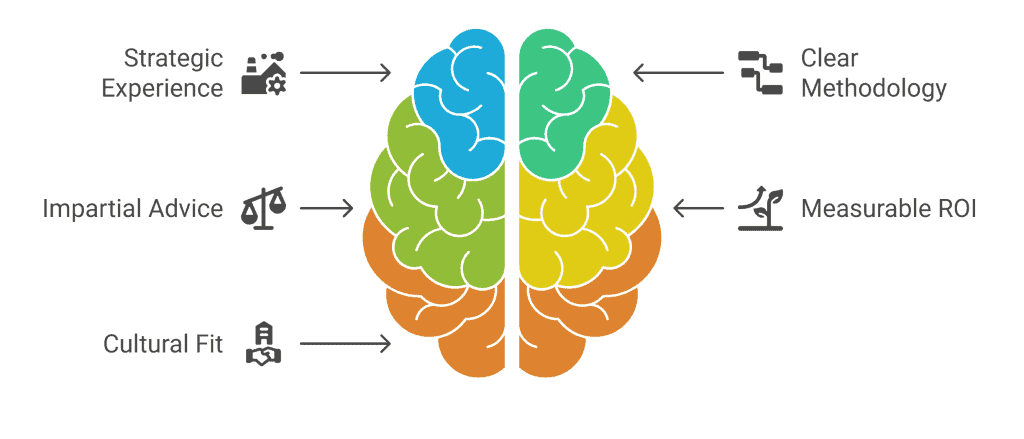
Selecting the right marketing consultant starts with deciding what attributes to prioritise. A strong consultant combines commercial experience, structured methodology, and a strategic mindset focused on growth and results.
Look for these attributes:
1. Strategic Experience Across Sectors
A consultant with experience across multiple industries often brings a broader commercial view and fresh thinking. They’re more likely to question assumptions and recommend solutions that aren’t tied to the norms of a particular sector. For SMEs, their input often leads to breakthroughs in positioning and targeting.
2. Clear, Proven Methodology
Consultants should have a defined process they follow with every client. Whether it’s a marketing audit, a structured Fast Track Marketing Plan, or a full strategic development framework, transparency in their approach demonstrates professionalism and structure, not guesswork or templates.
3. No Vested Interests in Execution
Be cautious of consultants who also sell executional services (such as SEO, web design, or PPC) as part of their package. While some do this well, many offer advice skewed towards the services they profit from. A strategic consultant should offer impartial recommendations based solely on what is right for your business.
4. Track Record of Measurable ROI
Case studies and testimonials speak volumes. Ask to see evidence of how their recommendations helped past clients grow, improve performance, or make better marketing decisions.
5. Fit with Your Business Ethos and Culture
Personality and communication style matter. A consultant will spend significant time with your senior team, so alignment on values, pace, and expectations is critical. Trust and rapport can’t be underestimated when the goal is long-term growth.
Understanding the Right Process: How a Strategic Consultant Works
A good consultant doesn’t just bring experience; they bring structure. The right process transforms ideas into actions and confusion into clarity. Here’s how that typically looks in an SME engagement:
Step 1: Discovery and Research
This is the foundation. Consultants conduct internal audits, review performance metrics, analyse financial data, and look at customer behaviour. They also research competitors, marketplace trends, and positioning strategies. Every recommendation stems from this evidence base.
Step 2: Strategic Definition
Once the data is in place, the consultant works to define:
- Target audience segments and personas.
- Defining the value proposition and positioning of the audience.
- Key messaging pillars and tone of voice.
- Commercial objectives and marketing priorities.
Step 3: Planning and Roadmapping
The output of strategic definition is a clear 12–36 month marketing roadmap. This includes:
- Recommended channels.
- Campaign timing and structure.
- Budget and resource planning.
- KPI frameworks and success metrics.
Step 4: Implementation Support
Many consultants extend their services beyond just strategy development. They also offer implementation management, supplier briefing, marketing mentoring, or fractional director support. Such assistance transforms the strategy into action and helps avoid the common problem of strategies gathering dust in a drawer.
Step 5: Ongoing Measurement and Refinement
Performances must be tracked, reviewed, and optimised. The right consultant will build in a review process to adjust tactics in response to results, ensuring your activity remains commercially relevant.
Questions Every SME Should Ask Before Hiring a Consultant
Choosing a marketing consultant is more than just outsourcing a task; it’s about entrusting someone with shaping the direction of your business’s growth. The wrong appointment could result in misaligned activity, wasted spend, or lost opportunities.
Asking the right questions during your evaluation process is crucial to finding a consultant who aligns with your commercial goals, understands your sector, and brings a structured, unbiased approach to marketing strategy. The following questions will help you assess credibility, process, suitability, and long-term value.
What is your exact process for developing marketing strategies?
This question tests whether the consultant has a clearly defined and structured methodology. A good consultant should be able to guide you through the steps of discovery, research, planning, and implementation. Look for specifics like audience analysis, competitive benchmarking, messaging frameworks, and activity planning. A lack of structure may signal guesswork or one-size-fits-all approaches, which are unlikely to deliver meaningful results for your SME.
Do you have examples of similar businesses you’ve helped? What were the outcomes?
Case studies and past project examples are essential indicators of a consultant’s experience and effectiveness. Ask to see tangible results, whether that’s revenue growth, lead generation, clearer positioning, or improved return on investment. While it’s not essential that they’ve worked in your exact industry, understanding how they’ve solved similar marketing challenges gives you insight into their commercial thinking and adaptability.
Are your recommendations impartial, or are they linked to other services you provide?
Impartiality is a major differentiator between strategic consultants and many agencies. This question helps you identify whether a consultant might be incentivised to steer you towards certain tactics, like SEO, PPC, or design, because they also sell those services. A truly strategic consultant will make decisions based solely on your business’s needs, without any hidden agendas or commercial bias.

Will you be involved after the strategy is written, or is your role purely advisory?
Marketing strategy without implementation support often results in stalled progress. Some consultants hand over a plan and move on. Others, like Opportunity Marketing, stay involved to manage the delivery, mentor staff, or guide third-party suppliers. If you want your strategy to lead to action and results, it’s important to know what level of ongoing support is available, and whether the consultant is committed to seeing recommendations through.
How do you work with internal teams or external suppliers?
A successful consultant must collaborate effectively with existing resources. This includes your in-house staff, who may have varying levels of marketing experience, as well as any external partners, such as digital agencies, PR firms, or web developers. Ask how the consultant supports, briefs, and aligns others involved in delivery. You’re looking for someone who can act as a project manager or strategic lead, not just offer theoretical guidance from the sidelines.
What does success look like, and how will we measure it?
This question is about defining expectations and outcomes from the outset. A professional marketing consultantation should help you establish clear marketing KPIs such as lead volume, customer acquisition cost, website conversion rate, or revenue growth linked to marketing. They should also explain how performance will be tracked, how often reviews will occur, and what happens if the activity isn’t working. Without this clarity, it becomes hard to justify continued investment.
These questions help clarify scope, expectations, and cultural fit. A transparent consultant will welcome them and likely have their set of questions to better understand your needs. The right partnership is built on mutual understanding, open communication, and a shared commitment to measurable results. SMEs should feel empowered to probe deeply before making a hiring decision. After all, a strategic consultant isn’t just a service provider; they are a growth partner.
What to Avoid: Red Flags and Common Pitfalls
Hiring the wrong marketing consultant can lead to misaligned priorities, wasted budget, and a lack of strategic clarity. While many consultants offer valuable insights, there are also those who overpromise, underdeliver, or apply a cookie-cutter approach that doesn’t serve the unique needs of your SME. Recognising the warning signs early in your selection process can protect your business from avoidable setbacks and underperformance.