 Skip to main content
Skip to footer
Skip to main content
Skip to footer

News
Why AI Agents Are Reshaping the Future of SME Marketing Strategy
The Shift Towards Intelligent Strategy
Artificial intelligence (AI) is no longer a futuristic concept reserved for tech giants; it has become a central part of modern business strategy. Marketing, one of the most data-driven disciplines, is now undergoing a transformation where AI agents are emerging as critical assets in shaping strategy, refining campaigns, and driving measurable results. For strategic marketers, particularly those working with SMEs, AI agents represent more than efficiency; they represent a new standard of competitive intelligence and decision-making capability.
Traditional marketing decision-making relies heavily on human interpretation, intuition, and manual analysis of performance data. Yet, as data sources multiply and marketing environments grow more complex, the human capacity to make timely, accurate decisions becomes increasingly limited. AI agents fill this gap by acting as analytical partners, able to analyse large datasets, interpret behaviours, predict outcomes, and recommend actions aligned with commercial objectives.
As strategic marketing consultancies like Opportunity Marketing advocate, sustainable growth depends on clarity, research, and informed decision-making. AI agents are helping businesses achieve precisely that, enabling marketers to shift from reactive tactics to proactive, data-informed strategies that align directly with measurable business outcomes.
The Strategic Marketing Mastery course helps business owners and marketing professionals apply the same data-driven principles discussed in this article by teaching them how to create structured, measurable marketing strategies built on commercial logic. Participants learn to integrate insights from emerging technologies such as AI agents to strengthen decision-making, improve ROI, and reduce marketing waste. Through clear, step-by-step guidance, the course empowers learners to think strategically, plan effectively, and execute marketing activity with confidence and precision. Contact Us: 0333 320 4108 or info@opportunitymarketing.co.uk.
Understanding AI Agents in Marketing
Defining AI Agents in a Strategic Context
An AI agent is an autonomous system that can perform marketing-related tasks, interpret data, make decisions, and learn from interactions. Unlike traditional AI software that follows predefined rules, AI agents use machine learning, natural language processing, and neural networks to adapt over time. They are designed to think and act strategically based on a defined objective, whether it is optimising campaigns, identifying market opportunities, or predicting customer behaviour.
These systems can execute complex operations such as analysing market trends, segmenting customers, automating ad spend, and generating data-driven recommendations. For marketers, this means having a continuously learning partner that refines insights, predicts ROI outcomes, and offers real-time intelligence without the time-consuming manual effort that traditional analytics demands.

Key Types of AI Agents in Modern Marketing
AI agents now perform a range of strategic functions across the marketing spectrum. The most common types include:
- Market Research Agents: Capable of scanning thousands of data sources, news, social platforms, and industry databases—to uncover competitor trends, market shifts, and consumer sentiment.
- Content Generation Agents: Tools powered by natural language models that create written, visual, and multimedia content tailored to audience segments and keyword intent.
- Media Buying Agents: These agents monitor ad performance, bidding dynamics, and conversion patterns to allocate budgets more effectively.
- Customer Interaction Agents: Deployed through chat interfaces, social media, and email automation, these systems personalise communication based on user behaviour and history.
- Strategic Analysis Agents: The newest category, focused on interpreting business-level data to inform decisions on positioning, pricing, and channel prioritisation.
Each of these agents contributes to the broader goal of improving marketing effectiveness and enabling data-led decision-making that aligns with commercial strategy.
From Automation to Intelligence
Marketing automation has existed for over a decade, but AI agents represent a significant evolution. Automation performs tasks; AI agents make decisions. They understand context, identify patterns, and anticipate the next step. Where automation answers “what happened”, AI agents answer “why it happened” and “what should happen next”.
This evolution empowers marketers to integrate intelligence at every stage of the strategic process, from planning and forecasting to measurement and refinement. It also marks the transition of marketing from being operationally driven to being strategically intelligent.
Why Strategic Marketers Need AI Agents
Managing Complexity in Modern Marketing
The marketing landscape has become saturated with data—analytics from websites, CRM systems, email campaigns, social media engagement, and third-party insights. While data abundance can theoretically lead to better decisions, in practice it overwhelms human analysts. Strategic marketers must now interpret thousands of signals to make choices about channels, audiences, and messaging.
AI agents address this complexity by processing and structuring data at scale. They detect patterns in user behaviour, forecast campaign results, and model future performances. These insights help marketers prioritise what matters most—audience segments that convert, channels that deliver ROI, and content that resonates.
Improving Strategic Decision-Making
A core function of marketing strategy is identifying which investments yield the highest return. AI agents play a vital role in forecasting these outcomes by using predictive analytics. They simulate different campaign variables, budget levels, creative variations, and timing, and calculate the probable financial outcomes of each scenario.
For example, when developing a Fast Track Marketing Plan, an AI system can analyse market conditions and recommend where to focus activity for the best return on investment. It can identify trends months before they become obvious through manual research, enabling businesses to act before competitors.
This analytical foresight enhances clarity, aligning with Opportunity Marketing’s principle of building strategy before execution. AI tools are not replacing the human strategist; they are amplifying their ability to interpret data objectively and make commercially sound recommendations.

Creating Consistent and Scalable ROI
Every strategic marketer aims to reduce waste and improve efficiency. AI agents contribute directly to this goal by making campaign execution measurable and accountable. They calculate metrics such as customer acquisition cost, return on ad spend, and customer lifetime value in real time, allowing continuous optimisation.
The result is a data ecosystem that learns and improves. Over time, marketing activities become increasingly efficient, driving greater consistency and profitability across campaigns.
Transforming the Strategic Marketing Process
Enhancing Market Research and Competitive Intelligence
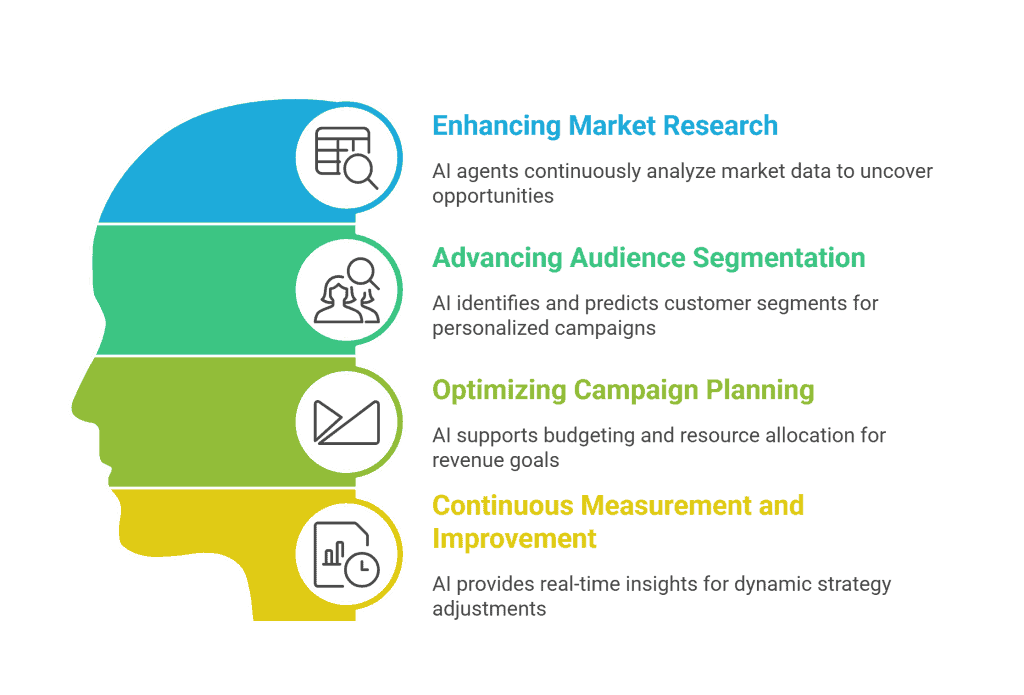
Traditional market research is resource-heavy, involving surveys, reports, and manual competitor analysis. AI agents transform this process by continuously collecting and analysing market data. They track emerging trends, competitor activity, pricing changes, and consumer sentiment to uncover hidden opportunities.
Strategic marketers can use these insights to refine positioning, adjust value propositions, and identify gaps in market demand. This automation allows small and medium-sized businesses to access enterprise-level intelligence without the cost of a dedicated research team.
Advancing Audience Segmentation and Personalisation
Understanding customers is central to effective marketing strategy. AI agents analyse demographic, behavioural, and psychographic data to reveal audience segments that might otherwise remain invisible. Beyond standard segmentation, they can predict purchasing intent, identify high-value customers, and uncover emerging segments before competitors do.
For instance, predictive segmentation enables marketers to tailor campaigns based on likelihood of conversion rather than static demographics. This approach increases efficiency, focusing marketing spend on prospects most likely to generate profit.
Optimising Campaign Planning and Resource Allocation
One of the most valuable capabilities of AI agents is their ability to support budgeting and resource planning. Using the principle of “budgeting backwards”, they calculate what level of marketing investment is required to reach specific revenue goals.
AI systems assess factors such as conversion rates, cost per lead, and anticipated lifetime value to recommend how budgets should be distributed across channels. This replaces guesswork with data-driven precision, improving ROI and accountability at every stage of the campaign.
Continuous Measurement and Improvement
AI agents transform performance tracking from a static reporting process into a live optimisation cycle. Rather than reviewing campaigns quarterly, marketers can receive continuous insights about performance fluctuations.
Agents monitor key metrics, ROI, customer acquisition cost, and churn rate, and adjust recommendations dynamically. This allows marketers to reallocate budgets or modify tactics based on what the data indicates, not what intuition suggests.
This level of agility ensures that strategy remains aligned with market changes, audience behaviour, and business objectives, a critical factor for achieving long-term profitability.
Strategic Advantages of AI Agents for SMEs
Operational Efficiency and Cost Reduction
Small and medium-sized businesses often lack large marketing teams or dedicated analytics departments. AI agents bridge this gap by performing complex analytical tasks at a fraction of the cost and time. They streamline processes, such as keyword analysis, content optimisation, and lead scoring.
This automation accelerates productivity and reduces human error. For SMEs with limited resources, the ability to make precise, data-backed marketing decisions translates into direct financial savings and better use of marketing budgets.
Data-Driven Accountability and ROI Clarity
AI introduces a new level of accountability to marketing strategy. Campaigns can now be measured using concrete data rather than estimates or intuition. For SMEs, this is transformative. Decision-makers can clearly see which activities deliver value and which waste resources.
This alignment with measurable ROI echoes Opportunity Marketing’s philosophy that marketing should be an investment, not an expense. With AI, businesses can quantify every decision, reallocate budgets intelligently, and achieve higher returns across all channels.
Personalisation at Scale
AI-driven personalisation allows businesses to communicate with each customer as if they were the only one. Agents use behavioural data to craft messages that match audience intent, predict needs, and adjust engagement strategies in real time.
This precision not only increases conversion rates but also strengthens customer relationships. It transforms marketing from being a broadcast activity into a dialogue based on understanding, relevance, and trust.
Improved Agility and Market Responsiveness
AI agents give businesses the ability to act quickly on market signals. When an emerging trend appears or a competitor changes strategy, AI identifies the shift and recommends countermeasures. This responsiveness can make the difference between gaining or losing market share.
For SMEs, this kind of agility was once out of reach. With AI tools integrated into their strategic planning, smaller organisations can compete with larger competitors on speed and adaptability.
Ethical and Practical Considerations
Balancing Human Oversight with Automation
While AI agents offer analytical precision, they still require human oversight. Strategic marketers must interpret AI insights within the context of brand values, ethics, and customer relationships. The human element provides empathy and contextual understanding that machines cannot replicate.
The most effective marketing strategies combine the computational power of AI with the creative and emotional intelligence of human professionals. This partnership guarantees that strategy remains authentic, customer-centric, and commercially viable.
Protecting Data Privacy and Integrity
AI agents rely on extensive data, which raises ethical and legal obligations. Under the UK GDPR framework, marketers must handle customer information responsibly, obtaining consent and maintaining transparency about data usage.
A commitment to data ethics strengthens brand trust. Businesses that demonstrate respect for privacy will maintain credibility and customer confidence, even as they embrace more advanced technologies.
Avoiding Overdependence on AI
Relying exclusively on AI to guide strategy poses risks. Algorithms can misinterpret data, reinforce biases, or overlook qualitative insights that human judgement would recognise. For this reason, marketers must treat AI recommendations as advisory rather than absolute.
Strategic decision-making remains a human responsibility. AI should support marketing intelligence, not replace it.
Integrating AI Agents into a Strategy-First Framework
Aligning with Core Strategic Principles
Opportunity Marketing’s methodology is built on five guiding principles: balance of depth and clarity, effective communication, strategic decision-making, professionalism, and compliance. AI agents directly enhance each of these principles through their analytical accuracy and adaptability.
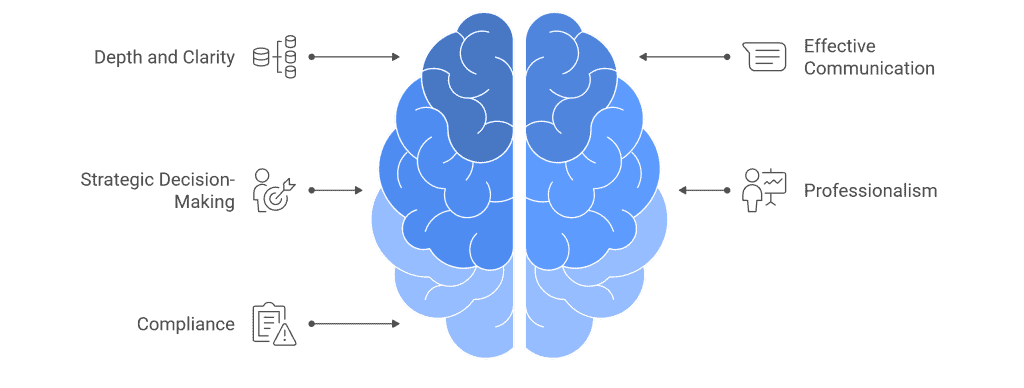
- Depth and Clarity: AI simplifies complex datasets into actionable insights that improve understanding of markets and audiences.
- Effective Communication: Data-driven insights guide more relevant and timely messaging.
- Strategic Decision-Making: Predictive analytics strengthens the objectivity of marketing plans.
- Professionalism: AI-supported strategies are structured, documented, and evidence-based.
- Compliance: Automated data validation processes reinforce adherence to regulatory standards.
This alignment demonstrates that AI complements a strategy-first approach rather than disrupting it.
Practical Steps to Implementation
Businesses can begin integrating AI agents into their strategic processes through the following steps:
- Define Objectives: Clarify commercial goals such as revenue growth, lead generation, or customer retention.
- Identify Data Sources: Consolidate existing data from CRM, social media, website analytics, and sales reports.
- Select AI Tools: Choose AI systems that align with your business size, data maturity, and marketing objectives.
- Integrate and Test: Start with pilot projects before expanding integration across channels.
- Monitor and Refine: Use AI dashboards to track progress, but interpret findings through strategic review meetings.
This phased approach allows businesses to adopt AI responsibly while building internal expertise and confidence.
Real-World Scenarios
Consider a mid-sized professional services firm using AI to optimise its lead generation. The agent analyses historical client data, identifies the most profitable industries, and recommends which marketing channels deliver the highest conversion rates. Within three months, the firm reallocates 20% of its budget based on AI insights, leading to a 30% increase in qualified leads.
Another example involves a retailer applying AI-powered forecasting to manage marketing spend. By predicting seasonal demand fluctuations, the retailer adjusts campaign intensity and messaging to maximise return on investment throughout the year.
These scenarios demonstrate how AI integrates seamlessly into strategy, transforming insight into measurable action.
The Future of AI Agents in Strategic Marketing
From Predictive to Prescriptive Intelligence
The next generation of AI agents will move beyond prediction to prescription, actively recommending strategic actions based on data models. They will not only interpret the market but also simulate possible outcomes, advising marketers on the most profitable course of action.
This evolution will enable businesses to move from reactive marketing management to pre-emptive strategy, where actions are taken before problems or opportunities fully emerge.

AI and Human Creativity: A Strategic Alliance
AI’s strength lies in data analysis; human marketers excel at understanding human motivation and emotion. The future belongs to those who can combine both. AI will handle the technical and analytical workload, allowing marketers to focus on creativity, empathy, and innovation.
Rather than reducing the value of human marketers, AI will elevate their role, transforming them into strategic interpreters who guide technology toward meaningful, brand-aligned outcomes.
The Strategic Marketer’s New Role
As AI adoption accelerates, the role of marketers will change. They will act as analysts, interpreters, and orchestrators of data-driven systems. Their success will depend on their ability to translate AI insights into commercially viable strategies that balance profitability with brand integrity.
This progression aligns with Opportunity Marketing’s core philosophy: marketing must be measurable, credible, and rooted in commercial logic. AI simply strengthens that foundation.
Redefining Strategic Marketing in the Age of AI
AI agents represent a defining shift in the way marketing strategy is conceived and executed. They empower marketers to act with clarity, speed, and confidence, making decisions backed by data rather than assumption.
For SMEs and marketing consultancies alike, AI agents are no longer optional tools but strategic necessities. They bring intelligence to every stage of the marketing process, from research and segmentation to forecasting and performance measurement, reducing waste and maximising return on investment.
The future of marketing strategy lies not in replacing human expertise but in augmenting it with intelligent systems capable of interpreting vast amounts of data and identifying commercial opportunities.
Businesses that adopt AI within a structured, strategy-first framework will gain a measurable advantage: faster insights, smarter decisions, and stronger ROI. As technology continues to evolve, the marketers who master the balance between human understanding and machine intelligence will lead the next generation of commercially driven marketing success.

Work With Opportunity Marketing
Opportunity Marketing specialises in helping SMEs transform their marketing from reactive to strategic. Our consultancy focuses on clarity, commercial logic, and measurable results, making sure that every marketing decision directly supports long-term growth. Whether you want to refine your strategy, integrate AI-driven insights, or maximise your ROI, our team can help you build a structured, data-informed marketing plan tailored to your business objectives.
Take the next step toward smarter, strategy-led marketing.
Call us today or visit Opportunity Marketing to start building a marketing strategy that delivers measurable growth and commercial success.
Visit: opportunitymarketing.co.uk
Call: 0333 320 4108 Email: info@opportunitymarketing.co.uk


Ian Kirk
Founder at Opportunity Marketing
Ian is the founder of Opportunity Marketing marketing, with over 18 years of experience in successfully setting up marketing departments, creating marketing strategies and implementing these strategies across a wide number of SME companies in both the B2B and B2C sectors through a variety of channels.

A-Z OF MARKETING
A complete guide that simplifies the wonderful world of marketing.
 Download Now


