 Skip to main content
Skip to footer
Skip to main content
Skip to footer

Marketing Strategy
What Is Strategic Marketing and Why It Matters for SMEs
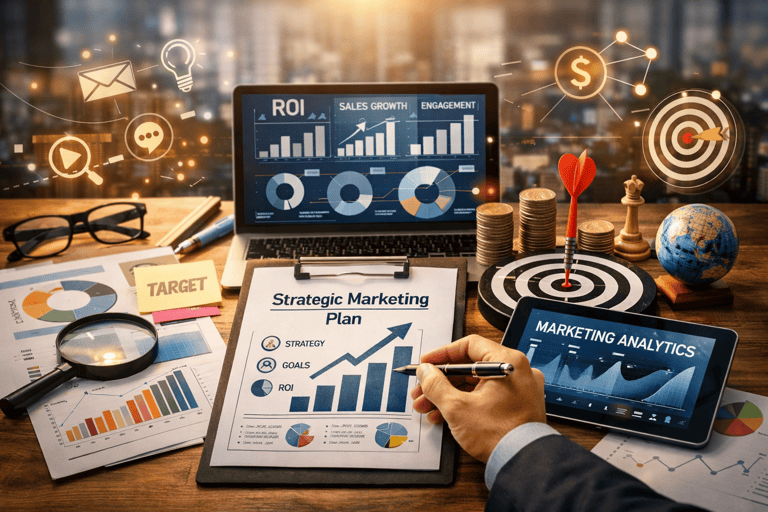
Why Strategic Marketing Has Become a Business Priority for SMEs
Strategic marketing has moved from being a secondary business consideration to a core commercial function for small and medium-sized enterprises. Competitive pressure, tighter margins, rising acquisition costs, and fragmented digital channels have made instinct-led marketing an expensive risk rather than a calculated investment. SME leaders increasingly recognise that marketing activities without direction often produce noise rather than growth.
Many businesses invest time and money into websites, social media, paid advertising, or content creation without a clear understanding of how those efforts support revenue, profitability, or long-term positioning. This lack of clarity leads to inconsistent results, frustration with suppliers, and marketing budgets that fail to deliver commercial impact. Strategic marketing addresses this problem by providing structure, focus, and decision-making confidence.
For SMEs, strategic marketing is not about complexity or corporate theory. It is about making informed choices, prioritising resources correctly, and linking marketing decisions directly to business objectives. When applied properly, it becomes a growth enhancer rather than a cost centre.
The Strategic Marketing Mastery course is designed to give SME business owners, directors, and junior marketers the clarity and structure needed to move away from reactive marketing activity and toward informed, commercially focused decision-making. The course walks learners through the core strategic marketing foundations, including defining objectives, understanding target audiences, clarifying positioning, and linking marketing activity directly to measurable business outcomes, helping them regain control over where time and budget are invested. As a result, participants develop the confidence to plan marketing with purpose, challenge ineffective tactics, and build a strategy-led approach that supports sustainable business growth rather than short-term experimentation. Contact Us: 0333 320 4108 or info@opportunitymarketing.co.uk.
What Strategic Marketing Actually Means in an SME Context
Strategic marketing is the structured process of defining how a business will compete in its chosen market and how marketing activity will support measurable business goals. It focuses on clarity before action and evidence before opinion. Rather than starting with tactics, strategic marketing begins with understanding the business, the audience, the market environment, and the commercial outcomes required.
Within an SME environment, strategic marketing brings discipline to decision-making. It clarifies who the business is targeting, why those customers should choose it, what message will resonate, and which marketing channels are worth investing in. This approach removes guesswork and replaces reactive activity with planned, purposeful action.
Strategic marketing also acts as a filter. Opportunities, ideas, and supplier recommendations can be assessed against a clear framework rather than personal preference or short-term trends. This protects SMEs from spreading budgets too thinly or pursuing activity that lacks commercial justification.
Strategic Marketing Versus Tactical Marketing: A Critical Distinction
Confusion between strategy and tactics remains one of the most common causes of poor marketing performance in SMEs. Tactical marketing refers to executional activities such as search optimisation, paid advertising, social media postings, email campaigns, or website design. Only when deployed in the right context can these activities prove valuable.
Strategic marketing defines the logic behind those activities. It determines which channels are appropriate, what success looks like, how much should be invested, and how performance will be measured. Without strategy, tactics operate in isolation and often compete for attention rather than working together.
SMEs often succumb to the trap of marketing driven solely by tactics. A competitor launches a campaign, a supplier recommends a channel, or a platform introduces a new feature. Activity follows without clarity. Results may appear positive on the surface, yet revenue impact remains unclear. Strategic marketing prevents this pattern by establishing direction before execution begins.
Why SMEs Commonly Struggle Without Strategic Marketing
SMEs face unique constraints that make strategic marketing both essential and challenging. Limited budgets, time pressure on business owners, and a lack of in-house expertise often push marketing decisions down the priority list. Activity happens when there is room for it, not as part of a planned schedule.
A common issue arises when businesses work with multiple agencies or suppliers. Without a strategic framework, each supplier focuses on their area, leading to fragmented messaging, duplicated effort, and unclear accountability. Without a clear definition of success, assessing performance becomes challenging.
Internal challenges also play a role. Business owners may feel uncertain about marketing terminology, metrics, or data interpretation. This leads to reliance on external opinions rather than informed judgement. Strategic marketing provides clarity and shared understanding, reducing dependency and improving confidence at the leadership level.
The Core Building Blocks of Strategic Marketing for SMEs
Strategic marketing rests on several interconnected components. Each element supports better decision-making and reduces wasted effort.
Business Objectives and Commercial Direction
Marketing must start with the business goals it is expected to support. Growth targets, profitability expectations, market expansion plans, and retention priorities should shape every marketing decision. Without this alignment, marketing activity becomes disconnected from commercial reality.
Clear objectives allow SMEs to assess whether marketing investment is proportionate, realistic, and relevant. They also provide a reference point for performance evaluation and budget planning.
Market and Competitive Understanding
A strong strategy requires a clear view of the market landscape. This includes understanding customer expectations, competitor positioning, pricing structures, and barriers to entry. Assumptions often replace evidence in SMEs, leading to misjudged opportunities and avoidable risk.
Market awareness allows businesses to position themselves intentionally rather than reactively. It supports differentiation and prevents marketing messages from blending into generic industry noise.
Audience Definition and Segmentation
Targeting everyone results in meaningful impact for no-one. Strategic marketing demands a clear audience definition based on behaviour, needs, and commercial value. SMEs benefit from focusing resources where returns are most likely rather than pursuing volume for its own sake.
Effective segmentation supports stronger messaging, improved conversion rates, and more efficient use of budget. It also helps businesses recognise which customers are worth prioritising and which may dilute profitability.
Positioning and Value Proposition
Positioning answers a fundamental question: why should a customer choose this business over alternatives? Strategic marketing articulates its benefits clearly, linking customer needs to genuine strengths rather than surface-level claims.
A clear value proposition supports consistency across marketing activity and helps SMEs avoid constantly changing messages in search of results.
Messaging and Narrative Consistency
Messaging translates strategy into communication. Strategic marketing establishes the business’s communication style, identifies the issues it tackles, and demonstrates its value. Consistency strengthens recognition, credibility, and trust over time.
Research and Analysis as the Foundation of Strategic Marketing
Research underpins credible strategic marketing. Decisions based on assumptions often reflect internal bias rather than market reality. Strategic research does not require enterprise-level budgets, but it does require structure and objectivity.
Audience insights, competitor reviews, performance analyses, and channel evaluations provide the evidence needed to prioritise activity. This process highlights opportunities worth pursuing and exposes areas where investment may be underperforming.
Analysis also supports risk management. Marketing decisions involve uncertainty, yet informed risk produces better outcomes than reactive experimentation. Strategic marketing replaces guesswork with calculated judgement.

Strategic Marketing and ROI: Treating Marketing as an Investment
Marketing only earns its place in an SME when it contributes to commercial outcomes. Strategic marketing frames marketing spend as an investment rather than an expense. This shift changes how decisions are made and how performance is evaluated.
Rather than focusing on vanity metrics such as impressions or engagement alone, strategic marketing prioritises indicators linked to revenue, conversion, and customer value. Budget decisions become more disciplined, and ineffective activity can be reduced or redirected.
This approach also supports accountability. Marketing performance can be reviewed against defined objectives rather than subjective satisfaction. Over time, this builds confidence in marketing as a growth driver rather than a cost burden.
How Strategic Marketing Improves Leadership Decision-Making
Strategic marketing supports better leadership decisions by reducing uncertainty. Business owners and directors gain a clearer understanding of where to invest, what to prioritise, and when to say no. This clarity prevents distraction and protects resources.
Budget planning becomes more controlled, supplier relationships more productive, and internal expectations more realistic. Strategic marketing provides a shared language between leadership, marketing, and external partners.
This clarity also reduces stress. Decisions feel deliberate rather than reactive, and progress can be measured against a defined plan.
Strategic Marketing and Sustainable Business Growth
Sustainable growth requires more than short bursts of activity or isolated campaigns. Strategic marketing provides a framework that balances immediate performance with long-term business stability. SMEs often feel pressure to generate quick wins, particularly when cash flow is tight, yet growth driven purely by short-term tactics frequently creates volatility rather than momentum.
Strategic marketing allows businesses to identify which activities contribute to repeatable outcomes rather than one-off spikes. Customer acquisition becomes more predictable, messaging becomes clearer, and resource planning improves. Over time, this consistency strengthens brand credibility and reduces reliance on constant promotional activity to maintain revenue.
A further benefit lies in scalability. When growth is guided by strategy, businesses can expand activity with confidence rather than rebuilding marketing foundations each time they reach a new stage. Instead of replacing itself every time circumstances change, strategic marketing evolves alongside the organisation.
Aligning Teams, Agencies, and Suppliers Through Strategic Marketing

One of the most practical advantages of strategic marketing is alignment. SMEs often rely on a mix of internal staff, freelancers, and external agencies to execute marketing activity. Without a clear strategy, each party operates with partial context, leading to conflicting priorities and diluted impact.
A documented marketing strategy acts as a shared reference point. Internal teams understand the direction, suppliers work toward the same objectives, and leadership can assess progress against defined expectations. This alignment reduces duplication, limits miscommunication, and supports more productive working relationships.
Strategic clarity also improves supplier accountability. Recommendations can be evaluated against agreed priorities rather than accepted at face value. SMEs regain control of decision-making instead of being led by whichever service provider speaks most convincingly.
Strategic Marketing as a Tool for Resource Prioritisation
Resource constraints define the SME environment. Time, budget, and internal capacity rarely stretch far enough to pursue every opportunity. Strategic marketing helps businesses prioritise activity that offers the highest potential return.
Rather than spreading effort across multiple channels, strategic marketing focuses attention where impact is most likely. This may involve concentrating on fewer audience segments, refining messaging, or reducing activity that consumes resources without delivering results.
Prioritisation also supports more realistic planning. Teams understand what matters most and can allocate effort accordingly. This clarity reduces burnout and improves consistency across marketing delivery.
Common Strategic Marketing Mistakes SMEs Make
Several recurring mistakes undermine strategic marketing effectiveness in SMEs. Recognising these pitfalls helps businesses correct course before significant resource is lost.
One frequent issue involves confusing activity with progress. Publishing content, running campaigns, or launching new platforms can feel productive, yet without clear objectives these actions lack direction. Strategic marketing reintroduces purpose to activity.
Another common mistake involves copying competitors without understanding context. What works for one business may fail elsewhere due to differences in audience, pricing, or capability. Strategic marketing encourages informed adaptation rather than imitation.
Overcomplication also presents a risk. Strategy should provide clarity, not complexity. When plans become overly detailed or rigid, execution slows and confidence erodes. Effective strategic marketing remains practical and adaptable.
When Should SMEs Invest in Strategic Marketing Support?
Strategic marketing support becomes valuable when internal clarity is lacking or growth has stalled. Warning signs include increasing marketing spend without proportional return, conflicting advice from suppliers, or uncertainty around audience targeting and messaging.
Businesses undergoing change also benefit from strategic input. Market expansion, product launches, restructuring, or leadership transitions introduce complexity that reactive marketing struggles to manage. Strategic marketing provides s