Skip to main content
Skip to footer
Skip to main content
Skip to footer

How To:, Marketing Strategy, Marketing Techniques, Marketing Tips
Competitive Brand Positioning Strategies That Help SMEs Grow

Competitive Brand Positioning Explained for Small Businesses
Small and medium sized businesses across the UK face intense competition, regardless of the sector in which they operate. Customers have more choice than ever before, digital channels have made it easier for new competitors to enter established markets, and purchasing decisions are increasingly influenced by trust, reputation and perceived value rather than price alone. Simply offering a good product or service is rarely enough to achieve sustainable growth if potential customers cannot clearly understand why one business is a better choice than another.
Competitive brand positioning gives businesses the opportunity to stand apart from competitors by creating a clear, memorable and valuable place in the minds of their target audience. A well positioned business attracts higher quality enquiries, commands greater customer loyalty and often avoids competing purely on price. Rather than attempting to appeal to everyone, successful SMEs communicate a compelling reason why they are the right choice for a specific audience.
Businesses that want to strengthen their competitive brand positioning and achieve sustainable growth can benefit from Opportunity Marketing’s Strategic Marketing Mastery course, which provides a structured framework for developing effective marketing strategies that differentiate them from competitors. The course helps business owners, directors and marketing professionals identify their ideal target audience, refine their value proposition, build a stronger market position and align every marketing activity with clear commercial objectives and measurable results. Contact Us: 0333 320 4108 or info@opportunitymarketing.co.uk.
What Is Competitive Brand Positioning?
Defining Competitive Brand Positioning
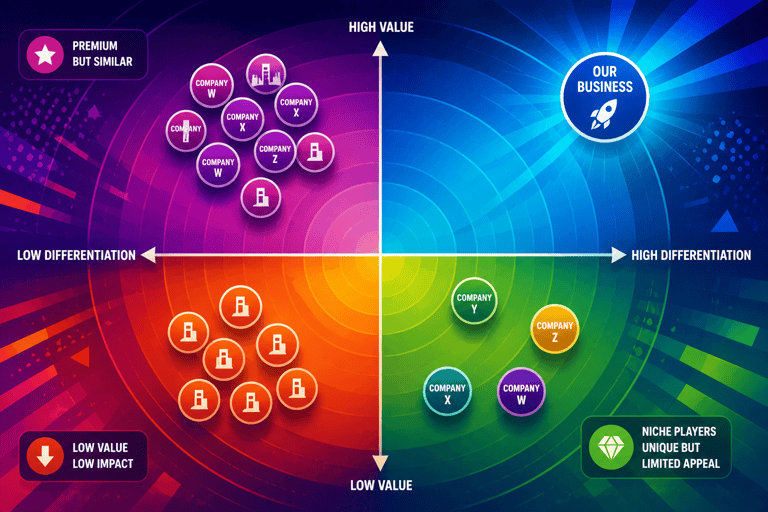
Competitive brand positioning is the strategic process of defining how a business wants to be perceived compared with its competitors. It focuses on creating a distinct identity that resonates with the right customers and clearly communicates why the business offers greater value than alternative providers.
Many people confuse branding with positioning, although they serve different purposes. Branding includes the visual identity, tone of voice, logo, colours and personality of a business. Brand positioning sits beneath those elements and defines the reason customers should choose one business instead of another. Every marketing activity, sales conversation and customer interaction should reinforce that position.
Positioning exists in the customer’s mind rather than within the business itself. A business may describe itself as innovative, trustworthy or customer focused, but those claims only become meaningful when customers genuinely associate those qualities with the organisation through consistent experience and communication.
Every business already occupies a position in the marketplace. Some develop that position deliberately through strategic planning, while others allow customers and competitors to define it for them. Businesses that fail to establish a clear position often become viewed as interchangeable with their competitors, making it much harder to win new business without reducing prices.
Why Positioning Is a Strategic Business Decision
Competitive positioning should never be viewed as a marketing slogan or advertising campaign. It is a strategic business decision that influences every aspect of commercial growth.
A clearly defined market position shapes product development, customer service standards, pricing strategy, sales messaging and marketing communications. It also provides a framework for evaluating future business opportunities. Whenever a new service, campaign or investment is considered, business leaders should ask whether it strengthens or weakens the organisation’s chosen market position.
Strong positioning also improves internal decision making. Employees understand the organisation’s purpose, marketing becomes more focused, and customers receive a more consistent experience across every touchpoint. This consistency strengthens trust and gradually builds competitive advantage over time.

Why Many SMEs Fail to Differentiate Themselves
Common Positioning Mistakes
Many SMEs struggle to stand out because they unknowingly make similar positioning mistakes. Although these businesses may provide excellent products or outstanding customer service, their marketing often fails to communicate meaningful differences that customers recognise and value.
Trying to appeal to everyone remains one of the most common mistakes. Business owners frequently believe that targeting a wider audience increases opportunities. Reality often produces the opposite result. Generic messaging rarely connects strongly with any particular customer group, making marketing less persuasive and less memorable.
Copying competitors is another frequent challenge. Businesses often imitate competitor websites, social media content, advertising campaigns or service descriptions, believing this reflects market expectations. Unfortunately, this removes any meaningful differentiation and makes competing on price increasingly difficult.
Price based competition creates further problems. Constant discounting may attract short term customers, but it reduces profit margins and encourages buyers to switch suppliers whenever a cheaper alternative becomes available. Sustainable businesses compete through expertise, service quality, specialist knowledge and measurable value rather than simply offering the lowest price.
Inconsistent messaging also weakens positioning. A website may communicate one message while social media presents another and sales conversations focus on completely different benefits. Customers quickly become confused when businesses fail to communicate a consistent value proposition.
The Cost of Weak Brand Positioning
Weak positioning affects far more than marketing performance. It influences profitability, customer acquisition, retention and long term business growth.
Businesses without clear positioning often experience lower enquiry quality because their marketing attracts people who are not ideal customers. Sales teams spend more time qualifying unsuitable prospects, increasing acquisition costs while reducing conversion rates.
Customer loyalty also suffers. When customers cannot identify meaningful differences between suppliers, purchasing decisions become increasingly influenced by price. This creates continual pressure to discount services and erodes profitability.
Marketing campaigns become less effective because generic messaging struggles to capture attention in crowded markets. Content marketing, search engine optimisation, advertising and social media all perform better when built around a distinctive market position that clearly communicates value.
Perhaps most importantly, weak positioning limits long term growth. Businesses become reactive rather than strategic, constantly responding to competitor activity instead of leading their chosen market through expertise and innovation.
The Foundations of Effective Competitive Brand Positioning
Successful positioning begins long before advertising campaigns, website redesigns or social media activity. Strong positioning develops through research, customer understanding and strategic planning. Businesses that invest time in these foundations create marketing that is more focused, more persuasive and more commercially effective.

Understand Your Ideal Customer
Effective positioning starts with understanding exactly who the business wants to serve. Customers purchase solutions that address specific problems, achieve desired outcomes or reduce particular frustrations. Businesses that understand these motivations communicate far more effectively than those relying on assumptions.
Customer research should examine demographic information alongside behavioural and commercial insights. Business owners should identify why customers purchase, what concerns influence decision making, how they compare suppliers and which outcomes matter most after purchase.
Understanding customer expectations also reveals opportunities to differentiate. Competitors may all promote similar features while overlooking issues customers genuinely value, such as responsiveness, specialist expertise, transparency, ongoing support or measurable commercial results.
Questions Every SME Should Answer
Several fundamental questions help businesses develop stronger customer insight.
Who represents the ideal customer? Defining the audience clearly allows marketing activity to become far more targeted and relevant.
What challenges or frustrations are customers trying to solve? Businesses that position themselves around solving genuine problems become considerably more valuable than those simply promoting products or services.
Why would customers choose one supplier instead of another? Understanding purchasing criteria helps organisations communicate benefits that genuinely influence buying decisions.
What outcomes matter most after purchase? Customers rarely buy products or services for their own sake. They invest because they expect improved business performance, reduced risk, increased efficiency or better financial results.
Answering these questions creates a much stronger foundation for competitive positioning than relying solely on assumptions or internal opinions.
Understand Your Competitors
Competitive positioning requires more than understanding customers. Businesses must also understand the marketplace in which they compete.
Competitor analysis should identify both direct and indirect competitors, their strengths, weaknesses, positioning strategies and target audiences. The objective is not to copy successful organisations but to discover opportunities they may have overlooked.
Many SMEs make the mistake of focusing only on competitor weaknesses. Strong positioning also requires recognising competitor strengths, allowing businesses to identify areas where genuine differentiation is possible rather than making unrealistic competitive claims.
Gap analysis is particularly valuable. Businesses should look for underserved customer groups, unmet needs, emerging trends and changing buyer expectations. These opportunities often provide stronger positioning than competing head to head against established market leaders.
Define Your Unique Value Proposition
A Unique Value Proposition explains why customers should choose one business instead of another. It moves beyond generic claims of excellent service or high quality products and focuses on measurable business value.
An effective value proposition communicates what the organisation does differently, how customers benefit and why those benefits matter. It should be specific, relevant and supported by evidence wherever possible.
Businesses often strengthen their value proposition by demonstrating specialist expertise, industry knowledge, proven methodologies or measurable commercial outcomes. Customer testimonials, case studies and success stories also reinforce credibility by providing independent validation of marketing claims.
Strong value propositions evolve alongside changing customer expectations and market conditions. Regular reviews help businesses remain relevant while continuing to differentiate themselves as competitors adapt their own strategies.
Proven Competitive Brand Positioning Strategies for SMEs
Competitive brand positioning is not achieved through a single marketing campaign or an updated logo. It develops through consistent strategic decisions that shape how customers perceive a business over time. Successful SMEs deliberately position themselves around strengths that competitors struggle to replicate, creating long term commercial advantages rather than relying on short term promotional activity.
The following positioning strategies have helped many growing businesses strengthen their reputation, attract better quality customers and improve profitability. Each strategy can be adapted to suit different industries, sectors and business models, although the strongest results usually come from combining several approaches into one cohesive marketing strategy rather than relying on a single differentiator.

Compete Through Expertise Rather Than Price
Competing on price is one of the quickest ways for SMEs to reduce profitability and weaken long term growth. Larger competitors often benefit from greater buying power, larger marketing budgets and economies of scale, making it difficult for smaller organisations to sustain continuous price competition.
Expertise provides a far stronger competitive advantage because genuine knowledge, experience and specialist capability are considerably harder for competitors to copy. Customers seeking professional advice or specialist services are frequently willing to pay higher prices when they believe they are receiving superior expertise and lower business risk.
Building authority begins with demonstrating knowledge rather than simply claiming it. Educational articles, practical guides, webinars, industry reports, speaking engagements and thought leadership content all contribute towards positioning a business as a recognised expert within its chosen field. These activities help prospective customers gain confidence before making purchasing decisions.
Subject matter expertise should also be visible throughout the customer journey. Website content, proposals, consultations and sales discussions should focus on solving customer problems rather than simply describing products or services. Businesses that educate prospective customers naturally become trusted advisers instead of sales organisations.
Professional qualifications, certifications, awards and measurable client outcomes also strengthen expert positioning. Rather than presenting these achievements as promotional material, businesses should explain how their knowledge directly benefits customers and reduces commercial risk.
Expert positioning also creates stronger referral opportunities. Customers are far more likely to recommend organisations they perceive as specialists than businesses offering generic services that appear interchangeable with competitors.
Focus on a Clearly Defined Market
Many SMEs believe expanding their target audience increases growth opportunities. Practical experience often demonstrates the opposite. Businesses that clearly define their market frequently become far more successful because their marketing becomes increasingly relevant, persuasive and memorable.
Market focus allows organisations to develop deeper customer understanding, stronger industry knowledge and more relevant solutions than competitors attempting to serve multiple unrelated markets.
Several approaches can strengthen market focus.
Industry specialisation allows businesses to build extensive knowledge within sectors such as manufacturing, construction, healthcare, professional services or education. Customers often prefer suppliers who understand industry regulations, terminology, commercial challenges and market trends without lengthy explanations.
Customer segment positioning concentrates on serving particular customer groups, such as start up businesses, established SMEs, charities, public sector organisations or larger commercial enterprises. Each audience has different priorities, budgets and purchasing behaviours that benefit from tailored marketing approaches.
Geographical positioning also creates opportunities. Businesses may establish themselves as recognised specialists within a particular city, county or region while gradually expanding into neighbouring markets. Local expertise, community involvement and regional knowledge often strengthen customer trust.
Service specialisation provides another effective positioning strategy. Rather than offering every possible service, businesses become recognised for delivering exceptional expertise within carefully selected areas where demand and profitability remain strongest.
Focused positioning creates clearer marketing messages, higher quality enquiries and stronger customer loyalty because prospective customers immediately recognise that the organisation understands their particular circumstances.

Solve Better Problems Than Your Competitors
Customers rarely purchase products or services because they admire features or technical specifications. Purchasing decisions are normally driven by the desire to solve problems, reduce risk, improve performance or achieve specific business outcomes.
Businesses that position themselves around solving important customer problems often outperform competitors concentrating primarily on product features or pricing.
Effective problem based positioning begins with identifying the issues customers experience before they start searching for solutions. These may include lost productivity, rising costs, poor marketing performance, regulatory compliance concerns, recruitment difficulties or declining profitability.
Once these challenges have been identified, businesses should demonstrate how their services reduce those problems while delivering measurable commercial benefits. Customers respond more positively to organisations explaining how they improve outcomes than those simply listing service features.
Problem solving positioning also encourages innovation. Customer research frequently reveals frustrations that competitors have overlooked, creating opportunities for new services, improved delivery methods or enhanced customer support.
Businesses should regularly review customer feedback, sales enquiries and post project discussions to identify emerging challenges within their market. These insights often provide valuable opportunities to refine positioning before competitors recognise changing customer expectations.
Successful organisations continually evolve their positioning alongside changing customer needs rather than relying upon messages that may have worked several years ago but no longer reflect market priorities.
Build Trust Through Consistency
Trust represents one of the strongest competitive advantages any SME can develop. Customers frequently choose organisations they trust, even when lower priced alternatives are available.
Consistency builds that trust gradually through every interaction customers experience with the business. Marketing promises, sales discussions, customer service, project delivery and ongoing support should all reinforce the same values, standards and positioning.
Consistent messaging allows prospective customers to understand exactly what the organisation represents. Repeated exposure to clear, reliable communication strengthens brand recognition while reducing confusion during purchasing decisions.
Visual consistency also contributes towards professional credibility. Websites, presentations, social media profiles, proposals and marketing materials should reflect a coherent identity that supports the organisation’s market position.
Customer experience remains equally important. Every interaction either strengthens or weakens positioning. Prompt communication, reliable delivery, transparent pricing, professional conduct and responsive customer support all reinforce positive perceptions.
Internal consistency should not be overlooked. Employees should understand the organisation’s positioning and communicate similar messages regardless of department or role. Customers expect a seamless experience whether speaking with sales staff, customer support teams or senior management.
Long term consistency gradually establishes reputation. Businesses recognised for reliability, integrity and dependable service often achieve stronger customer loyalty than organisations continually changing direction or chasing short lived marketing trends.
Position Around Results and Value
Many businesses describe what they do without explaining why it matters. Customers rarely purchase services because they appreciate technical processes. They invest because they expect improved commercial outcomes.
Result based positioning focuses marketing around measurable value delivered to customers. Rather than emphasising activities performed, businesses communicate the commercial improvements customers can realistically expect.
Examples may include increasing qualified enquiries, reducing operating costs, improving productivity, strengthening compliance, improving customer retention or supporting sustainable business growth. These outcomes provide considerably stronger reasons to purchase than generic descriptions of services provided.
Evidence strengthens value based positioning significantly. Customer testimonials, case studies, measurable performance improvements and independent reviews demonstrate credibility while reducing perceived purchasing risk.
Value positioning should also explain broader commercial benefits beyond immediate project delivery. Customers increasingly seek partners who contribute towards long term success rather than suppliers delivering isolated services.
Businesses should avoid making unrealistic promises or exaggerated claims. Credibility develops through honest communication supported by evidence rather than ambitious marketing statements that cannot be substantiated.
Result based positioning also helps organisations justify premium pricing. Customers generally compare value received rather than headline price when they clearly understand measurable business benefits.
Finally, value positioning should continue after the initial sale. Ongoing customer support, regular reviews, continuous improvement and proactive communication reinforce the organisation’s commitment to delivering lasting commercial value. This approach strengthens customer retention, encourages referrals and supports sustainable growth through long term relationships rather than transactional sales.
How Marketing Supports Competitive Brand Positioning
Competitive brand positioning only creates value when it is consistently reflected across every aspect of marketing. A well-defined position should influence every customer interaction, from the first website visit to long term customer relationships. When marketing activities become disconnected from the organisation’s positioning, businesses create confusion that weakens trust and reduces marketing effectiveness.
Every communication should reinforce the same message, demonstrate the same expertise and support the same commercial objectives. Customers are far more likely to remember organisations that consistently communicate their strengths than businesses whose messages change depending on the marketing channel being used.
Align Every Marketing Activity with Your Positioning
Every marketing activity should support the organisation’s competitive position rather than operate independently. This creates a consistent customer experience while strengthening brand recognition and trust over time.
Your website should immediately communicate who you help, the problems you solve and why customers should choose your business. Visitors should understand your unique value proposition within the first few moments of arriving on your homepage. Service pages should explain commercial benefits rather than simply describing products or processes.
Search engine optimisation should focus on attracting your ideal customers rather than generating large volumes of untargeted traffic. Selecting keywords that reflect your positioning attracts visitors who are already looking for the expertise your business provides, resulting in higher quality enquiries and improved conversion rates.
Content marketing provides one of the strongest opportunities to reinforce positioning. Publishing informative articles, practical guides, industry insights and educational resources demonstrates expertise while helping prospective customers solve genuine business problems. Useful content also builds credibility before direct sales conversations begin.
Social media should reinforce your positioning rather than simply increase posting frequency. Every post should support your reputation as a knowledgeable, reliable and commercially focused organisation. Sharing valuable insights, customer success stories and practical advice strengthens authority far more effectively than constant promotional messaging.
Email marketing should continue building trust by delivering relevant information that reflects your positioning. Educational newsletters, market updates and practical business advice help maintain relationships while reinforcing your expertise.
Advertising campaigns should clearly communicate the value your organisation delivers. Rather than competing through discounts or generic promotional messages, advertisements should focus on solving customer problems and highlighting meaningful competitive advantages.
Sales conversations should remain consistent with marketing communications. Customers expect the promises made through advertising and website content to be reflected throughout consultations, proposals and ongoing customer relationships.
Customer service also contributes significantly to competitive positioning. Professional communication, prompt responses and a genuine commitment to customer success reinforce the organisation’s reputation and encourage repeat business and referrals.
Why Strategy Must Come Before Marketing Execution
Many businesses invest considerable time and money in marketing activities without first establishing a clear strategy. Websites are redesigned, advertising campaigns launched and social media content published before fundamental questions about target audiences, positioning and business objectives have been answered.
This tactical approach often produces inconsistent results because marketing activities lack strategic direction. Businesses become busy without necessarily becoming more successful.
A strategy first approach provides clarity before resources are committed. Business objectives, target markets, competitive positioning and customer value propositions are clearly defined before selecting marketing channels or developing campaigns. Every marketing investment therefore contributes towards measurable commercial goals rather than isolated promotional activity.
This disciplined approach also makes marketing performance easier to evaluate. Businesses understand why specific activities are being undertaken, how success will be measured and how individual campaigns contribute towards wider business growth.
Opportunity Marketing follows this strategy first philosophy because sustainable business growth depends upon informed planning rather than reactive marketing. Building positioning before execution creates stronger marketing foundations, reduces wasted investment and improves long term commercial performance.

Measuring Whether Your Brand Positioning Is Working
Developing a competitive brand position is only the beginning. Businesses should regularly evaluate whether their positioning continues to resonate with customers and contributes towards commercial growth. Effective positioning produces measurable improvements across multiple areas of business performance rather than simply increasing brand awareness.
Several indicators demonstrate that positioning is becoming more effective.
Higher quality enquiries often represent one of the earliest signs of stronger positioning. Prospective customers have a clearer understanding of the organisation’s expertise before making contact, resulting in more productive sales conversations and improved conversion rates.
Customer acquisition costs may gradually reduce because focused marketing attracts more relevant audiences. Better targeting and clearer messaging improve marketing efficiency while reducing wasted expenditure.
Improved customer retention provides another valuable measure. Customers who recognise genuine value beyond price are generally more loyal and more likely to purchase additional services over time.
Referral levels frequently increase as customer confidence grows. Organisations with strong positioning become easier for satisfied clients to recommend because their strengths are clearly understood and easily explained.
Brand recognition within target markets should also improve. Businesses increasingly become associated with particular expertise, sectors or commercial outcomes rather than simply being viewed as another supplier.
Profitability often strengthens as organisations move away from price based competition towards value based positioning. Customers become more willing to invest in expertise, specialist knowledge and measurable business outcomes when they clearly understand the value being delivered.
Regular customer feedback, market research, competitor analysis and performance reviews help businesses refine their positioning as markets evolve. Positioning should remain relevant to changing customer expectations while continuing to support long term strategic objectives.

Work With Opportunity Marketing
Opportunity Marketing specialises in helping experienced marketers and ambitious professionals turn their expertise into thriving consulting businesses. Our Becoming a Marketing Consultant course gives you the structure, strategy, and confidence to take control of your career, while our wider consultancy services support business owners and SMEs in achieving sustainable, ROI-driven growth. Whether you want to start your own consultancy, refine your marketing strategy, or gain expert guidance to maximise business performance, we’re here to help you every step of the way.
📩 Request a Free Consultation
Let’s talk about how we can help you stop reacting to agency ideas and start driving your marketing with purpose. Complete our quick inquiry form or give us a call; we’ll walk you through what’s possible and how to get started.
📍 Visit: opportunitymarketing.co.uk
📞 Call: 0333 320 4108
📧 Email: info@opportunitymarketing.co.uk


Ian Kirk
Founder at Opportunity Marketing
Ian is the founder of Opportunity Marketing marketing, with over 18 years of experience in successfully setting up marketing departments, creating marketing strategies and implementing these strategies across a wide number of SME companies in both the B2B and B2C sectors through a variety of channels.

A-Z OF MARKETING
A complete guide that simplifies the wonderful world of marketing.
 Download Now