Skip to main content
Skip to footer
Skip to main content
Skip to footer

Marketing Strategy
Marketing Strategy That Drives Revenue

Why Many Marketing Strategies Fail to Deliver Revenue Growth
Many UK businesses invest heavily in marketing activity yet struggle to connect that activity with measurable revenue growth. Business owners often find themselves spending money on websites, advertising, social media, SEO, email campaigns, and content marketing without fully understanding which activities contribute to profit and which simply create noise. This lack of clarity creates frustration, inconsistent results, and growing scepticism around the real value of marketing.
A revenue-driven marketing strategy changes that mindset completely. Rather than focusing purely on visibility, impressions, or engagement metrics, a strategic marketing approach focuses on measurable business outcomes such as qualified lead generation, customer acquisition, conversion improvement, retention, and profitability. Revenue growth becomes the primary objective, with every marketing activity contributing towards commercial performance.
Strategic marketing also gives businesses greater control over their growth. Organisations that understand their audience, positioning, marketing funnel, customer value, and performance data are far more likely to outperform competitors operating without a clear commercial framework. Opportunity Marketing’s strategy-first approach reflects this principle directly, helping SMEs build structured, ROI-led marketing systems designed to support long-term growth and measurable commercial outcomes.
A marketing strategy that drives revenue growth focuses on measurable business outcomes such as qualified leads, customer acquisition, conversion rates, retention, and profitability. Businesses that align marketing activity with commercial objectives achieve stronger ROI, improved efficiency, and more sustainable long-term growth.
Opportunity Marketing’s Strategic Marketing Mastery course helps SME business owners, marketers, consultants, and managers develop structured, revenue-focused marketing strategies that support measurable business growth. The course teaches participants how to align marketing activity with commercial objectives, improve lead generation and conversion performance, measure ROI effectively, and reduce wasted marketing spend through data-driven decision-making. Strategic Marketing Mastery also helps businesses strengthen positioning, audience targeting, customer retention, and long-term profitability by applying practical strategic marketing frameworks used within real commercial environments. Contact Us: 0333 320 4108 or info@opportunitymarketing.co.uk.
What Is a Revenue-Driven Marketing Strategy?

Defining Revenue-Focused Marketing
A revenue-driven marketing strategy is a structured marketing approach designed to support measurable business growth. Every marketing activity, campaign, communication, and investment is aligned with commercial objectives such as increasing revenue, improving profitability, generating qualified leads, improving customer retention, or increasing customer lifetime value.
Traditional marketing often focuses too heavily on activity itself. Businesses may celebrate website traffic increases, social media engagement, or growing follower counts without asking whether those results actually contribute to revenue. Revenue-focused marketing removes that disconnect by placing commercial performance at the centre of all marketing decisions.
This approach requires greater accountability and stronger strategic planning. Marketing teams, business owners, and leadership teams must work together to define realistic objectives, measurable KPIs, and commercial growth targets. Marketing becomes less about random activity and more about creating a repeatable growth system built around measurable outcomes.
The Core Objectives of Revenue-Driven Marketing
Increasing Qualified Lead Generation
Lead generation remains one of the most important functions of strategic marketing. Yet many businesses pursue lead volume rather than lead quality, which creates wasted time, poor conversion rates, and rising acquisition costs. Revenue-driven marketing focuses on attracting prospects with genuine buying intent rather than broad audiences with little commercial relevance.
Qualified leads are more likely to convert because they align closely with the organisation’s products, services, pricing structure, and value proposition. This improves sales efficiency while reducing wasted marketing spend. Strategic audience targeting, SEO, content marketing, paid search campaigns, and strong positioning all contribute towards stronger lead quality.
Improving Conversion Rates
Generating enquiries alone does not create revenue growth. Businesses must also convert those opportunities into paying customers efficiently. Conversion rate optimisation therefore becomes a critical component of revenue-focused marketing.
Small improvements in conversion performance can produce substantial financial gains. Organisations that improve enquiry handling, strengthen sales processes, refine messaging, and reduce friction within the customer journey often increase profitability without increasing overall marketing spend.
Increasing Customer Lifetime Value
Long-term growth rarely comes from one-off transactions alone. Sustainable revenue growth is often driven by customer retention, repeat purchases, upselling opportunities, subscriptions, service renewals, and ongoing customer relationships.
Customer lifetime value gives businesses greater clarity around profitability. Organisations that understand how much profit customers generate over time can make smarter marketing investment decisions while improving retention strategies and long-term planning.
Building the Foundations of a Revenue-Driven Marketing Strategy
Starting With Clear Business Objectives
Strong marketing strategies always begin with commercial objectives rather than marketing activity. Businesses that fail to define clear growth targets often struggle to measure success accurately because there is no agreed definition of what success actually looks like.
Commercial objectives might include increasing annual turnover, improving profit margins, entering new markets, generating more inbound enquiries, reducing customer acquisition costs, or improving retention rates. Once these objectives are established, marketing activity can then be aligned to support those outcomes directly.
Clear objectives also improve internal alignment between leadership teams, marketing departments, finance teams, and operational staff. Everyone understands the organisation’s priorities, growth expectations, and commercial direction.
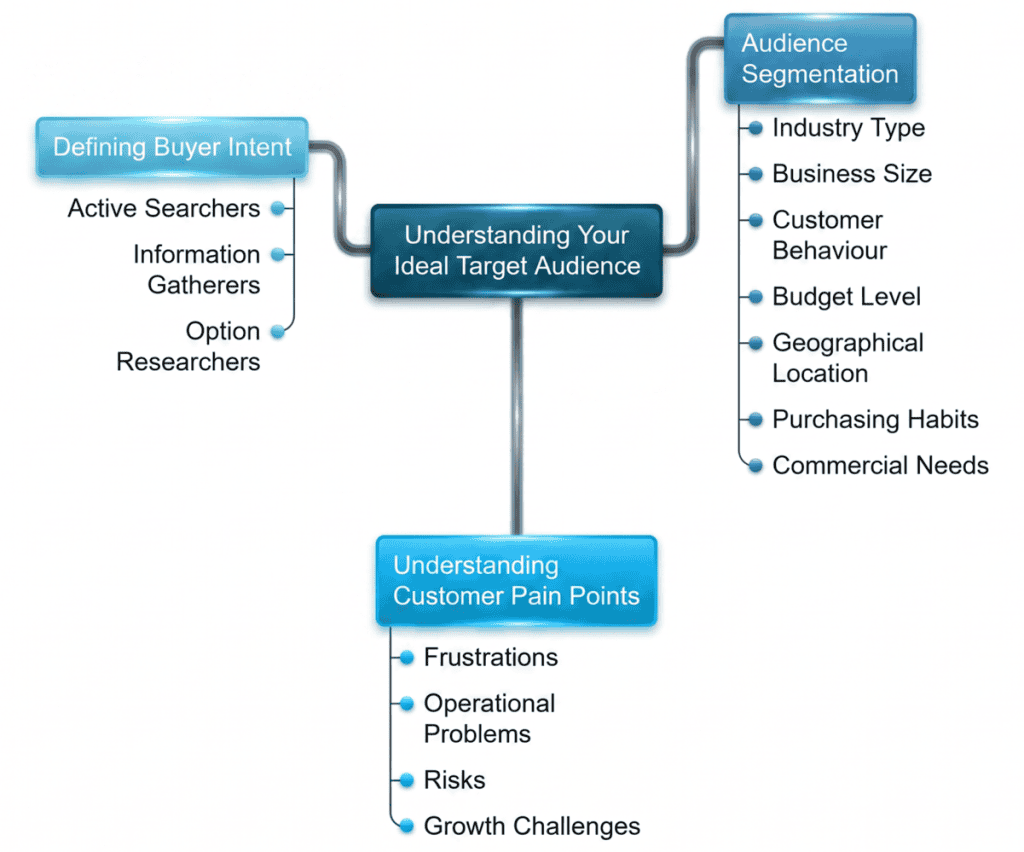
Understanding Your Ideal Target Audience
Audience Segmentation
Not all customers contribute equal value to a business. Some audiences generate higher profits, convert more efficiently, purchase repeatedly, or require less support and servicing. Audience segmentation helps organisations identify which customer groups contribute the strongest commercial value.
Segmentation can include industry type, business size, customer behaviour, budget level, geographical location, purchasing habits, or commercial needs. Businesses that segment effectively can tailor their messaging more precisely while improving campaign efficiency and conversion performance.
Understanding Customer Pain Points
Revenue-focused marketing requires businesses to understand customer frustrations, operational problems, risks, and growth challenges. Customers rarely buy products or services simply because they exist. Purchasing decisions are usually driven by problems that require solutions.
Marketing messages become significantly stronger when organisations focus on measurable outcomes rather than generic service descriptions. Businesses that clearly explain how they reduce risk, improve efficiency, increase profitability, or solve operational challenges are far more likely to generate high-quality enquiries.
Defining Buyer Intent
Buyer intent refers to how close a prospect is to making a purchasing decision. Some audiences are actively searching for immediate solutions, while others are only gathering information or researching options.
Strategic marketing prioritises audiences with stronger commercial intent. SEO strategies, Google Ads campaigns, landing pages, and lead magnets should all be aligned with specific stages of the buying process. This approach improves lead quality while reducing wasted spend on audiences unlikely to convert.
Positioning Your Business for Revenue Growth
Why Positioning Impacts Profitability
Weak positioning is one of the most common reasons businesses struggle to generate consistent growth. Organisations operating with unclear messaging often blend into crowded marketplaces, making it difficult for prospects to understand why they should choose one provider over another.
Positioning defines how a business wants to be perceived within its target market. Strong positioning communicates expertise, commercial value, credibility, and differentiation clearly. Businesses with strong positioning usually generate higher-quality leads because prospects already understand the organisation’s strengths before entering the sales process.
Poor positioning creates price sensitivity, inconsistent lead quality, and weak conversion performance. Strategic positioning helps reduce those issues while strengthening commercial authority.
Creating a Strong Value Proposition
Communicating Commercial Value Clearly
Customers rarely purchase services based purely on features alone. Buyers are more interested in measurable outcomes, operational improvements, risk reduction, revenue opportunities, efficiency gains, or long-term business benefits.
Strong value propositions therefore focus on business impact rather than service descriptions. Businesses that explain how they solve problems, improve performance, or support measurable growth are usually more persuasive than competitors relying on generic marketing language.
Solving Real Business Problems
Problem-solving marketing performs particularly well because it aligns directly with customer intent. Organisations should therefore structure marketing content around common customer frustrations, challenges, inefficiencies, or commercial risks.
This approach also improves SEO performance because customers frequently search online using problem-based language rather than product terminology alone. Businesses that answer those problems comprehensively strengthen both visibility and conversion performance simultaneously.
The Role of Data and Marketing Performance Measurement
Why Revenue-Focused Marketing Requires Data
Marketing without data creates uncertainty. Businesses operating without measurable performance tracking often continue funding ineffective campaigns because they lack visibility into what is actually driving results.
Data-led marketing allows organisations to measure performance accurately, improve forecasting, identify inefficiencies, and make informed commercial decisions. Strategic marketing becomes significantly more effective when supported by measurable evidence rather than assumptions or opinions.
Opportunity Marketing’s commercial methodology strongly reflects this principle, positioning ROI, performance tracking, and measurable outcomes at the centre of strategic marketing development.
The Most Important Marketing Metrics for Revenue Growth
Return on Investment (ROI)
ROI remains one of the most important marketing performance indicators because it measures profitability directly. Businesses that track ROI accurately can identify which campaigns, channels, and activities contribute genuine commercial value.
Customer Acquisition Cost (CAC)
CAC measures the total cost of winning new customers. This metric gives businesses clarity around marketing efficiency while supporting better budget allocation decisions.
Customer Lifetime Value (CLV)
CLV helps organisations understand long-term customer profitability. Businesses with high customer lifetime value can often justify greater acquisition investment because customer relationships produce stronger long-term returns.
Conversion Rates
Conversion rate analysis helps businesses identify weak points within the customer journey. Improving conversion efficiency often delivers higher profitability without requiring additional traffic or advertising spend.
Creating a Marketing Funnel That Supports Revenue Growth
Understanding the Modern Marketing Funnel
The marketing funnel represents the stages prospects move through before becoming customers. Awareness, consideration, and conversion all play important roles within revenue-focused marketing strategies.
Awareness campaigns attract attention and visibility. Consideration content builds trust, credibility, and audience engagement. Conversion-focused activity encourages enquiries, purchases, consultations, or direct commercial action.
Businesses that understand how prospects move through the funnel can identify where customers disengage, where messaging weakens, and where conversion opportunities are being lost.
Many businesses invest in marketing without seeing measurable growth. A revenue-driven marketing strategy helps organisations improve lead quality, strengthen conversion rates, reduce wasted spend, and connect marketing activity directly to commercial performance. Learn how strategic marketing supports sustainable business growth for UK SMEs.

Improving Funnel Efficiency
Strengthening Awareness Campaigns
Strategic awareness activity should focus on attracting commercially relevant audiences rather than broad, untargeted traffic. SEO, thought leadership, content marketing, LinkedIn marketing, and targeted advertising all support stronger awareness generation when aligned correctly.
Improving Lead Nurturing
Many prospects do not convert immediately after first engagement. Lead nurturing therefore becomes essential for supporting long-term conversion performance. Email marketing, educational content, retargeting campaigns, and follow-up communication all help maintain engagement throughout longer buying cycles.
Optimising Conversion Stages
Conversion optimisation involves reducing friction throughout the customer journey. Clear calls-to-action, faster response times, simplified enquiry forms, strong landing pages, and aligned sales communication can all improve conversion performance significantly.
Choosing the Right Marketing Channels for Revenue Growth

Why Channel Selection Matters
Many businesses spread marketing budgets too thinly across too many channels without understanding which platforms generate the strongest commercial returns. Revenue-focused marketing prioritises channel effectiveness rather than channel quantity.
Channel selection should always align with audience behaviour, commercial intent, and measurable performance data.
Organic Marketing Channels
Search Engine Optimisation (SEO)
SEO supports sustainable long-term growth by improving organic visibility for high-intent search terms. Businesses that rank well for commercially relevant searches often generate consistent inbound lead opportunities while reducing long-term advertising dependency.
Content Marketing
Strategic content marketing builds authority, educates audiences, supports SEO, and strengthens trust simultaneously. Businesses that publish valuable, commercially focused content often generate stronger lead quality because prospects already recognise expertise before making contact.
Email Marketing
Email marketing remains one of the most cost-effective channels for retention, lead nurturing, upselling, and repeat business generation. Organisations with structured email strategies often improve customer lifetime value substantially.
Paid Marketing Channels
Google Ads
Google Ads works particularly well for high-intent searches because users are already actively searching for solutions. Paid search campaigns can generate fast lead opportunities when supported by strong targeting and conversion-focused landing pages.
LinkedIn Marketing
LinkedIn provides strong commercial value for B2B businesses targeting decision-makers, directors, managers, and professional audiences. Thought leadership content, strategic networking, and targeted campaigns often perform well within professional sectors.
Marketing Strategy Must Drive Commercial Outcomes
Revenue growth rarely happens through disconnected marketing activity alone. Businesses that achieve sustainable growth usually operate with clear strategic direction, measurable objectives, strong positioning, effective targeting, structured lead generation systems, and performance measurement frameworks that support informed decision-making.
Strategic marketing gives organisations greater clarity, stronger control over growth, improved budget efficiency, and better long-term profitability. Marketing activity becomes commercially accountable rather than reactive, allowing businesses to invest with greater confidence while reducing wasted spend.
Opportunity Marketing’s strategy-first philosophy reflects this commercial mindset directly, helping SMEs build structured, ROI-led marketing systems focused on measurable business growth rather than vanity metrics or short-term activity. Businesses that align marketing with commercial performance are far more likely to build sustainable growth, stronger customer relationships, and long-term competitive advantage within increasingly competitive marketplaces.
Work With Opportunity Marketing
Many businesses struggle to connect marketing activity with measurable revenue growth because they lack strategic direction, commercial clarity, and structured performance measurement. Opportunity Marketing helps SMEs, business owners, directors, managers, and growing organisations develop ROI-focused marketing strategies that align directly with commercial objectives, lead generation targets, customer acquisition goals, and long-term profitability. Our strategy-first approach focuses on reducing wasted marketing spend, improving conversion performance, strengthening customer retention, and helping businesses make smarter, data-driven marketing decisions.
Whether you need a structured marketing strategy, independent strategic guidance, outsourced marketing support, or help improving marketing performance, Opportunity Marketing provides practical commercial support tailored to your business goals. We work closely with SMEs across multiple sectors to help improve positioning, targeting, marketing performance, audience engagement, lead quality, and overall marketing ROI through measurable and accountable strategic marketing frameworks. Every recommendation we provide is grounded in commercial logic, measurable outcomes, and sustainable long-term growth principles.
Our Strategic Marketing Services
- Fast Track Marketing Plan
- Strategic Marketing Mastery
- Marketing Health Check Audit
- Outsourced Marketing Support
- Marketing Mentoring
- Become a Marketing Consultant Programme

Strategic Marketing Mastery
Opportunity Marketing’s Strategic Marketing Mastery programme helps business owners, marketers, consultants, and managers develop structured marketing strategies designed to support measurable business growth. The programme teaches participants how to improve marketing ROI, strengthen audience targeting, build commercially focused marketing plans, improve lead generation performance, and align marketing activity with wider business objectives. Participants also gain practical insight into performance measurement, strategic planning, conversion optimisation, and long-term growth strategy development within real commercial environments.
Learn more about Strategic Marketing Mastery:
https://opportunitymarketing.co.uk/marketing-strategy-for-smes/strategic-marketing-mastery/
Speak With Opportunity Marketing
If your business is looking to improve marketing performance, generate stronger commercial results, reduce wasted spend, and build a marketing strategy that supports measurable revenue growth, Opportunity Marketing can help. Our consultancy services are designed specifically for SMEs that want practical strategic guidance, commercial accountability, measurable ROI, and sustainable long-term growth.
📍 Visit:opportunitymarketing.co.uk
📞 Call: 0333 320 4108
📧 Email: info@opportunitymarketing.co.uk


Ian Kirk
Founder at Opportunity Marketing
Ian is the founder of Opportunity Marketing marketing, with over 18 years of experience in successfully setting up marketing departments, creating marketing strategies and implementing these strategies across a wide number of SME companies in both the B2B and B2C sectors through a variety of channels.

A-Z OF MARKETING
A complete guide that simplifies the wonderful world of marketing.
 Download Now