Skip to main content
Skip to footer
Skip to main content
Skip to footer

Marketing Strategy, Marketing Tips
Building a Numbers-First Marketing Culture

Most conversations about marketing improvement focus on two things: strategy and execution. This makes sense. Strategy matters, and equally execution matters. But there is a third factor that often determines whether either of those things actually stick inside a business- culture.
A company can have a sensible strategy on paper and still struggle if its day-to-day behaviour is driven by opinions, habits and unchallenged assumptions. It can have good people in the team and still fail to improve if nobody owns the numbers, if reports are vague, or if commercial accountability is treated as optional. That is why Chapter 11 of Opportunity Marketing’s “The Maths Behind Marketing”ebook is so important. It makes the case that better marketing is not only a planning issue, it is also a cultural one.
What a numbers-first culture really means
A numbers-first culture does not mean turning marketers into robots or forcing every decision through a spreadsheet before anyone can think creatively. It means something simpler and more useful than that.
It means decisions are expected to have evidence behind them. It means outcomes matter more than activity. It means reporting is honest. It means people are comfortable asking what worked, what did not, why it happened and what should change next.
It also means marketing is managed as a commercial function, not a protected zone where judgment becomes soft and accountability becomes negotiable. That kind of culture creates consistency.
Why accountability changes performance
One of the clearest effects of a numbers-first culture is accountability.
When teams know they will be discussing outcomes rather than simply listing completed tasks, the quality of thinking improves.
Marketing campaigns are briefed more carefully, objectives are defined more clearly. channels are chosen more intelligently, follow-up improves, reporting becomes sharper and marketing suppliers face better questions. It becomes harder for waste to hide behind vague language or decorative dashboards.
This is not about blame. It is about ownership – and ownership nearly always lifts standards.
Marketing and finance should not feel like separate worlds
Although we don’t like to talk about it, there is a clear divide that often exists between marketing and finance. This is because typically they communicate in different ways.
This is one of the reasons marketing can lose credibility internally. Marketing may talk about engagement and brand response. Meanwhile Finance talks about margin, return and cost control. Both may be looking at the same business, but they are not always speaking the same language.
A numbers-first culture helps close that gap between these two critical functions.
When marketers become more confident with CAC, ROI, CLPV, ROAS and conversion rates, their conversations with leadership improve immediately. The work starts to sound commercially relevant because it is being framed in commercially relevant terms. Finance becomes less sceptical because the evidence is clearer. Leadership becomes more confident because they can see the logic behind decisions.
This kind of alignment is powerful.
Data literacy is now part of the job
There was a time when marketers could lean more heavily on instinct and communication flair alone. That time has passed.
Today, if someone is going to influence marketing decisions seriously, they need a working grasp of numbers. Not in an overly technical or intimidating way, but enough to interpret performance, question assumptions and recognise what the data is actually saying.
That does not require everyone to become an analyst. It does require a basic level of data literacy. Teams need to know what the core measures mean, what “good” looks like, and how to connect those measures back to profit and growth.
The businesses that develop this capability usually get stronger faster because they are not waiting for somebody else to interpret performance for them.
Creative marketing ideas become stronger when they are challenged properly
One of the most useful points in this chapter is the argument that creative ideas should be challenged by commercial logic, not protected from it.
That is a healthy discipline. Not because creativity is unimportant, but because creative work becomes more effective when it has a clear purpose and a realistic measure of success.
A numbers-first culture asks better questions before a creative idea is approved.
- What is this meant to achieve?
- How will we know if it worked?
- Which audience is it for?
- What commercial outcome should it influence?
- Is it likely to outperform the alternatives?
Those questions do not kill creativity. They sharpen it.
Dashboards are only useful if people use them honestly
Many businesses have dashboards already. The issue is not access to data. The issue is what happens around the data.
A good dashboard should create clarity, not camouflage. It should help a team see where performance is strong, where it is drifting and where action is needed. That means keeping it practical. A small set of meaningful commercial measures, reviewed regularly, is more valuable than pages of stats nobody truly acts on.
The same rule applies to review meetings. If meetings are used to protect egos or decorate underperformance, the culture does not improve. But if they are used to learn, decide and refine, the organisation starts becoming more resilient and more commercially mature.
Small improvements compound
Perhaps the biggest benefit of a numbers-first culture is that it makes continuous improvement possible.
Instead of waiting for the next big campaign or dramatic overhaul, the business gets better through marginal gains. A slightly higher conversion rate here. Better lead qualification there. Faster response times. More honest reporting. Better channel choice. Sharper cost control. Over time those gains add up.
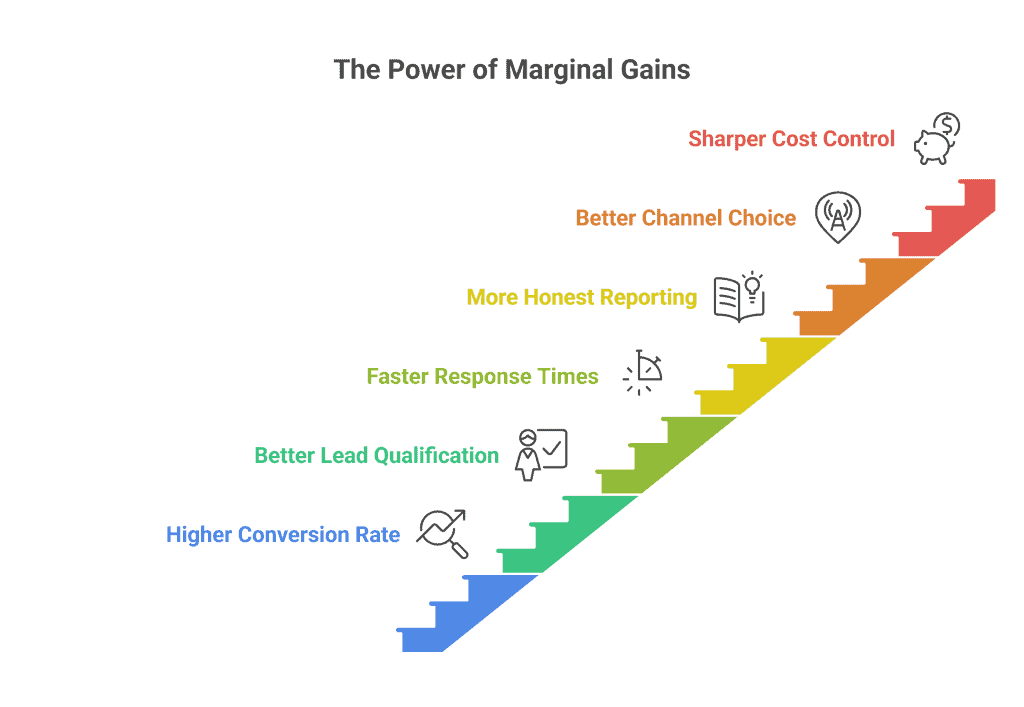
That is often how sustainable growth actually happens.
Not through one heroic piece of marketing, but through a culture that keeps learning and keeps adjusting. So building a numbers-first culture is not just about the marketing team. It is about the whole business deciding that marketing should be treated with the same seriousness as any other growth lever.
If you want marketing to become more accountable, more respected and easier to manage, The Maths Behind Marketing will help you build the kind of numbers-first culture that supports better decisions over time.



Ian Kirk
Founder at Opportunity Marketing
Ian is the founder of Opportunity Marketing marketing, with over 18 years of experience in successfully setting up marketing departments, creating marketing strategies and implementing these strategies across a wide number of SME companies in both the B2B and B2C sectors through a variety of channels.

A-Z OF MARKETING
A complete guide that simplifies the wonderful world of marketing.
 Download Now