 Skip to main content
Skip to footer
Skip to main content
Skip to footer

How To:, Marketing Strategy, Marketing Tips
How Marginal Gains Can Transform Your Marketing Performance

How to Improve Marketing Performance Without Increasing Your Budget
Many business owners and marketing professionals spend considerable time searching for the next big breakthrough that will transform results overnight. They invest in new websites, rebrands, advertising campaigns, software platforms, and marketing trends, hoping one major change will solve their growth challenges. Although significant changes can occasionally produce positive outcomes, sustainable marketing success is often built through a series of smaller improvements that compound over time.
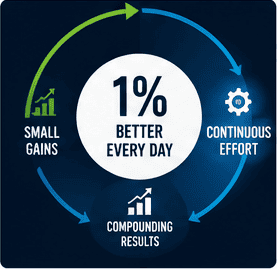
The concept of marginal gains focuses on making small, measurable improvements across multiple areas of marketing performance. A one percent improvement in lead generation, conversion rates, customer retention, campaign targeting, website usability, and sales processes may seem insignificant individually. When combined, these small improvements can create substantial increases in revenue, profitability, and return on investment.
For UK SMEs, professional services firms, manufacturers, technology companies, consultants, and growing organisations, marginal gains offer a practical and commercially sensible approach to marketing improvement. Rather than gambling on large-scale changes, businesses can focus on continuous refinement, better decision-making, and measurable progress that supports long-term growth. This philosophy aligns closely with Opportunity Marketing’s strategy-first approach, where every marketing decision is guided by commercial objectives, measurement, and return on investment.
The Strategic Marketing Mastery course helps business owners, managers, aspiring marketing consultants, and marketing professionals understand how to apply strategic thinking and continuous improvement principles to achieve stronger marketing performance. Learners will discover how to identify marginal gains opportunities, measure the metrics that matter, improve return on investment, reduce marketing waste, and build a structured marketing strategy that supports long-term business growth. Through practical frameworks, proven methodologies, and commercially focused guidance, the course provides the knowledge and confidence needed to make smarter marketing decisions based on data, evidence, and measurable outcomes rather than guesswork. Contact Us: 0333 320 4108 or info@opportunitymarketing.co.uk.
Understanding the Marginal Gains Philosophy
The Power of Small Improvements
Marginal gains are based on the principle that numerous small improvements can collectively create significant performance enhancements. While a single one percent improvement may appear insignificant, the cumulative impact across multiple areas of a marketing operation can be substantial.
Consider a business that improves its advertising click-through rate by three percent, increases website conversion rates by two percent, improves lead qualification by four percent, and increases customer retention by three percent. Each improvement appears modest in isolation. Together, they create a stronger marketing system that generates better commercial outcomes.
This approach is particularly effective because it focuses on realistic, achievable improvements rather than unrealistic expectations. Teams often find it easier to improve existing processes than completely redesign them. Small improvements can also be measured more accurately, allowing businesses to understand what is working and what requires further refinement.
Marginal Gains Versus Marketing Overhauls
Large-scale marketing transformations often involve considerable investment, disruption, and risk. A complete website redesign, major rebrand, or entirely new marketing strategy may deliver positive results, but there is also potential for significant failure if assumptions prove incorrect.
Marginal gains offer a different route. Rather than changing everything at once, businesses make incremental improvements, test results, analyse performance, and build upon successful changes. This process reduces risk while creating a culture of continuous improvement.
A balanced approach is often most effective. Strategic direction should remain stable while tactical execution is continuously refined. Businesses benefit from having a clear marketing strategy supported by ongoing optimisation across all marketing activities.
Why Marginal Gains Work Particularly Well for SMEs
Many SMEs operate with limited budgets, smaller teams, and restricted resources. Large marketing investments are not always practical or commercially sensible.
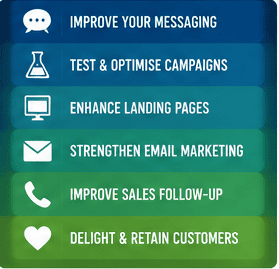
Marginal gains allow SMEs to improve performance without dramatically increasing expenditure. Small improvements in website conversion rates, email marketing effectiveness, sales follow-up processes, and customer retention can generate meaningful financial returns without requiring significant additional investment.
This approach also helps business owners gain greater control over marketing performance. Instead of relying on unpredictable campaigns, they build a more reliable system based on evidence, testing, and continuous refinement.
Identifying Areas Where Marginal Gains Exist
Marketing Performance Audit
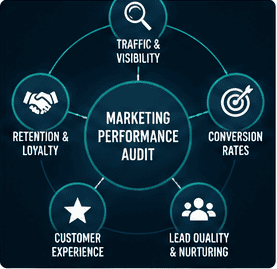
Before making improvements, businesses need a clear understanding of current performance. A marketing performance audit provides this foundation.
The audit process should examine all marketing channels, lead generation activities, conversion processes, customer journeys, and reporting systems. This evaluation helps identify areas where small improvements could generate meaningful commercial benefits.
Many organisations discover that they are already generating sufficient traffic, leads, or enquiries. The challenge often lies within conversion processes, follow-up procedures, messaging clarity, or customer retention activities rather than lead generation itself.
Looking Beyond Vanity Metrics
Marketing teams frequently focus on vanity metrics that appear impressive but offer limited commercial value. Social media followers, impressions, page views, and engagement statistics may provide useful information, but they rarely tell the complete business story.
Commercially focused businesses should concentrate on metrics that directly influence revenue and profitability. These include lead generation, conversion rates, customer acquisition costs, customer lifetime value, retention rates, and return on investment.
Moving attention towards commercially meaningful metrics helps identify opportunities where marginal gains can create measurable financial improvement.
Finding Hidden Opportunities
Website Performance
Many websites lose potential customers through avoidable issues. Slow loading speeds, confusing navigation, weak calls-to-action, complicated enquiry forms, and unclear messaging can all reduce conversion rates.
Small improvements to user experience often generate disproportionate results. Simplifying forms, improving page loading times, clarifying value propositions, and strengthening calls-to-action can increase enquiry levels without increasing traffic volumes.
Lead Generation Processes
Lead generation frequently contains hidden inefficiencies. Businesses may attract enquiries successfully but fail to capture sufficient information, respond quickly enough, or nurture prospects effectively.
Improving lead management processes often delivers significant gains. Faster response times, better qualification procedures, and more effective nurturing sequences can increase conversion rates while reducing customer acquisition costs.
Sales and Marketing Alignment
Marketing and sales teams frequently operate independently despite sharing common objectives. Poor communication between departments can create friction that reduces overall performance.
Improved collaboration allows both functions to work more effectively. Marketing gains greater understanding of lead quality while sales teams receive better-qualified opportunities. Small improvements in alignment can create substantial commercial benefits.
Marginal Gains Across the Marketing Funnel
Awareness Stage Improvements
The awareness stage focuses on attracting the right audience rather than simply generating more visibility.
Refining Audience Targeting
Many businesses attempt to reach audiences that are too broad. Better audience segmentation and targeting often improve campaign performance significantly without increasing expenditure.
Understanding customer characteristics, behaviours, challenges, and motivations allows marketing activity to become more relevant. More relevant messaging generally leads to higher engagement, better lead quality, and improved conversion rates.
Improving Messaging Relevance
Marketing messages should address customer needs rather than business features alone. Small improvements in messaging relevance can significantly increase audience engagement.
Businesses that clearly communicate how they solve customer problems often outperform competitors with larger marketing budgets but weaker messaging.
Consideration Stage Improvements
Prospects entering the consideration stage require information, confidence, and reassurance before making purchasing decisions.
Strengthening Content Quality
Content should help prospects understand their challenges, evaluate options, and make informed decisions. Improving content quality through greater relevance, clarity, and usefulness often increases engagement and trust.
Educational content, case studies, industry insights, and practical guidance can all contribute to stronger consideration-stage performance.
Improving Website Engagement
Visitors who spend more time engaging with valuable content are often more likely to convert later. Improving internal linking, content structure, navigation, and user experience can encourage deeper engagement throughout the website.
Conversion Stage Improvements
Optimising Calls-to-Action
Calls-to-action frequently represent one of the simplest opportunities for marginal gains. Small adjustments to wording, positioning, visibility, and design can improve conversion rates considerably.
Testing different approaches helps businesses identify which options generate the strongest response from target audiences.
Improving Landing Page Performance
Landing pages should remove distractions and focus attention on a single desired action. Improvements in page structure, messaging clarity, trust signals, and user experience can increase conversion rates significantly without increasing traffic costs.
The Mathematics Behind Marginal Gains
Understanding Compound Marketing Performance
Marginal gains become particularly powerful because improvements compound throughout the marketing funnel.
A business that improves advertising performance, website conversion rates, lead qualification, and sales conversion simultaneously benefits from gains at every stage of the customer journey.
For example, increasing advertising effectiveness by 10%, website conversion by 10%, and sales conversion by 10% does not simply create a 30% improvement. The combined impact can be substantially greater because each improvement builds upon previous gains.
Why Marginal Gains Improve ROI
Marketing return on investment improves when businesses generate more value from existing resources. Marginal gains support this objective by improving efficiency rather than simply increasing expenditure.
Better targeting reduces wasted advertising spend. Improved conversion rates increase the value of existing traffic. Stronger retention improves customer lifetime value. Collectively, these improvements strengthen profitability and marketing performance.
Key Areas Where SMEs Can Achieve Quick Marginal Gains
Search Engine Optimisation (SEO)
SEO offers numerous opportunities for incremental improvement. Updating existing content, improving internal linking, refining keyword targeting, and strengthening user experience can all contribute to better organic visibility.
Technical improvements such as faster page speeds, mobile optimisation, and resolving indexing issues may also generate measurable performance improvements.
Email Marketing
Email remains one of the most effective marketing channels for many SMEs. Small improvements in subject lines, audience segmentation, content relevance, and calls-to-action can significantly increase campaign effectiveness.
Businesses frequently overlook existing subscriber databases while focusing on acquiring new leads. Improving performance from existing audiences often provides faster returns.
Paid Advertising
Paid advertising campaigns contain multiple opportunities for optimisation. Audience targeting, ad copy, bidding strategies, landing pages, and conversion tracking can all be refined incrementally.
Continuous testing allows businesses to improve campaign efficiency while reducing acquisition costs.
Social Media Marketing
Social media success depends upon quality rather than quantity. Creating more relevant content, encouraging meaningful engagement, and supporting wider business objectives often delivers better results than simply increasing posting frequency.
Building a Marginal Gains Culture Within Your Business
Creating a Continuous Improvement Mindset
Successful marginal gains programmes require cultural commitment. Teams must embrace testing, measurement, and ongoing improvement rather than seeking instant results.
This mindset encourages evidence-based decision making. Assumptions are replaced by data, while opinions are supported by measurable outcomes.
Making Data Part of Everyday Decision Making
Marketing performance should be reviewed regularly using commercially meaningful metrics. Consistent measurement helps identify opportunities, track progress, and guide future improvements.
Data becomes particularly valuable when used to support strategic decisions rather than simply report historical performance.
Encouraging Cross-Department Collaboration
Marketing improvement rarely occurs in isolation. Sales, customer service, operations, and leadership teams all influence customer experience and business performance.
Improved collaboration helps organisations identify opportunities that may otherwise remain hidden. Small improvements across multiple departments frequently generate stronger results than large improvements within a single function.