 Skip to main content
Skip to footer
Skip to main content
Skip to footer

Marketing Tips, Traditional Marketing
What Your Marketing Funnel Is Really Telling You
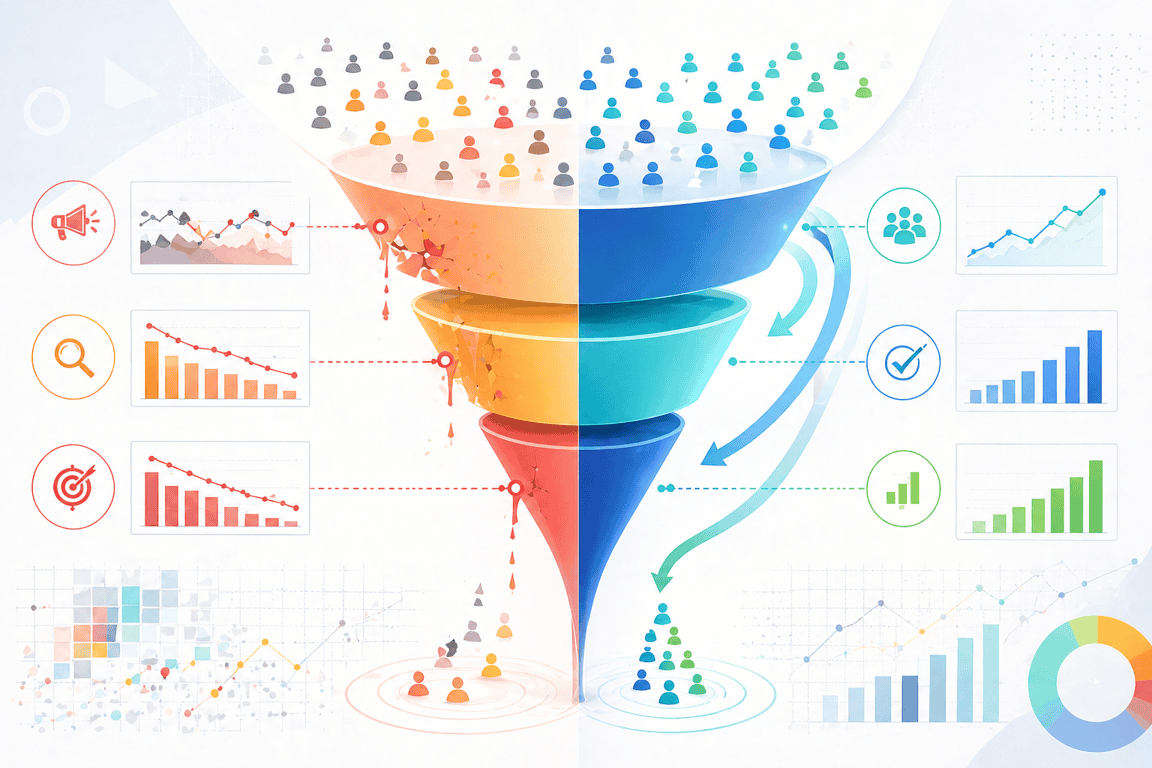
The marketing funnel
Most businesses know the idea of a marketing funnel. They understand, broadly, that customers move from awareness to interest to action. They know there are stages. They know people drop out along the way. They know conversion matters. But despite all that familiarity, the funnel is still badly underused.
Too often it is treated as a theory, a workshop diagram, or a piece of marketing jargon rather than what it actually is: one of the most useful commercial tools a business has.
Because when you look at it properly, the funnel tells a story. It tells you whether the right people are finding you. It tells you whether your message is landing. It tells you whether interest is turning into intent. It tells you whether leads are being lost through weak follow-up, poor targeting, confusing offers or unnecessary friction. In short, it shows you how efficiently your marketing is turning attention into revenue.
That is why the funnel matters so much.
Using the marketing funnel as a performance system
For an SME, the funnel should never be viewed as a generic model pulled from a textbook. It should be treated as a performance system. Every stage contains numbers. Every stage reveals behaviour. And every stage offers clues about what is helping or hurting growth.
At the top of the funnel, the focus is visibility. Are enough of the right people becoming aware of your business? Not just random traffic, but relevant traffic. Not just broad reach, but qualified reach. If the wrong audience is entering the funnel, everything downstream becomes harder and more expensive. This is where poor targeting often creates problems that businesses mistakenly try to solve later with better sales techniques or more budget.
In the middle of the funnel, the question shifts from awareness to relevance. Now the issue is whether people are engaged enough to continue. Are they exploring your site? Downloading information? Booking calls? Responding to emails? Comparing your offer seriously? If not, it may not be because the channel is weak. It may be because the message is vague, the value proposition is unclear, or the content is not helping them move closer to a decision.
At the bottom of the funnel, the question is action. Are people converting? Are enquiries turning into customers? Are proposals being accepted? Is follow-up strong enough? Is trust high enough? Are you losing opportunities that should reasonably have progressed?
This is where the funnel becomes extremely revealing.
Identifying the bottlenecks and leaks
Many businesses blame the wrong thing when results are disappointing. They assume they need more leads when the real issue is poor conversion. They think paid ads are too expensive when the actual problem is weak qualification. They conclude that social media “doesn’t work” when the landing page is doing a poor job of continuing the conversation. Without funnel visibility, they are effectively diagnosing performance blindfolded. That is expensive.
The real strength of funnel thinking is that it breaks marketing into measurable stages. Instead of asking, “Is our marketing working?” you can ask more precise questions.
- What percentage of visitors are becoming leads?
- What percentage of leads are becoming customers?
- Where is the biggest drop-off?
- Which part of the journey needs the most attention?
Those questions lead to far better decisions because they tell you where commercial improvement is most likely to come from. And that is often surprising.
Marginal marketing gains
Sometimes the fastest route to growth is not generating more traffic. It is improving what happens after traffic arrives. A small increase in landing page conversion, lead handling or sales follow-up can sometimes produce more revenue than a much larger increase in top-of-funnel spend. That is one of the biggest advantages of understanding the funnel properly: it helps businesses stop assuming that more activity is always the answer.
Often, better efficiency is the answer.
This is where funnel maths becomes powerful. Small percentage improvements at each stage can create a major cumulative effect. If more of the right people enter the funnel, more stay engaged, and a slightly higher proportion convert, the impact compounds quickly. That means businesses can often grow substantially without dramatically increasing their marketing budget. They simply need to understand where leakage is happening and deal with it intelligently.
That also makes the funnel a budgeting tool, not just a measurement tool.
The marketing equation
Once a business knows roughly how many leads are needed to create a customer, and how many visitors are needed to create a lead, planning becomes more grounded. Marketing stops being based on vague ambition and starts being based on ratios, assumptions and conversion logic. Growth becomes easier to forecast because the business understands the mechanics behind it. That is especially valuable for SMEs, where budgets are tighter and errors cost more.
It is also why the funnel should never sit entirely within the marketing team. Sales, service and leadership all influence funnel performance. Slow follow-up, inconsistent pricing conversations, weak proposals and poor handovers can all create leakage.
If the funnel is only discussed as a marketing concept, businesses miss the wider truth: conversion is often a whole-business issue.
The best-performing companies tend to understand this. They treat the funnel as a shared commercial framework. They review it regularly. They look for friction points. They test improvements. They focus on where marginal gains will make the biggest difference. And crucially, they use the funnel to challenge assumptions instead of reinforcing them.
The marketing funnel mindset shift
The funnel is not there to make marketing sound more sophisticated. It is there to show where money is being won or lost. It reveals whether performance problems sit in reach, relevance or conversion. It makes improvement visible. It helps teams prioritise. And it creates a much more rational basis for deciding where time and budget should go next.
So when someone says their marketing funnel is underperforming, the right response is not panic. It is curiosity.
- What is it telling you?
- Where is the friction?
- What is leaking?
- What is converting?
- What should be fixed before more money is spent?
Those are the questions that turn the funnel from a diagram into a decision-making tool.
And once that happens, marketing becomes much easier to improve.
Download our latest Ebook
If you want to understand where your marketing is really winning or leaking value, The Maths Behind Marketing will help you turn the funnel into a practical commercial tool rather than just a marketing concept.



Ian Kirk
Founder at Opportunity Marketing
Ian is the founder of Opportunity Marketing marketing, with over 18 years of experience in successfully setting up marketing departments, creating marketing strategies and implementing these strategies across a wide number of SME companies in both the B2B and B2C sectors through a variety of channels.