 Skip to main content
Skip to footer
Skip to main content
Skip to footer


Why Relevance Is the New Marketing Currency
Modern marketing success hinges on one central principle: relevance. Businesses can no longer rely on broadcasting generic messages or pushing one-size-fits-all campaigns. Audiences today demand content that speaks directly to their needs, expectations, and preferences. As digital channels multiply and competition intensifies, the ability to create content that resonates with a specific audience segment has become one of the most powerful differentiators in marketing.
Artificial intelligence (AI) agents are transforming how businesses achieve that level of precision. These intelligent systems are not just automating content creation; they are helping marketing teams make smarter, data-led decisions that improve engagement, strengthen trust, and generate better returns on investment. Instead of relying on guesswork, businesses can use AI agents to analyse audience data, predict behaviours, and recommend highly targeted content strategies that genuinely align with audience intent.
AI agents have become indispensable strategic tools for marketers who want to create meaningful connections with their audiences. They go beyond automation, bridging the gap between raw data and human creativity to produce messaging that is relevant, valuable, and timely.
The Strategic Marketing Mastery course equips business owners and marketers with the skills to apply strategic, data-led thinking to their marketing decisions. It teaches how to understand audience behaviour, align content with customer intent, and create measurable, ROI-driven campaigns that make marketing more relevant and effective. This structured, step-by-step training empowers participants to integrate tools such as AI agents into a clear marketing framework for smarter, audience-focused growth. Contact Us: 0333 320 4108 or info@opportunitymarketing.co.uk.
Understanding AI Agents and Their Role in Marketing
Defining AI Agents in a Marketing Context
AI agents are intelligent software systems capable of analysing data, learning from interactions, and performing tasks autonomously. Unlike standard automation tools that follow predefined rules, AI agents adapt and improve over time. In marketing, they analyse complex audience behaviours, interpret engagement data, and recommend or generate content based on what is most likely to resonate with specific audience groups.
These systems rely on machine learning and natural language processing (NLP) to interpret large datasets, identify trends, and predict outcomes. This allows marketers to make informed, evidence-based decisions about what content to produce, when to distribute it, and which channels are most effective for their target audience. AI agents can even personalise website experiences, optimise email campaigns, and generate tailored marketing messages with remarkable precision.

Why Marketers Are Turning to AI Agents
Marketers face increasing pressure to produce consistent, high-quality content across multiple channels while maintaining relevance for diverse audiences. Traditional methods, manual segmentation, intuition-based decisions, and one-size-fits-all campaigns are no longer sufficient. AI agents help overcome these limitations by analysing behavioural, demographic, and psychographic data faster and more accurately than human teams can.
They also help address three key marketing challenges:
- Data Overload: Businesses collect enormous volumes of data that often go underused. AI agents make sense of that data, highlighting actionable insights.
- Personalisation at Scale: They enable businesses to tailor messages for individual audience segments without manually managing every interaction.
- Performance Optimisation: AI agents continuously monitor engagement metrics and adjust strategies based on what works best, ensuring sustained relevance.
The result is a marketing process that is not only more efficient but also more human in its precision, with content that feels personal, timely, and trustworthy.
The Strategic Importance of Audience Relevance
The Shift from Mass Messaging to Micro-Relevance
A decade ago, marketing success depended largely on reach. Today, it depends on resonance. The digital environment has made consumers more selective, and algorithms have made relevance essential for visibility. Whether on Google, social media, or email, audience-focused content performs better across every measurable metric, from engagement to conversions.
Micro-relevance means creating content that addresses the specific challenges, interests, or aspirations of a clearly defined audience segment. For example, a technology start-up targeting small business owners must tailor its messaging differently from one targeting corporate CIOs. Each audience has distinct motivations, and AI agents help uncover those nuances by analysing customer data, search trends, and sentiment patterns.
Relevance also drives trust and loyalty. When audiences consistently receive content that reflects their goals and pain points, they are more likely to engage and remain loyal to the brand. AI agents empower marketers to maintain this level of relevance continuously rather than relying on periodic campaigns.
Data as the Foundation of Audience Understanding
Data sits at the heart of audience relevance. To create meaningful content, businesses must understand who their audiences are, what they care about, and how they behave online. AI agents collect and interpret data from multiple sources, social media, search engines, CRM systems, and email campaigns to build detailed audience profiles. These profiles go far beyond basic demographics, encompassing interests, content preferences, and even emotional triggers.
The challenge for many small and medium-sized businesses is that they often have fragmented or inconsistent data. AI agents unify these data streams, turning isolated insights into a coherent view of customer intent. This enables businesses to identify patterns that would otherwise remain hidden, such as emerging topics, preferred content formats, or declining engagement trends. Marketers can craft content that attracts attention and retains it.

How AI Agents Transform the Content Creation Process
Turning Raw Data into Actionable Insights
AI agents are experts at converting data into decision-ready insights. They analyse online behaviour, track competitor activity, and monitor performance metrics to reveal which content topics are performing well and which ones are losing traction. Through sentiment analysis, they can detect shifts in audience mood or preferences, allowing marketers to adjust their messaging before engagement declines.
These systems also identify content gaps, areas where the target audience is searching for information but finding limited or outdated resources. Businesses position themselves as authoritative sources, improving both visibility and trust. The key advantage of AI agents is their ability to process this analysis continuously, offering real-time recommendations rather than quarterly reports.
Crafting Content That Speaks Directly to Audience Segments
Once insights are available, AI agents help translate them into actionable creative direction. They can suggest headlines, tone adjustments, or structural changes that align with specific audience personas. For example, a B2B audience may prefer data-led articles with clear ROI outcomes, while a consumer audience might respond better to storytelling and emotional appeal.
Integrating AI recommendations into a strategy-first framework, such as that used by Opportunity Marketing, ensures that every piece of content supports wider business goals. This approach avoids random content production and focuses on material that contributes directly to audience engagement, lead generation, or conversion.
Maintaining Consistency Across Channels
Modern audiences engage across multiple touchpoints, websites, emails, social platforms, and searches. AI agents help maintain consistency in tone, message, and brand positioning across all these channels. They can automatically adjust content style and format for each platform while preserving the brand’s voice. This consistency strengthens brand recognition and helps audiences trust the content they receive, regardless of where they encounter it.
Personalisation at Scale: From Insight to Implementation
AI Agents and Behaviour-Based Personalisation
One of the most powerful applications for AI agents is their ability to personalise content experiences based on user behaviour. They track how individuals interact with websites, emails, and adverts, then use that information to tailor future interactions. A visitor who repeatedly engages with pricing-related content, for example, may later receive case studies or ROI-focused emails instead of introductory material.
This level of personalisation increases engagement and accelerates the buyer’s journey. Rather than serving identical messages to all users, AI agents deliver the right information at the right moment, creating a seamless experience. Businesses that adopt this method see measurable improvements in conversion rates and customer satisfaction.

Integrating AI Agents into the Marketing Strategy
The effectiveness of AI agents depends on how well they are integrated into a broader marketing framework. Strategy must lead technology, not the other way around. Before deploying AI tools, businesses should define clear objectives: improving engagement, refining targeting, or increasing content efficiency. AI agents then function as enablers, providing the data intelligence required to achieve those goals.
To integrate AI successfully, businesses can follow these steps:
- Identify key data sources, CRM, website analytics, and customer feedback.
- Use AI tools that complement strategic goals, such as audience analysis or content optimisation.
- Start small with pilot campaigns, using AI-generated insights to refine processes.
- Gradually expand across other marketing activities as confidence grows.
When implemented correctly, AI agents do not replace human marketers; they amplify their ability to make informed, creative decisions.
Enhancing SEO and Content Visibility with AI Agents
Intelligent Keyword Optimisation
AI agents revolutionise search marketing by analysing intent rather than just keywords. Traditional keyword research identifies popular terms; AI-driven systems interpret the context and purpose behind those searches. This insight allows marketers to craft content that directly answers user queries and ranks higher for intent-driven search results.
An AI agent, for instance, can tell that people who are looking for “marketing automation tools for SMEs” are also interested in “ROI-driven marketing” or “how to choose a marketing consultant.” It can then recommend related subtopics or internal links that keep audiences engaged longer. This intelligent keyword mapping aligns perfectly with data-led content marketing practices and Opportunity Marketing’s focus on relevance and authority.
Continuous Content Improvement
Content does not remain effective forever. Search trends shift, algorithms evolve, and audience preferences change. AI agents perform continuous audits to assess which articles, videos, or pages are underperforming. They recommend updates such as revising metadata, adding relevant examples, or refreshing outdated statistics.
This proactive approach eliminates stagnation and maintains strong search visibility over time. Rather than waiting for traffic declines, businesses can act early and keep their content assets working efficiently. This process also contributes to brand credibility, as audiences are more likely to trust businesses that consistently provide up-to-date and accurate information.

Measuring Performance and Refining Strategy
Data-Driven Performance Tracking
AI agents make it easier for marketers to track performance against key metrics. They consolidate analytics from multiple sources into a single dashboard, showing engagement rates, conversion performance, and content ROI. This unified view allows decision-makers to pinpoint what drives results and what requires improvement.
AI can show, for instance, that some content works well with current customers but doesn’t bring in new leads. Armed with that knowledge, marketers can adjust their strategy to rebalance their efforts. This continuous cycle of measurement and refinement embodies the principles of ROI-driven marketing consultancy.
Adaptive Learning and Continuous Optimisation
AI agents are designed to learn from outcomes. When a campaign achieves strong engagement, the system identifies which variables contributed to success, tone, topic, or format, and applies those learnings to future campaigns. Likewise, if certain strategies underperform, the AI agent automatically adjusts recommendations.
This process of adaptive learning mirrors the concept of continuous progression championed by leading marketing consultancies. It turns content marketing into a self-optimised system, allowing businesses to maintain alignment with audience expectations while minimising wasted effort.
Ethical and Strategic Considerations
Maintaining Authenticity and Human Oversight
While AI agents can handle analysis and automation, they cannot replicate genuine human insight or empathy. Authenticity remains essential to building trust, particularly in markets where credibility drives buying decisions. Businesses must balance AI efficiency with human creativity and judgement.
Human oversight is vital to review AI-generated content for tone, sensitivity, and accuracy. This partnership of human strategy and machine intelligence reflects the principle of strategic integrity, where decisions are guided by ethics and clarity rather than short-term convenience. Businesses that preserve this balance achieve better long-term outcomes and maintain strong brand reputations.
Data Privacy and Compliance
Data ethics must underpin all AI-driven marketing activity. The UK’s General Data Protection Regulation (GDPR) and Privacy and Electronic Communications Regulations (PECR) govern how businesses collect, process, and use personal data. AI agents can support compliance by managing anonymised data, tracking consent status, and preventing misuse.
Transparency also plays a crucial role in maintaining trust. When audiences understand how their data is used to improve their experience, they are more likely to engage willingly. Responsible use of AI not only safeguards compliance but also strengthens brand credibility and customer confidence.
Practical Implementation Guide for SMEs
Steps to Introduce AI Agents into Content Marketing
Businesses can follow a structured approach to introduce AI agents effectively:
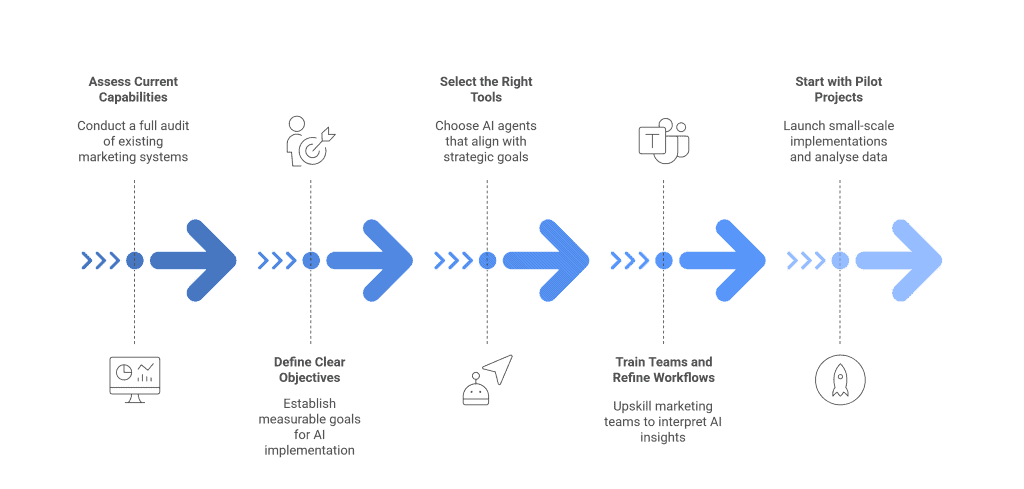
- Assess Current Capabilities: Conduct a full audit of existing marketing systems and identify where AI could improve efficiency or insight generation.
- Define Clear Objectives: Establish measurable goals, such as improving engagement rates or shortening content production time.
- Select the Right Tools: Choose AI agents that align with strategic goals and integrate seamlessly with CRM, CMS, and analytics platforms.
- Train Teams and Refine Workflows: Upskill marketing teams to interpret AI insights and incorporate them into creative decision-making.
- Start with Pilot Projects: Launch small-scale implementations, analyse performance data, and expand gradually based on results.
This approach ensures that AI adoption enhances, rather than disrupts, existing marketing strategies.
Common Challenges and How to Overcome Them
Adopting AI-driven marketing can present challenges, particularly for SMEs with limited budgets or technical expertise. Common obstacles include:
- Data Fragmentation: Consolidate data into centralised systems before deploying AI. Clean, structured data produces more reliable insights.
- Skill Gaps: Invest in training or partner with a marketing consultancy experienced in strategic AI integration.
- Over-Reliance on Automation: Use AI as a support tool, not a substitute for strategic thinking. Human oversight remains essential.
With the right approach, AI agents become invaluable partners in achieving more relevant, effective marketing outcomes.
Future of Audience-Focused Marketing with AI Agents
The future of AI in content marketing is both promising and complex. AI agents are rapidly evolving from simple analytical tools to sophisticated systems capable of autonomously managing campaigns, predicting outcomes, and recommending strategic actions. They will soon interact directly with customers, adapting content in real time based on engagement signals.
For SMEs, the prospect represents both an opportunity and a challenge. Those that invest early in AI-driven strategies will gain a competitive advantage through efficiency, insight, and audience understanding. As AI technology becomes more accessible, even small businesses will be able to compete with larger businesses by delivering personalised, high-performing content.
The future belongs to businesses that can blend the analytical power of AI with the strategic wisdom of experienced marketers. This combination will define the next era of audience-focused marketing, where every interaction is purposeful, personal, and measurable.

Strategy and Intelligence Working Together
Relevance has become the cornerstone of effective marketing. Businesses that can consistently produce audience-focused content enjoy stronger engagement, greater loyalty, and higher returns on investment. AI agents provide the intelligence to make that possible, turning raw data into insight and insight into action.
Yet technology alone is not enough. The most successful organisations use AI as a partner in strategic decision-making, combining human creativity with data precision. When used thoughtfully, AI agents empower marketers to make content more targeted, meaningful, and effective.
The path forward is clear: those who embrace AI responsibly and strategically will lead the next generation of audience-focused marketing. The challenge is not to replace human thinking but to enhance it through intelligent automation and evidence-based insight.
Work With Opportunity Marketing
Creating relevant, audience-focused content starts with a strong strategic foundation. At Opportunity Marketing, we help businesses move beyond guesswork by developing clear, data-driven marketing strategies that align with their goals and target audiences. Whether you need expert guidance through our Fast Track Marketing Plan, ongoing support via Outsourced Marketing, or skills development through Marketing Mentoring, our strategy-first approach guarantees measurable progress.
If you’re ready to make your marketing more intelligent, efficient, and results-driven, partner with us to turn audience insight into action. Contact Opportunity Marketing today and discover how strategic thinking can elevate your business performance and maximise your marketing ROI.
Call: 0333 320 4108
Email: info@opportunitymarketing.co.uk


Ian Kirk
Founder at Opportunity Marketing
Ian is the founder of Opportunity Marketing marketing, with over 18 years of experience in successfully setting up marketing departments, creating marketing strategies and implementing these strategies across a wide number of SME companies in both the B2B and B2C sectors through a variety of channels.

A-Z OF MARKETING
A complete guide that simplifies the wonderful world of marketing.
 Download Now


