 Skip to main content
Skip to footer
Skip to main content
Skip to footer

Become a Marketing Consultant, Marketing Strategy, Marketing Tips
Marketing Consultant vs Agency: Which Option Delivers Better ROI?

Marketing Strategy First or Campaigns First? Consultant vs Agency Explained
A marketing consultant focuses on developing marketing strategy, analysing market opportunities, and guiding long term business growth. A marketing agency focuses on executing marketing campaigns such as digital advertising, content marketing, and design. Businesses often benefit from using both, where a consultant develops the strategy and an agency delivers the marketing campaigns.
Business owners frequently encounter confusion when deciding how to obtain professional marketing support. The marketing services industry contains many overlapping roles, and the terminology used by providers can make it difficult to identify which type of support a business genuinely needs. Some organisations invest heavily in marketing agencies to run campaigns, while others hire marketing consultants to provide strategic direction and guidance.
Clear understanding of the differences between a marketing consultant and a marketing agency helps organisations make more informed decisions about marketing investment. Marketing budgets often represent a significant financial commitment for small and medium sized enterprises. Poor decisions at this stage can lead to fragmented campaigns, wasted expenditure, and disappointing commercial outcomes.
Strategic Marketing Mastery course, offered by Opportunity Marketing, helps business owners, managers, and marketing professionals develop the strategic marketing knowledge needed to make informed decisions about whether to work with a marketing consultant, a marketing agency, or both. The course explains how to build a structured marketing strategy, define target audiences, position products or services effectively, and allocate marketing budgets based on measurable commercial outcomes rather than guesswork. Contact Us: 0333 320 4108 or info@opportunitymarketing.co.uk.
What Is a Marketing Consultant?
Defining the role of a marketing consultant
A marketing consultant is an independent professional who provides strategic marketing advice and guidance to organisations. Their primary role is to analyse the business, understand the competitive marketplace, identify opportunities for growth, and develop structured marketing strategies that support long term commercial objectives.
Consultants typically work closely with business owners, directors, and senior managers. Their involvement often begins with a detailed evaluation of the organisation’s current marketing performance, customer base, and competitive positioning. This strategic assessment helps clarify where the business stands in the marketplace and which marketing opportunities are worth pursuing.
Unlike agencies that primarily deliver marketing campaigns, consultants focus on strategic decision making. Their objective is to help organisations identify the most effective marketing direction before committing financial resources to specific tactics or channels.
Core Responsibilities of a Marketing Consultant
Marketing consultants perform several key functions that support strategic business growth.
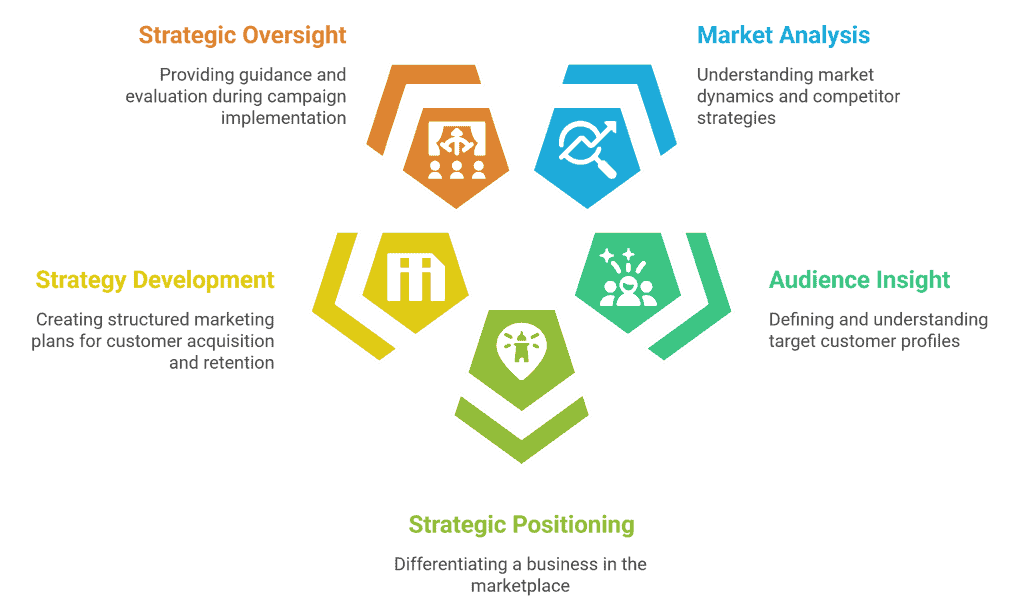
Market and competitor analysis
Market analysis forms a critical foundation of effective marketing strategy. Consultants study the wider market environment to understand customer demand, competitor positioning, pricing structures, and emerging trends.
This analysis helps organisations identify gaps within the market where they can compete more effectively. It also allows businesses to understand how competitors attract customers and where opportunities exist to differentiate products or services.
Accurate market insight reduces the risk of investing in marketing campaigns that fail to resonate with target audiences.
Audience and customer insight
Clear understanding of the target audience sits at the centre of effective marketing strategy. Consultants work with organisations to define ideal customer profiles and understand purchasing behaviour.
This process often includes identifying demographic characteristics, professional roles, industry sectors, buying motivations, and typical customer challenges. Understanding these factors allows businesses to communicate more effectively with their audiences and develop marketing messages that address real customer needs.
Customer insight also guides decisions about marketing channels and communication styles.
Strategic positioning and messaging
Strategic positioning refers to how a business differentiates itself within the marketplace. Consultants help organisations articulate their unique value proposition and clarify why customers should choose their products or services over competing alternatives.
Strong positioning supports consistent messaging across marketing channels. It also improves brand recognition and strengthens customer trust. Businesses with clear positioning often experience more effective marketing results because their communication resonates more strongly with the intended audience.
Marketing strategy development
Once research and analysis are complete, consultants develop structured marketing strategies that outline how the business should attract, convert, and retain customers.
These strategies typically define target markets, marketing objectives, communication channels, messaging frameworks, and performance indicators. A clear strategy allows organisations to prioritise marketing activity and allocate budgets more effectively.
Strategic planning also provides a roadmap that aligns marketing activity with long term business goals.
Strategic oversight and implementation guidance
Consultants frequently provide guidance during implementation stages. Although they may not execute campaigns directly, they help organisations coordinate marketing activity and evaluate whether tactics align with strategic objectives.
This oversight prevents organisations from drifting into disconnected marketing activity. It also allows businesses to adapt their marketing plans when performance data reveals new insights or changing market conditions.
What Is a Marketing Agency?
Understanding the role of marketing agencies
Marketing agencies focus primarily on executing marketing activities on behalf of businesses. Agencies usually specialise in delivering campaigns, producing creative assets, managing advertising platforms, and implementing digital marketing tactics.
Businesses often engage agencies when they lack internal marketing resources or specialist technical expertise. Agencies typically operate with teams of specialists who handle different aspects of campaign delivery, such as graphic design, search engine optimisation, content marketing, or paid advertising.
The relationship between a business and a marketing agency generally centres on delivering specific marketing outputs rather than shaping long term marketing strategy.
Types of marketing agencies businesses may encounter
Several types of agencies operate within the marketing services industry. Each focuses on different areas of marketing execution.
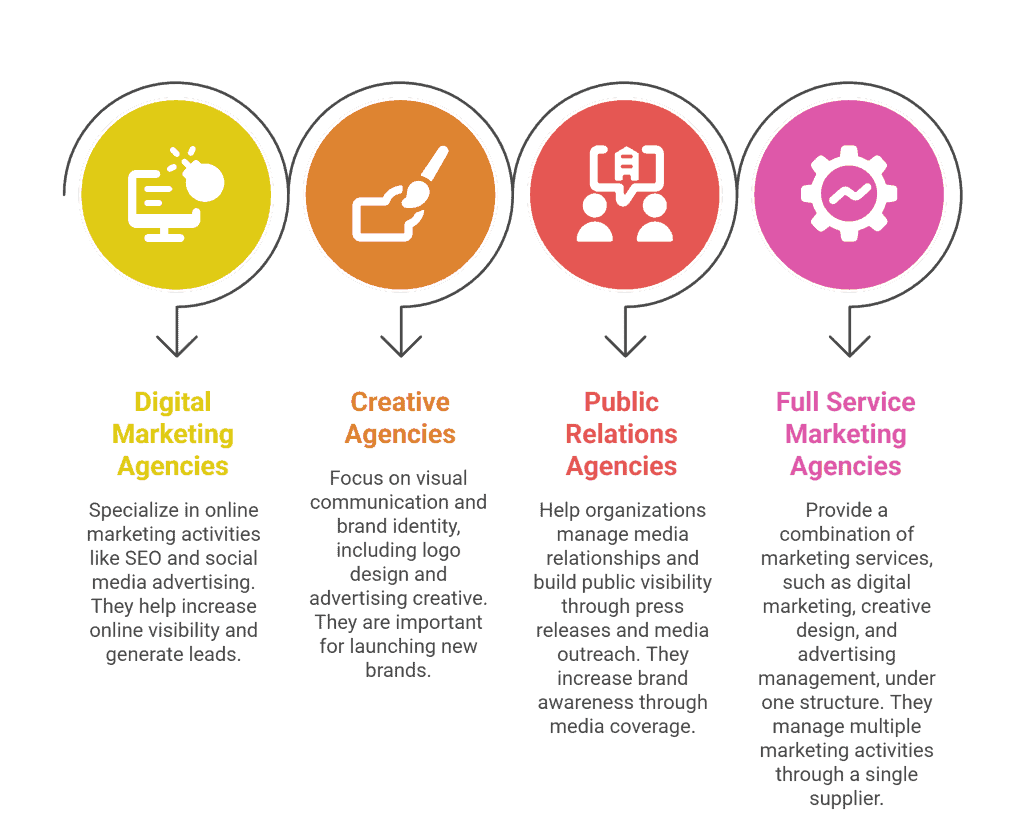
Digital marketing agencies
Digital marketing agencies specialise in online marketing activities. Their services often include search engine optimisation, pay per click advertising, social media advertising, email marketing campaigns, and website optimisation.
Businesses frequently hire digital agencies when they want to increase online visibility, attract website traffic, or generate online leads.
Creative agencies
Creative agencies focus on visual communication and brand identity. Their services include logo design, brand development, advertising creative, website design, and visual marketing materials.
These agencies play an important role when organisations are launching new brands or refreshing existing brand identities.
Public relations and communications agencies
Public relations agencies help organisations manage media relationships and build public visibility. Their services include press release distribution, media outreach, reputation management, and communication strategy.
Organisations often use PR agencies when they want to increase brand awareness through media coverage or manage public perception.
Full service marketing agencies
Full service agencies provide a combination of marketing services under one organisational structure. These agencies may offer digital marketing, creative design, advertising management, and analytics reporting.
Businesses sometimes prefer full service agencies because they can manage multiple marketing activities through a single supplier.
What agencies typically focus on
Marketing agencies usually concentrate on operational marketing tasks. These tasks often include managing advertising campaigns, producing creative materials, publishing social media content, and optimising digital marketing performance.
Campaign performance reports frequently highlight activity metrics such as impressions, clicks, engagement levels, and website traffic. Although these metrics can provide useful insight, they do not always translate directly into business growth or profitability.
Key Differences Between Marketing Consultants and Marketing Agencies

Strategic thinking versus tactical execution
The most important distinction between consultants and agencies lies in their primary focus. Marketing consultants concentrate on strategy, planning, and business alignment. Agencies concentrate on implementing specific marketing activities.
Strategic guidance helps businesses determine which marketing channels and tactics are worth pursuing. Execution focuses on delivering campaigns that operate within those strategic boundaries.
Businesses that begin marketing activity without strategic clarity often experience inconsistent results because their marketing actions lack a coherent framework.
Independent advice versus service based recommendations
Consultants operate independently and do not rely on selling marketing services. Their advice therefore remains impartial and centred on what best supports the organisation’s commercial goals.
Agencies typically generate revenue through the marketing services they provide. Their recommendations may therefore favour the services available within their organisation.
This difference does not imply that agencies lack integrity. It simply reflects the structural incentives that influence how marketing recommendations are presented.
Long term planning versus short term campaign delivery
Consultants typically work with organisations to develop long term marketing roadmaps. These roadmaps guide how marketing activity should evolve over months or years as the business grows.
Agencies frequently operate within shorter campaign cycles. Their work may revolve around advertising campaigns, website redesign projects, or content production schedules.
Strategic oversight helps connect these individual campaigns into a broader plan that supports sustainable growth.
Commercial accountability versus marketing activity
Consultants usually measure success through commercial outcomes such as revenue growth, customer acquisition rates, and profitability.
Agencies often report performance using marketing metrics such as click through rates, impressions, and engagement levels. These indicators can provide useful operational insight, yet they do not always reflect overall business performance.
Businesses benefit most when marketing activity connects clearly to financial results.
Advantages of Hiring a Marketing Consultant
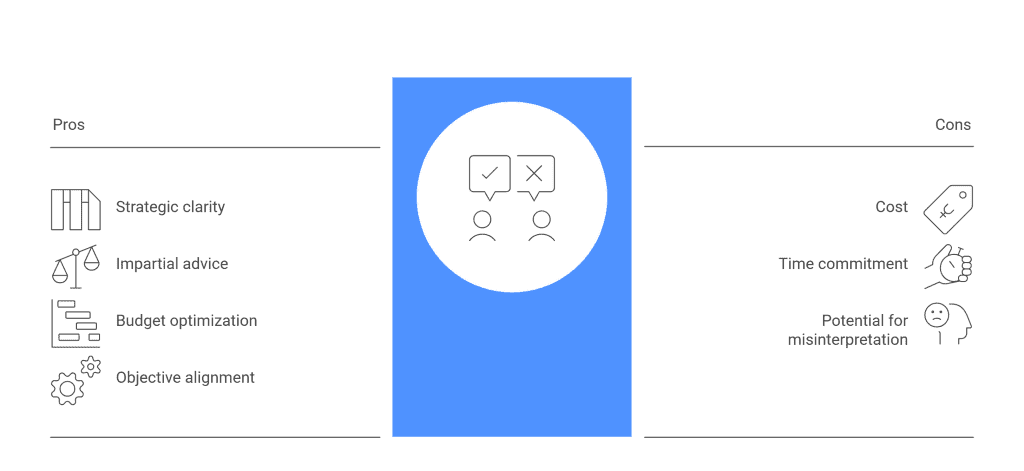
Strategic clarity for business growth
A marketing consultant provides an objective assessment of the organisation’s current position within the marketplace. This strategic clarity helps leadership teams understand which opportunities offer the strongest potential for growth.
Consultants analyse customer segments, market trends, and competitive dynamics. Their insight enables organisations to prioritise marketing activities that deliver meaningful commercial outcomes.
Strategic clarity also prevents businesses from pursuing marketing tactics that appear fashionable but lack relevance for their specific audience.
Objective and impartial advice
Consultants do not rely on selling marketing services. Their role focuses on advising businesses about which marketing actions are most appropriate for achieving commercial objectives.
This independence allows organisations to receive unbiased recommendations about marketing channels, messaging strategies, and resource allocation. Businesses often find this perspective valuable when reviewing existing marketing investments.
Independent advice also supports stronger decision making within leadership teams.
Improved allocation of marketing budgets
Many organisations struggle to allocate marketing budgets effectively. Consultants analyse historical performance data and forecast potential outcomes from different marketing activities.
This financial perspective allows businesses to prioritise marketing investments that deliver stronger returns. Marketing budgets can then be allocated according to strategic priorities rather than intuition or short term trends.
More disciplined budget allocation reduces wasted expenditure and improves long term marketing performance.
Alignment between marketing and business objectives
Marketing activity should always support wider organisational goals such as revenue growth, market expansion, or improved customer retention.
Consultants work with senior leadership to align marketing plans with financial objectives and operational priorities. This alignment transforms marketing from a disconnected promotional activity into a structured driver of business growth.
When marketing activity connects directly to commercial objectives, organisations gain greater confidence in their marketing investments.
Advantages of Hiring a Marketing Agency
Access to specialist technical expertise
Marketing agencies often employ teams of specialists with expertise across different marketing disciplines. These specialists may include search engine optimisation professionals, paid advertising managers, graphic designers, content creators, data analysts, and web developers. Access to this range of expertise allows businesses to implement complex marketing campaigns without hiring multiple internal employees.
For organisations that lack internal marketing teams, agencies can provide a practical solution for delivering marketing activity at scale. Agencies often have experience managing campaigns across many industries, which allows them to apply proven marketing techniques and industry insights when executing campaigns.
Technical marketing platforms also evolve rapidly. Agencies frequently maintain expertise in digital advertising platforms, marketing automation systems, analytics tools, and content management systems. Businesses benefit from this technical knowledge without needing to invest heavily in training internal staff.
Campaign execution and operational support
Marketing agencies play an important operational role when businesses need consistent marketing output. Agencies manage the day to day tasks associated with campaign delivery, including designing marketing materials, managing advertising accounts, publishing content, and monitoring campaign performance.
Many organisations choose to outsource operational marketing activity because it allows internal teams to focus on other areas of business management. Agencies can handle routine marketing tasks that require technical expertise and ongoing attention.
This operational support is particularly valuable when organisations run multiple marketing campaigns simultaneously across different channels such as search engines, social media platforms, and email marketing systems.
Access to marketing technology and tools
Modern marketing campaigns rely on a wide range of technology platforms. These tools include marketing automation software, customer relationship management systems, digital advertising platforms, and analytics dashboards.
Marketing agencies often maintain subscriptions to advanced marketing technology that would be expensive for individual businesses to acquire independently. Businesses therefore gain access to these tools through the agency relationship.
Access to advanced marketing technology can improve campaign efficiency and provide deeper insight into customer behaviour and marketing performance.
Scalability of marketing activity
Agencies allow businesses to scale marketing activity quickly without recruiting new employees. When organisations need to increase marketing output during periods of growth or expansion, agencies can allocate additional resources to support increased campaign activity.
This scalability provides flexibility for organisations whose marketing needs change over time. Businesses can increase or decrease marketing activity depending on market conditions, seasonal demand, or strategic priorities.
Agencies therefore provide an adaptable marketing resource that can respond quickly to changes in business requirements.

Disadvantages of Marketing Consultants
Limited operational capacity
Marketing consultants focus primarily on strategic planning rather than operational campaign delivery. Organisations that require immediate campaign execution may need to hire additional agencies or internal marketing staff to implement the consultant’s recommendations.
This separation between strategy and execution can sometimes require coordination between multiple suppliers. Businesses therefore need effective project management to translate strategy into practical marketing activity.
Despite this limitation, many organisations benefit from developing strategy first before investing in execution.
Implementation requires additional resources
Once a consultant develops a marketing strategy, the organisation must allocate resources to implement that strategy. These resources may include marketing agencies, freelancers, internal marketing staff, or specialist contractors.
Businesses without existing marketing infrastructure may need time to build the necessary implementation capabilities. Leadership teams must also remain actively involved in overseeing marketing execution.
Successful implementation therefore requires commitment from both internal teams and external partners.
Not always suitable for short term campaign needs
Consultants typically focus on long term strategic improvement rather than short term marketing campaigns. Businesses seeking immediate marketing output may find that consultants recommend a period of analysis and planning before launching campaigns.
Although this approach may initially appear slower, strategic planning frequently produces stronger results over time. Businesses that invest time in developing a clear marketing strategy often avoid costly mistakes associated with poorly targeted campaigns.
Disadvantages of Marketing Agencies
Limited strategic perspective
Some marketing agencies focus heavily on campaign execution without fully understanding the broader strategic objectives of the organisation. When agencies operate without clear strategic guidance, marketing campaigns may lack coherence or alignment with long term business goals.
This limitation can lead to fragmented marketing activity across multiple channels. Campaigns may generate activity metrics such as website visits or social media engagement without contributing meaningfully to revenue growth.
Strategic direction helps agencies execute campaigns that support the organisation’s broader commercial objectives.
Potential conflicts of interest
Agencies generate revenue by providing marketing services. As a result, their recommendations may emphasise services that they already offer.
For example, an agency that specialises in paid advertising may recommend advertising campaigns even when other marketing strategies could produce stronger long term results. This structural incentive does not necessarily indicate poor advice, yet it can influence the types of marketing solutions presented to clients.
Businesses benefit from reviewing agency recommendations carefully and considering whether they align with broader strategic priorities.
Fragmented marketing activity
Organisations sometimes work with multiple agencies simultaneously. One agency may manage social media campaigns while another handles website development and a third manages advertising campaigns.
Without clear strategic oversight, these separate marketing activities may operate independently of each other. Messaging may become inconsistent and campaigns may target different audiences without coordination.
Fragmented marketing activity reduces the effectiveness of overall marketing investment.
Marketing metrics that lack commercial relevance
Agencies frequently report performance using operational marketing metrics such as impressions, click through rates, or follower growth. These metrics provide useful insight into campaign activity, yet they do not always indicate whether marketing investment contributes to business profitability.
Businesses ultimately require marketing results that translate into new customers, increased revenue, and long term customer relationships. Operational metrics should therefore be evaluated alongside commercial performance indicators.
When Should a Business Hire a Marketing Consultant?
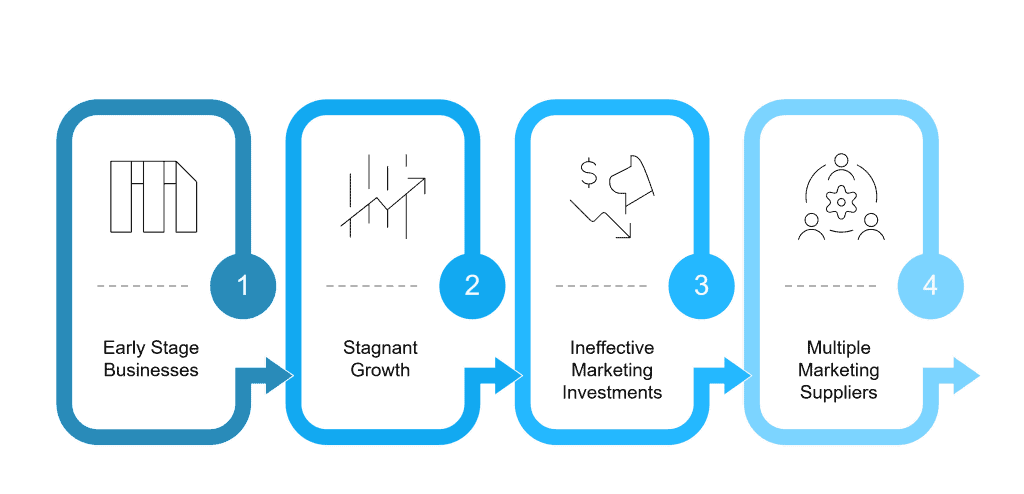
Early stage businesses requiring strategic direction
New businesses often struggle to determine which marketing activities deserve attention first. Limited resources mean that marketing investment must be prioritised carefully.
Marketing consultants help early stage organisations identify their ideal target audience, define their value proposition, and select appropriate marketing channels. This strategic guidance helps businesses avoid spending resources on ineffective campaigns.
Clear strategy also helps new organisations communicate their value more effectively to potential customers.
Businesses experiencing stagnant growth
Organisations sometimes reach a point where marketing activity produces diminishing returns. Lead generation slows, customer acquisition becomes more expensive, or marketing campaigns fail to deliver consistent results.
Consultants analyse these situations to identify underlying problems within the marketing strategy. Issues may include unclear positioning, poorly defined target audiences, or ineffective messaging.
Strategic reassessment often reveals opportunities for improving marketing performance.
Companies investing heavily in marketing without clear results
Some organisations allocate substantial marketing budgets yet struggle to measure meaningful business outcomes. Marketing consultants conduct structured marketing audits to examine how marketing investments are performing.
These audits identify inefficiencies, highlight underperforming channels, and recommend improvements to marketing strategy. Businesses gain greater visibility into which marketing activities contribute to growth and which require adjustment.
A strategic audit can often recover significant value from existing marketing investments.
Organisations managing multiple marketing suppliers
Businesses that work with several marketing agencies may experience coordination challenges. Different agencies may pursue separate objectives or adopt inconsistent messaging.
A marketing consultant can provide independent oversight and coordinate marketing activity across multiple suppliers. This coordination helps align campaigns with strategic objectives and improves overall marketing efficiency.
When Should a Business Hire a Marketing Agency?
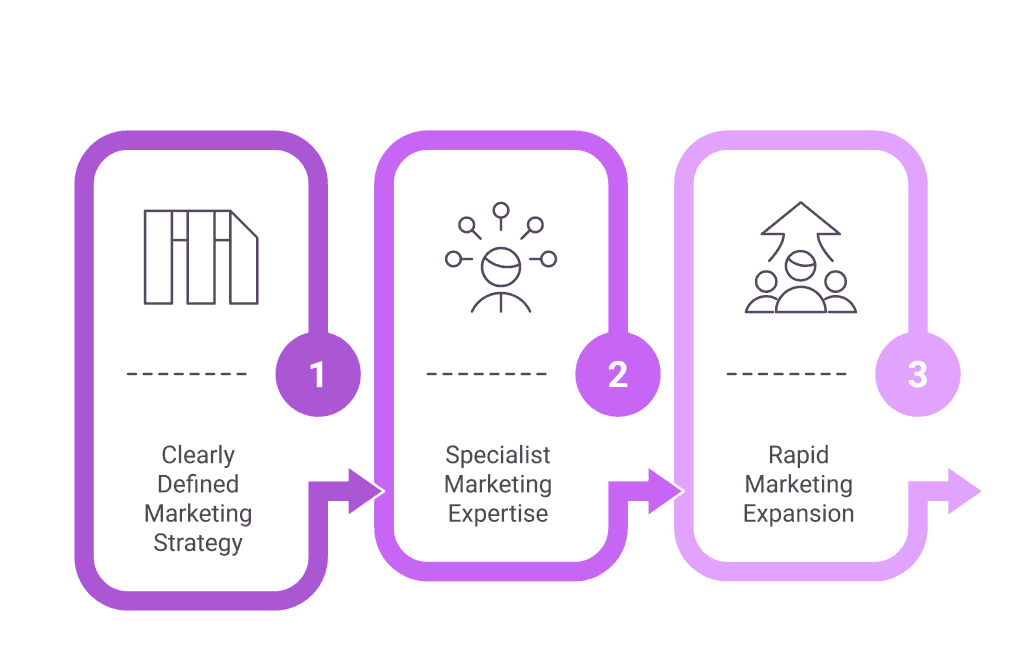
Businesses with a clearly defined marketing strategy
Organisations that already possess a structured marketing strategy often require agencies to implement the tactical elements of that strategy. Agencies can deliver advertising campaigns, manage digital platforms, and produce marketing materials.
With strategic direction already established, agencies can focus on executing campaigns efficiently.
Organisations requiring specialist marketing expertise
Certain marketing disciplines require highly specialised technical knowledge. Search engine optimisation, pay per click advertising, marketing automation, and conversion rate optimisation all require expertise that may not exist within internal teams.
Agencies provide access to this technical expertise and can implement sophisticated marketing campaigns across multiple platforms.
Businesses expanding marketing activity rapidly
Companies entering new markets or launching new products often need to scale marketing activity quickly. Agencies can allocate additional personnel and technical resources to support these initiatives.
This flexibility allows businesses to respond quickly to new opportunities without committing to long term internal recruitment.
The Best Approach for Many SMEs: Strategy First, Execution Second
Why marketing strategy should guide marketing investment
Marketing campaigns produce stronger results when guided by a clearly defined strategy. Strategy defines the target audience, value proposition, messaging framework, and marketing objectives that shape campaign activity.
Businesses that skip the strategic stage often pursue disconnected marketing tactics. Advertising campaigns, social media activity, and content marketing efforts may operate independently without contributing to a coherent customer acquisition process.
Strategic clarity improves marketing efficiency and increases the likelihood that campaigns will produce measurable business outcomes.
The role of consultants in guiding agency activity
Many successful organisations combine the strengths of marketing consultants and marketing agencies. Consultants develop the strategic roadmap that defines how the organisation should approach the market.
Agencies then implement campaigns that align with this strategic framework. This structure allows businesses to benefit from both strategic expertise and operational execution.
Consultants can also review agency performance and provide guidance when campaigns require adjustment.
Creating a structured marketing framework
- Businesses often benefit from following a structured marketing framework that connects strategy and execution. This framework typically includes several stages.
- Research and analysis identify market opportunities and customer needs.
- Strategic planning defines positioning, messaging, and marketing objectives.
- Campaign execution implements marketing activity across selected channels.
- Performance measurement tracks marketing outcomes and informs ongoing improvements.
- This structured approach allows marketing activity to evolve systematically as the organisation grows.
How to Decide Which Option Is Right for Your Business
Key questions business owners should consider
Business leaders evaluating marketing support should begin by examining several important questions.
- What stage of growth is the organisation currently experiencing?
- Does the business have a clearly defined marketing strategy?
- What internal marketing capabilities already exist within the organisation?
- What outcomes does the business expect from its marketing investment?
Answering these questions provides valuable insight into whether strategic consulting or agency execution represents the most appropriate starting point.
Businesses lacking strategic clarity often benefit from consulting support. Organisations that already possess a clear marketing plan may focus on selecting agencies capable of delivering high quality campaign execution.
Common Mistakes Businesses Make When Choosing Marketing Support
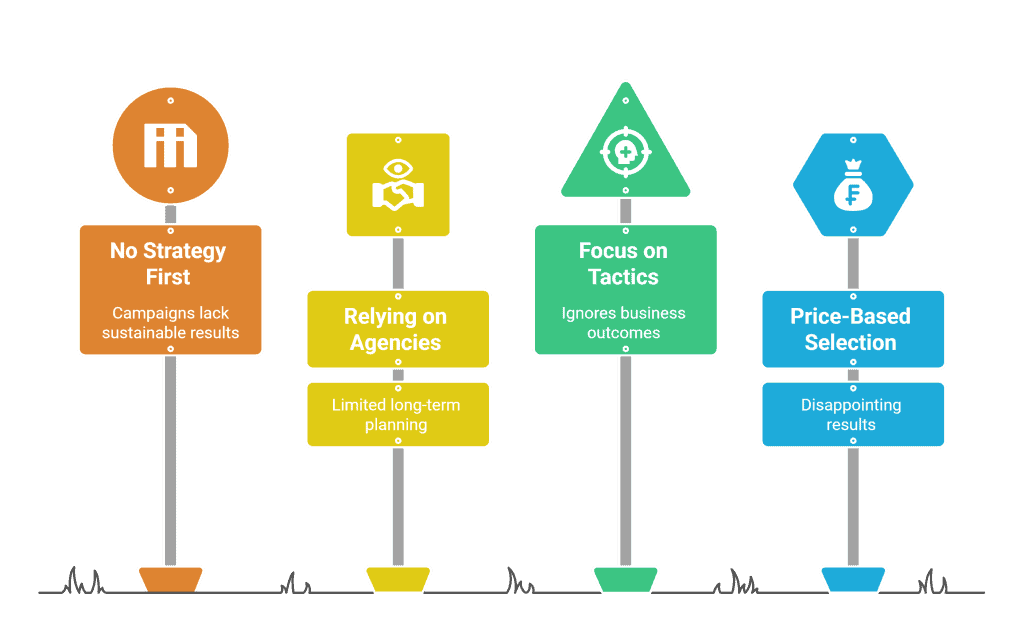
Hiring an agency before developing strategy
Many businesses invest in marketing campaigns before clarifying their positioning, target audience, or messaging. Campaign activity may generate engagement or website traffic, yet it rarely produces sustainable commercial results without strategic alignment.
Developing a structured marketing strategy first helps guide campaign activity and improve performance.
Expecting agencies to provide strategic direction
Although many agencies offer strategic input, their core expertise often lies in campaign execution. Businesses expecting agencies to provide comprehensive strategic guidance may find that long term planning receives limited attention.
Independent strategic guidance often provides greater clarity for marketing decisions.
Focusing on tactics rather than outcomes
Marketing discussions sometimes focus heavily on specific channels such as social media platforms, search advertising, or email marketing tools.
Effective marketing decisions should instead focus on the business outcomes these channels support. Customer acquisition, revenue growth, and brand positioning provide more meaningful measures of marketing success.
Selecting marketing partners based solely on price
Cost considerations naturally influence marketing decisions. Selecting marketing suppliers solely based on the lowest price frequently produces disappointing results.
Marketing support should be evaluated based on expertise, strategic understanding, and the ability to contribute to commercial growth.
Choosing the Right Marketing Partner
Marketing consultants and marketing agencies each play valuable roles within the marketing ecosystem. Consultants provide strategic insight, market analysis, and long term planning that guides effective marketing decisions. Agencies deliver operational expertise that transforms strategy into practical marketing activity.
Businesses achieve the strongest results when marketing investment follows a clear strategic framework. Strategic clarity helps organisations prioritise marketing opportunities, allocate budgets more effectively, and measure marketing performance using meaningful commercial indicators.
Many organisations ultimately benefit from combining strategic consulting with agency execution. This balanced approach allows businesses to develop a coherent marketing strategy while accessing the specialist expertise required to deliver high quality campaigns.
Careful evaluation of organisational needs, resources, and growth objectives will help business leaders select the marketing support structure that best supports their long term success.
Work With Opportunity Marketing
Opportunity Marketing provides independent strategic guidance for SMEs that want greater clarity and accountability from their marketing investment. We help organisations evaluate their current marketing performance, identify opportunities for improvement, and develop practical marketing plans that can be implemented internally or through carefully selected marketing agencies. This approach allows businesses to maintain control of their marketing direction while gaining access to specialist expertise where needed.
📩 Request a Free Consultation
Let’s talk about how we can help you stop reacting to agency ideas and start driving your marketing with purpose. Complete our quick inquiry form or give us a call; we’ll walk you through what’s possible and how to get started.
📍 Visit: opportunitymarketing.co.uk
📞 Call: 0333 320 4108
📧 Email: info@opportunitymarketing.co.uk


Ian Kirk
Founder at Opportunity Marketing
Ian is the founder of Opportunity Marketing marketing, with over 18 years of experience in successfully setting up marketing departments, creating marketing strategies and implementing these strategies across a wide number of SME companies in both the B2B and B2C sectors through a variety of channels.

A-Z OF MARKETING
A complete guide that simplifies the wonderful world of marketing.
 Download Now


