 Skip to main content
Skip to footer
Skip to main content
Skip to footer

Become a Marketing Consultant, Marketing Strategy
What Does a Strategic Marketing Consultant Actually Do?

Why Businesses Need Strategic Marketing Consultancy
Many businesses struggle to understand what a strategic marketing consultant truly does. People often assume that all marketing professionals concentrate on promotional campaigns, social media content, or advertising management. A strategic marketing consultant operates at a much deeper commercial level, working to align every marketing decision with the long-term goals, positioning, and profitability of a business. Rather than focusing on creative execution or isolated tactics, their purpose is to add structure, clarity, and measurable direction to an organisation’s marketing activity.
Strategic marketing consultancy is vital for businesses that want to stop wasting money on disconnected marketing campaigns and start making decisions that produce tangible, measurable results. Many small and medium-sized enterprises (SMEs) find themselves investing in various marketing services, SEO, social media, or paid ads, without understanding whether these activities contribute to growth. A consultant helps to connect these dots, defining what needs to be achieved, how success should be measured, and which channels will yield the greatest return on investment (ROI).
At its core, a strategic marketing consultant bridges the gap between the boardroom and the marketing team. Their purpose is to provide clarity, structure, and confidence in every marketing decision made. They identify what works, remove what doesn’t, and construct a plan that positions marketing as a commercial driver of business performance rather than a cost centre.
The Strategic Marketing Mastery course from Opportunity Marketing equips business owners, managers, and marketers with the structured thinking and practical tools needed to build a results-driven marketing strategy. It helps participants understand how to define objectives, identify target audiences, and align every marketing activity with measurable business outcomes. Through a clear, step-by-step framework, the course transforms marketing from guesswork into a strategic, ROI-focused process that drives sustainable growth. Contact Us: 0333 320 4108 or info@opportunitymarketing.co.uk.
Defining the Role of a Strategic Marketing Consultant
A strategic marketing consultant is a professional advisor who analyses a business’s market position, audience, competition, and objectives to design a marketing strategy that directly supports business growth. Instead of managing campaigns or creating adverts, their focus is on the strategic thinking, planning, and analysis that steer these activities. Their role involves defining the business’s purpose, identifying its ideal audience, and determining the most effective ways to reach and convert that audience profitably.
A key distinction between a strategic marketing consultant and a marketing agency is objectivity. Agencies often specialise in specific tactics, such as digital advertising, content creation, or design, and are naturally biased towards selling those services. A consultant is independent, offering impartial advice that serves the client’s best interests, not their own. This independence is essential as it ensures that the business’s objectives, not the consultant’s service portfolio, guide every recommendation.
Strategic marketing consultants operate as commercial partners rather than suppliers. They collaborate with decision-makers to build a marketing strategy that links all activity to measurable outcomes. Their focus is on clarity, profitability, and sustainability, three pillars that form the foundation of effective marketing.
Core Responsibilities of a Strategic Marketing Consultant
Strategic marketing consultants perform several interconnected functions. Each responsibility contributes to transforming marketing from a reactive function into a structured, ROI-driven discipline.
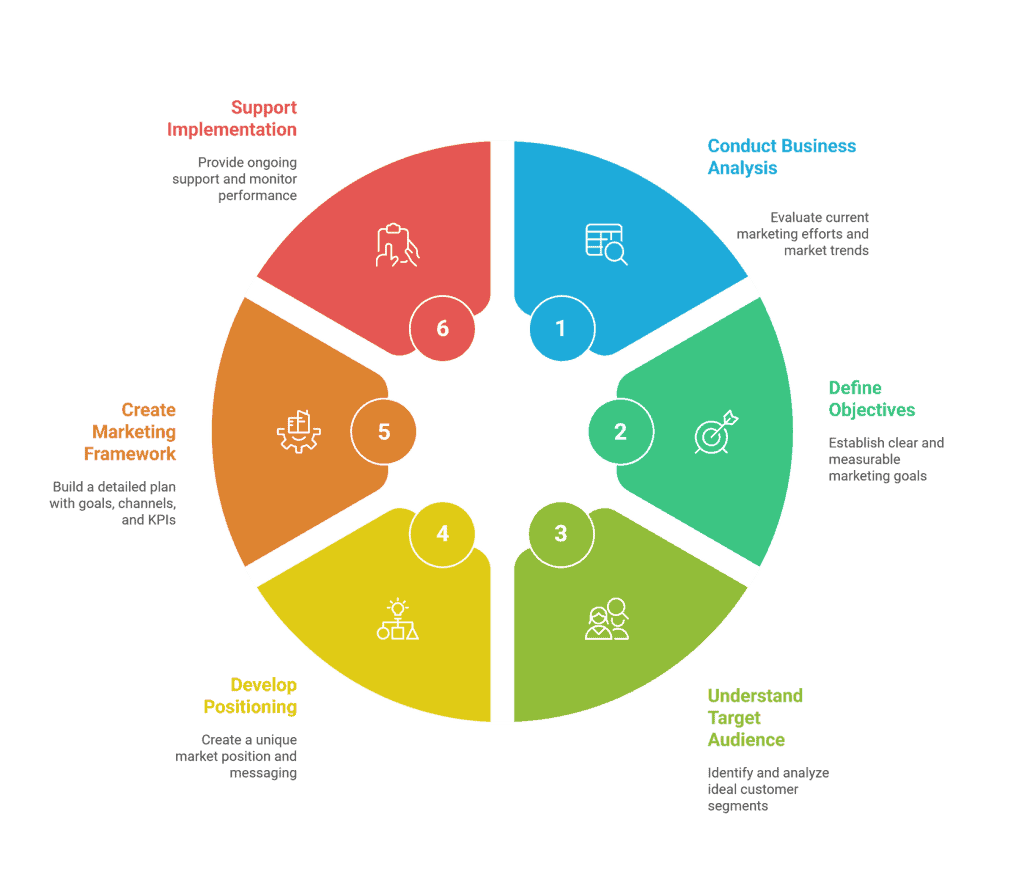
1. Conducting Comprehensive Business and Market Analysis
Before recommending any marketing activity, consultants carry out a detailed review of the business’s current situation. This process begins with a marketing audit, examining all aspects of existing marketing efforts, customer data, financial performance, and brand positioning. The consultant evaluates what has been done previously, what worked, what failed, and why.
Market analysis follows, focusing on external influences such as industry trends, competitor performance, and customer behaviour. This research helps identify opportunities for differentiation and areas of weakness that require attention. Tools such as Google Analytics, SEMrush, CRM systems, and customer feedback platforms are used to build a complete picture of the marketplace.
The goal is to understand not only where the business currently stands but also where it can go. This foundational step provides the data and insight needed to develop an actionable, evidence-based marketing strategy.
2. Defining Business Objectives and Strategic Direction
A consultant helps a business establish clear and measurable objectives that align with its overall mission and financial targets. Many businesses fall into the trap of launching marketing campaigns without knowing what they are trying to achieve. A strategic marketing consultant brings discipline to this process, ensuring that every activity is linked to a specific goal, whether that’s increasing qualified leads, improving conversion rates, enhancing brand awareness, or expanding into new markets.
This step also involves prioritising objectives. For example, a company might aim to increase sales by 20% within 12 months, but the consultant will identify the key performance indicators (KPIs) required to measure progress, such as lead-to-sale conversion ratios, average customer value, and cost per acquisition.
Businesses can monitor performance objectively and make data-led decisions rather than relying on assumptions by defining these metrics early.
3. Understanding and Defining Target Audiences
No marketing strategy succeeds without a precise understanding of the target audience. Strategic marketing consultants conduct audience segmentation, identifying the demographics, psychographics, and behavioural traits of ideal customers. This involves analysing existing client data, reviewing purchase patterns, and developing buyer personas that represent the most profitable customer types.
Consultants also help uncover hidden opportunities, such as untapped customer segments or neglected markets. This process enables businesses to direct their resources toward audiences that generate the highest ROI instead of spreading their efforts too thin across irrelevant markets.
4. Developing Clear Market Positioning and Messaging
Once the target audience is defined, the consultant works on positioning, the unique place the business occupies in the market relative to competitors. This step is about identifying what makes the business different and how that difference translates into value for customers. Consultants develop the core messaging and brand story that communicate these advantages clearly and consistently across all marketing channels.
Effective positioning provides clarity both internally and externally. Internally, it guides decision-making, pricing, and marketing priorities. Externally, it communicates a distinct value proposition that resonates with customers and sets the business apart from competitors.
5. Creating the Marketing Strategy Framework
The consultant then builds a marketing framework, a detailed plan that outlines the strategy for achieving the objectives. This framework covers several key elements:
- The framework includes strategic goals and timelines.
- Chosen marketing channels (digital, offline, or hybrid).
- Budget allocation and resource planning.
- KPIs and measurement systems.
- Activity schedules for implementation.
This plan acts as a roadmap, linking every activity to measurable outcomes. The consultant’s job is to convert strategic intent into an organised action plan that internal teams or external partners can execute effectively.
6. Supporting Implementation and Performance Management
While consultants focus on strategy, they also provide ongoing support during execution. They work closely with marketing teams, agencies, and senior management to make certain that tactics align with the strategy. They may project manage campaigns, monitor performance data, and conduct regular reviews to identify optimisation opportunities.
Performance management is a continuous process. Consultants evaluate key metrics such as ROI, cost per lead, and customer lifetime value, making recommendations for improvement based on real data rather than assumptions. This iterative approach helps businesses refine their marketing efforts and maintain consistent growth over time.
The Process a Strategic Marketing Consultant Follows
A structured methodology separates a professional consultant from ad hoc advisors or agencies. The process typically unfolds in five stages, each building on the last to create a cohesive and actionable marketing plan.
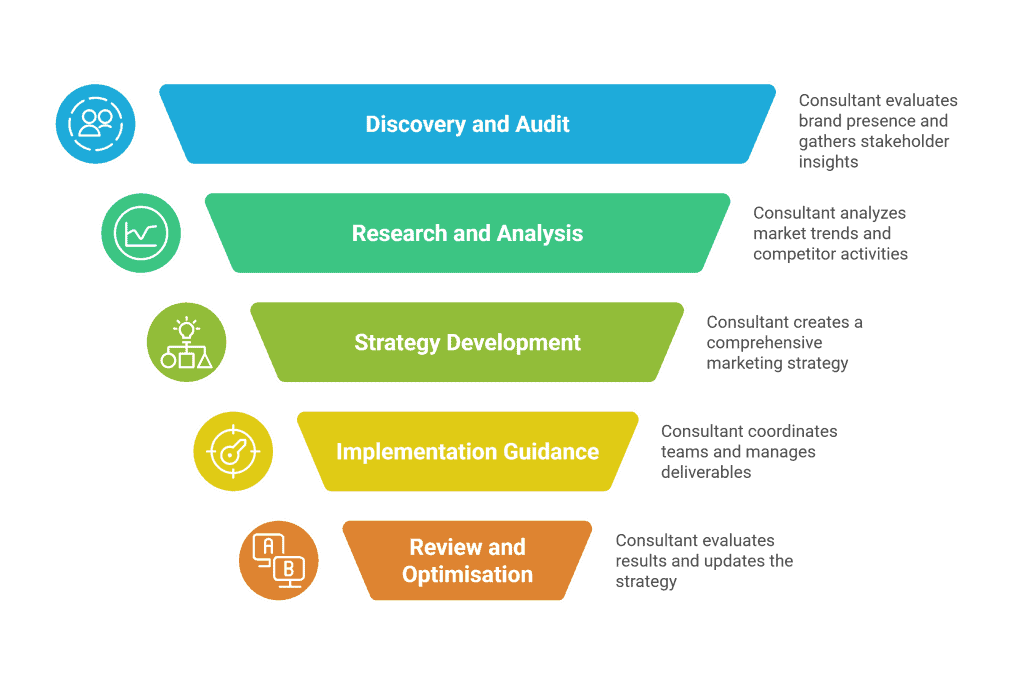
Stage 1: Discovery and Audit
The consultant begins with a discovery phase that involves reviewing the current marketing situation. This includes evaluating brand presence, customer data, digital channels, and overall marketing effectiveness. Interviews with stakeholders help reveal internal perspectives and challenges that may not appear in data reports.
Stage 2: Research and Analysis
Research forms the evidence base for all recommendations. Consultants analyse the marketplace, assess competitors, and evaluate audience behaviour. They study trends, pricing structures, and customer sentiment to identify opportunities for differentiation. The goal is to build a factual foundation for all strategic decisions.
Stage 3: Strategy Development
Using insights from the previous stages, the consultant develops a complete marketing strategy. This strategy outlines clear objectives, audience segments, positioning statements, key messages, and tactical priorities. It also includes timelines, KPIs, and measurement frameworks to track progress effectively.
Stage 4: Implementation Guidance
Once the strategy is approved, the consultant provides implementation support. They coordinate internal teams, brief agencies, and project manage deliverables to guarantee alignment with strategic objectives. They act as a bridge between leadership and the marketing function, maintaining accountability and direction.
Stage 5: Review and Optimisation
The final stage is an ongoing process of review, analysis, and improvement. The consultant evaluates the campaign results against KPIs, identifies lessons learnt, and updates the strategy to maintain momentum. This approach ensures that marketing performance continues to evolve alongside market conditions and business goals.
How Strategic Marketing Consultants Deliver ROI
A key part of a consultant’s value lies in their ability to translate marketing into measurable financial results. Their objectives are to maximise the profitability of every marketing investment through structured analysis, strategic planning, and ongoing optimisation.

1. ROI-Driven Planning
Strategic consultants link every marketing action to the bottom line. They use data to identify which activities produce the best returns and allocate budgets accordingly. Rather than spreading investment across multiple tactics, they help businesses focus on high-impact activities that contribute to revenue growth.
2. Budgeting Backwards
One of the most effective approaches is “budgeting backwards”, starting with the desired revenue target and calculating what marketing activity and investment are required to achieve it. This prevents guesswork and replaces it with evidence-based budgeting that aligns resources with outcomes.
3. Customer Lifetime Value (CLV) and Retention
Consultants help businesses calculate and improve customer lifetime value by focusing on retention, repeat purchases, and upselling. Retaining an existing customer often costs significantly less than acquiring a new one, so strategies are developed to strengthen loyalty, improve service quality, and extend customer relationships.
4. Eliminating Waste and Inefficiency
A consultant’s analytical approach helps identify where marketing budgets are being wasted. This may include channels with poor conversion rates, duplicate efforts across departments, or campaigns that do not align with strategy. Reallocating those funds to better-performing areas directly improves overall ROI.
5. Measurable Accountability
Data and measurable KPIs support every recommendation a consultant makes. This implies that stakeholders can justify marketing decisions and connect them to business performance. Over time, this transparency builds trust between marketers and the wider organisation.
Key Tools and Techniques Used by Strategic Marketing Consultants
Strategic consultants use a wide range of tools to collect data, analyse performances, and develop insights. These include:
- Google Analytics and Search Console: To analyse traffic, user behaviour, and channel performance.
- SEMrush and Screaming Frog: For competitor research, keyword analysis, and website audits.
- CRM Platforms: To review sales pipelines, customer journeys, and conversion ratios.
- Financial Dashboards: To track marketing ROI, cost per acquisition, and profitability.
- Surveys and Focus Groups: To capture customer feedback and sentiment.
While these tools provide valuable data, the consultant’s expertise lies in interpreting the information to make strategic decisions. Technology supports the process, but human insight turns that data into actionable marketing direction.
The Difference Between a Strategic Marketing Consultant and a Marketing Agency
Many business owners mistakenly assume that hiring a marketing agency is the same as hiring a consultant. The difference lies in purpose and approach.
A marketing agency specialises in execution, creating ads, managing campaigns, designing websites, or handling social media. Their goal is to deliver outputs.
A strategic marketing consultant, on the other hand, focuses on direction, defining objectives, audience, positioning, and messaging before any campaign is executed. They determine which activities will generate results and why, guiding businesses to spend wisely and avoid waste.
Agencies are valuable partners once strategy is defined, but without strategic clarity, even the most creative campaign may fail to deliver ROI. The consultant provides that clarity, ensuring every activity supports a unified, measurable marketing plan.

When Should a Business Hire a Strategic Marketing Consultant?
Hiring a consultant is particularly beneficial when a business is facing one or more of the following challenges:
- Marketing activity lacks focus or measurable outcomes.
- Sales growth has stagnated despite active marketing efforts.
- Internal teams lack strategic marketing expertise.
- The organisation is preparing for a new product launch, expansion, or rebrand.
- Marketing spend is increasing, but results are inconsistent.
SMEs without in-house marketing leadership gain the most benefit from working with a consultant. Businesses with turnovers between £0.5m and £10m often lack a dedicated marketing director but still require strategic oversight. Consultants fill that gap, offering senior-level expertise at a fraction of the cost of a full-time hire.
How Strategic Marketing Consultants Work with Clients
Consultants typically work through several engagement models depending on client needs:
- Fast Track Marketing Plan:
A structured consultation delivered over four weeks that provides a complete marketing strategy, outlining priorities, messaging, and a three-year roadmap. - Outsourced Marketing:
Acting as an external marketing department, the consultant manages all marketing activities, suppliers, and implementation to guarantee strategic alignment. - Marketing Mentoring:
The consultant provides one-on-one guidance to junior marketers or business owners, assisting them in developing their marketing skills and confidence. - Marketing Health Check Audit:
A short-term review of current marketing performance, identifying inefficiencies and opportunities for improvement.
Through these models, consultants become partners in success, not just advisors. They provide clarity, support, and accountability throughout the entire marketing lifecycle.
Common Misconceptions About Strategic Marketing Consultants
Many business owners misunderstand what consultants do. Some assume consultants only provide theory without practical outcomes. Strategic consultants combine commercial expertise with hands-on implementation guidance. Their recommendations are actionable, measurable, and based on evidence.
Another misconception is that consultants are expensive or only suitable for large corporations. In truth, consultancy can save businesses significant money by eliminating wasted marketing spend and improving ROI. For SMEs, hiring a consultant is often more cost-effective than recruiting an internal marketing director.
Lastly, consultants are sometimes viewed as replacements for marketing teams or agencies. This is not accurate. Consultants complement existing teams, providing leadership, focus, and strategic oversight that helps all marketing partners perform better.

How a Strategic Marketing Consultant Transforms a Business
Imagine an SME spending heavily on digital advertising with disappointing results. The business attracts traffic but struggles to convert leads into paying customers.
A strategic marketing consultant begins by auditing the current campaigns, analysing conversion data, and reviewing customer feedback. The findings reveal a mismatch between messaging and audience expectations. The consultant develops a new strategy, refining audience segmentation, repositioning the offer, and adjusting pricing to improve competitiveness.
Over six months, the business sees a 30% increase in qualified leads and a 40% improvement in conversion rates. Marketing spend remains consistent, but the ROI increases dramatically. This outcome demonstrates the power of strategy-led marketing: clarity replaces confusion, and results become predictable.
The Benefits of Working with an Independent Strategic Marketing Consultant
Working with an independent consultant offers numerous advantages. Businesses gain objective advice free from the bias of agencies that sell specific services. Consultants bring senior-level expertise, structure, and accountability without the overheads of a permanent hire.
They also provide commercial insight, connecting marketing metrics to business profitability. By using data to guide decision-making, consultants create transparency across organisations, allowing directors to understand exactly how marketing contributes to growth.
Most importantly, consultants provide peace of mind. Clear, evidence-based strategies designed to deliver measurable outcomes guide business owners’ marketing investments with confidence.
Why Businesses Choose Opportunity Marketing
Opportunity Marketing stands out because of its strategy-first philosophy and proven track record. Founded in 2008, the consultancy has helped hundreds of UK SMEs develop structured marketing strategies that generate tangible results. Unlike agencies that focus on tactical execution, Opportunity Marketing prioritises commercial clarity and measurable ROI.
Its services, Fast Track Marketing Plan, Outsourced Marketing, Marketing Mentoring, and Marketing Health Check, are designed specifically for SMEs that want professional marketing direction without unnecessary complexity. Every client receives advice based on evidence, not sales, thanks to the consultancy’s impartial and data-driven approach.
Experienced professionals committed to transparency, accountability, and long-term growth work closely with clients. On average, Opportunity Marketing clients achieve a return exceeding 450% on their total marketing investment, proof that strategy, not guesswork, drives success.

How to Work With a Strategic Marketing Consultant
Businesses ready to engage a consultant typically follow these steps:
- Initial Consultation: A discovery discussion to identify goals, challenges, and opportunities.
- Proposal and Strategy Development: The consultant outlines a tailored plan, timelines, and KPIs.
- Collaboration and Implementation: Regular progress reviews and open communication maintain alignment.
- Measurement and Review: The consultant monitors performance, refines the strategy, and reports results.
The process is transparent, structured, and outcome-driven, giving businesses clarity and confidence at every stage.
Strategy Is the Foundation of Every Successful Marketing Investment
Every marketing activity should start with a clear, data-driven strategy. Without it, businesses risk wasting valuable resources on disconnected campaigns that fail to produce measurable outcomes. Strategic marketing consultants bring order, structure, and commercial focus to marketing, helping organisations transform confusion into clarity and expenditures into investment.
Businesses that embrace a strategy-first approach gain a competitive advantage. They understand their audience, communicate more effectively, and invest only in marketing that delivers results. Partnering with an experienced strategic marketing consultant such as Opportunity Marketing provides the expertise, tools, and insight required to make marketing a true driver of business growth.
Work With Opportunity Marketing
If your business is ready to stop wasting money on ineffective marketing and start driving measurable results, Opportunity Marketing can help. Our team of experienced consultants specialises in developing tailored, ROI-focused marketing strategies that give you clarity, direction, and confidence in every decision. Whether you need a structured Fast Track Marketing Plan, ongoing Outsourced Marketing support, one-to-one Marketing Mentoring, or an independent Marketing Health Check Audit, we’ll work with you to build a strategy that delivers real commercial outcomes.
Take the first step towards strategic marketing success today. Contact Opportunity Marketing to discover how our impartial, strategy-first approach can help your business grow sustainably and profitably.
Visit: opportunitymarketing.co.uk
Call: 0333 320 4108
Email: info@opportunitymarketing.co.uk


Ian Kirk
Founder at Opportunity Marketing
Ian is the founder of Opportunity Marketing marketing, with over 18 years of experience in successfully setting up marketing departments, creating marketing strategies and implementing these strategies across a wide number of SME companies in both the B2B and B2C sectors through a variety of channels.

A-Z OF MARKETING
A complete guide that simplifies the wonderful world of marketing.
 Download Now


