Skip to main content
Skip to footer
Skip to main content
Skip to footer

Marketing Strategy, Marketing Techniques, Marketing Tips
The Marketing Metrics That Matter and the Waste You Can Eliminate

It has definitely never been easier to measure marketing. And oddly enough, that is part of the reporting problem. Businesses now have access to more dashboards, reports, platform stats and campaign data than ever before. They can monitor traffic, clicks, impressions, open rates, engagement, followers, reach, bounce rates and countless other indicators. Yet despite all this visibility, many still have very little clarity about what their marketing is actually contributing.
That is because having data is not the same as measuring what matters.
Marketing activity can look healthy while performance is weak
This is one of the most dangerous things about modern marketing reporting: it can create false confidence. A business can appear busy and visible, reports can look full, numbers can move in the right direction, and teams can feel productive. But underneath that surface, commercial performance may be disappointing.
Website traffic might be rising while lead quality is falling. Social engagement may be strong while conversions remain poor. Ad campaigns may look efficient until the real cost of winning a customer is properly calculated.
This, unfortunately, is how waste survives. Not because nobody is measuring anything, but because the wrong things are being used as proof of success.
Which marketing metrics actually deserve attention?
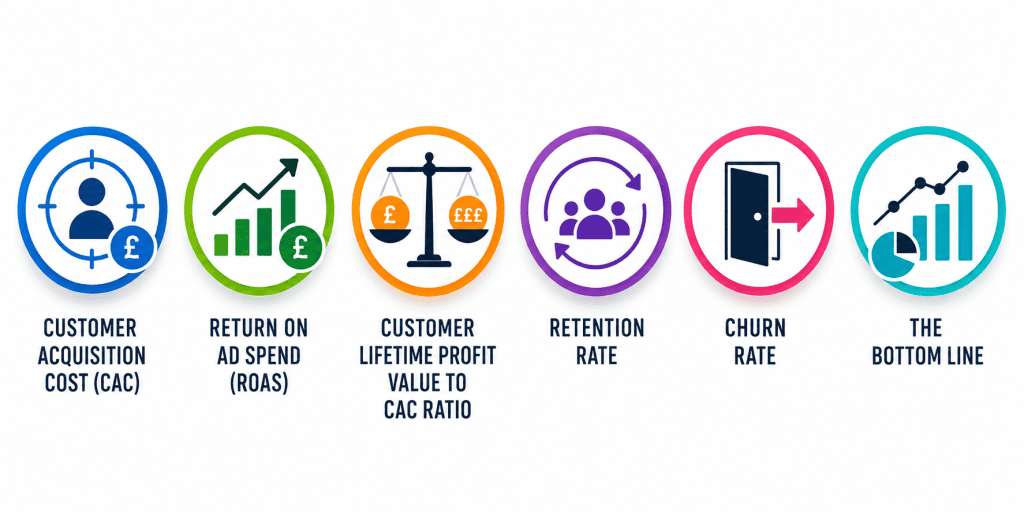
For most SMEs, the most useful marketing metrics are the ones that connect activity to revenue, profit and customer value. That usually means paying close attention to measures such as:
Customer Acquisition Cost (CAC) – What does it really cost to win a customer?
Return on Ad Spend (ROAS) – What sales revenue is being generated from advertising?
Customer Lifetime Profit Value to CAC ratio – Are you acquiring customers at a commercially sensible cost relative to what they are worth?
Retention rate – How many customers stay?
Churn rate – How many leave?
These are not glamorous metrics. They are not the ones most likely to impress in a quick presentation. But they are the ones that help a business decide where to keep investing, where to optimise, and where to stop kidding itself.
Why vanity metrics are so seductive
There is a reason businesses fall into this trap. Vanity metrics are really easy to access, easy to report and often flattering. They give a sense of motion and they are useful for social proof and tactical observation. After all, many of these dashboards are provided by the channels in question themselves, and they want you to keep using the channel. And, to be fair, in some contexts, they do tell you something worth knowing.
But, in isolation, they are not enough.
A spike in attention is not the same as a contribution to profit. A well-performing post is not automatically a well-performing marketing decision. Visibility can support growth, of course, but unless it is linked to better lead flow, conversion, retention or value, it remains just that: visibility.
The danger is not that vanity metrics exist. It is that they are mistaken for commercial evidence.
Marketing waste often hides in familiar places
When businesses start tracking the right metrics properly, marketing waste tends to reveal itself in predictable places.
- Channels that have been funded for years without serious challenge.
- Suppliers producing attractive reports without meaningful outcomes.
- Poor targeting, muddled messaging, or a weak handover between marketing and sales.
- Activities that are not terrible, but simply not good enough to justify continued spend.
This is where commercial measurement becomes so useful. It makes those conversations easier. Without that data, businesses rely on opinion, hierarchy or habit. With it, they can ask harder questions:
- Which channels are genuinely producing profitable outcomes?
- Which activities are underperforming?
- Where are we paying for attention rather than return?
- What should be improved, and what should be cut?
Those questions are how waste starts to come out of hiding.
Better marketing measurement does not mean more complexity
A lot of SMEs assume that serious measurement requires complicated software, expensive reporting infrastructure or a dedicated analyst. It doesn’t, this is a fallacy.
A smaller number of meaningful KPIs, tracked consistently and reviewed properly, is far more useful than a sprawling dashboard nobody really understands. What matters is not the sophistication of the reporting tool. It is the quality of the commercial thinking behind it.
If a business can see spend by channel, leads generated, conversions, sales value, customer cost and retention trends in one sensible view, it already has the foundations for much better decision-making.
Waste reduction is not about becoming cynical
Sometimes when businesses begin to focus harder on efficiency, they become nervous about cutting things too quickly. They worry that every activity will be reduced to a short-term profit test. That is not the right interpretation.
Eliminating waste is not about becoming mean-spirited or obsessed with immediate numbers. It is about creating discipline. It is about ensuring that marketing decisions have a rationale, that underperformance is noticed early, and that spend goes where it has the best commercial case.
That still leaves room for brand-building, testing and longer-term thinking. But even those activities should sit inside a framework that explains why they matter and how their contribution will be assessed over time.
A practical mindset shift for SME leaders
If there is one mindset shift worth making, it is this:
Stop asking whether marketing looks active, and start asking whether it looks economically sound.
That one shift changes a lot.
It encourages better reporting. It sharpens accountability. It makes it easier to challenge weak spend. It also improves confidence in the areas that are working well, because those decisions are being backed by evidence rather than instinct.
And for SMEs, that is enormously valuable. Limited budgets demand sharper judgement. The businesses that make the fastest progress are not always the ones spending the most. They are often the ones learning fastest, cutting waste sooner and concentrating their resources where results are strongest.
If your business is tracking lots of marketing data but still lacks confidence in what is really working, The Maths Behind Marketing will help you focus on the metrics that matter and spot the waste you can eliminate.



Ian Kirk
Founder at Opportunity Marketing
Ian is the founder of Opportunity Marketing marketing, with over 18 years of experience in successfully setting up marketing departments, creating marketing strategies and implementing these strategies across a wide number of SME companies in both the B2B and B2C sectors through a variety of channels.

A-Z OF MARKETING
A complete guide that simplifies the wonderful world of marketing.
 Download Now