 Skip to main content
Skip to footer
Skip to main content
Skip to footer

How To:, Marketing Techniques
How to Build a Marketing Process That Delivers Results

Build a Marketing Process That Attracts and Converts Customers
A successful marketing process connects commercial objectives, customer needs and marketing activity through a structured system. It replaces disconnected campaigns and reactive decisions with clear priorities, defined responsibilities and measurable outcomes. For UK SMEs with limited budgets or small marketing teams, this structure can be the difference between purposeful investment and repeated spending without a clear return.
Strong marketing rarely comes from finding one perfect channel. Sustainable results usually develop when research, positioning, planning, implementation, sales and performance measurement work together. The following process helps business owners, directors, marketing managers and junior marketers create that connection.
Opportunity Marketing’s Strategic Marketing Mastery course helps SME owners, junior marketers and aspiring marketing professionals build a structured, strategy-first marketing process. Participants learn how to define their target audience, strengthen their market positioning, select suitable marketing channels and connect activity to measurable business objectives. Practical frameworks and expert guidance help learners replace disconnected tactics with a clear marketing plan focused on stronger decision-making, improved return on investment and sustainable business growth. Contact Us: 0333 320 4108 or info@opportunitymarketing.co.uk.
What Is a Marketing Process?
A marketing process is the repeatable sequence a business uses to understand its market, attract suitable prospects, convert interest into sales and retain valuable customers. It covers everything from research and objective setting to campaign delivery, lead management, reporting and improvement.
The Difference Between Marketing Strategy, Process and Activity
Marketing strategy defines where the business wants to compete, who it wants to serve and how it will create value. The marketing process translates that strategic direction into an organised way of working. Marketing activities are the individual tactics used within the process, including content, email, SEO, advertising, social media, events and referral programmes.
Problems arise when a business begins with tactics. Launching paid advertising, publishing social media posts or redesigning a website without a clear strategic foundation may create activity, but it does not necessarily create progress.
What an Effective Marketing Process Should Achieve
An effective process should connect marketing decisions to revenue, profitability, customer retention and wider business priorities. It should also give employees, agencies and external specialists clear responsibilities.
Successful processes create consistency without becoming unnecessarily rigid. They provide enough structure to maintain direction while allowing the business to respond to performance data, customer feedback and changing market conditions.
Step 1: Assess the Current Marketing Position
Every process should begin with an honest assessment of the current position. Starting from assumptions can cause a business to repeat ineffective activity or abandon work that was beginning to produce value.
Complete a Marketing Health Check

Review the current strategy, website, campaigns, content, customer communications, lead sources, suppliers and marketing technology. Examine historical expenditure alongside enquiries, conversion rates, sales revenue, customer acquisition costs and retention.
Look beyond headline results. A campaign that generates many enquiries may still be unprofitable if those enquiries are unsuitable or require excessive sales time. Conversely, a channel generating fewer leads may have greater value if those prospects convert more often and remain customers for longer.
A health check should identify activity worth strengthening, work requiring improvement and expenditure that should stop. Independent assessment can be valuable where internal teams or existing suppliers have become too close to the activity to challenge it objectively.
Identify Process Gaps and Commercial Risks
Search for unclear responsibilities, duplicated work, inconsistent messaging, weak reporting and slow lead follow-up. Check whether marketing and sales use the same definitions for enquiries, qualified leads and sales opportunities.
External risks also matter. Competitor activity, economic pressure, regulatory developments, technological changes and dependency on a single platform can all weaken a marketing process.
Step 2: Set Clear Business and Marketing Objectives
Marketing objectives should originate from commercial priorities rather than arbitrary activity targets. A business seeking profitable growth needs a different process from one entering a new market, launching a service or improving customer retention.
Start With Commercial Priorities
Clarify what the business must accomplish during the chosen period. Relevant priorities may include increasing revenue, improving margins, attracting higher-value customers, entering a geographical market or reducing customer loss.
Separate short-term sales requirements from longer-term goals such as brand recognition, competitive positioning and customer trust. Both matter, but they require different activities, timescales and performance measures.
Turn Priorities Into Measurable Objectives
Give each objective a baseline, target, timescale and accountable owner. “Generate more leads” is too vague. “Generate 20 qualified enquiries per month from UK manufacturing businesses by the end of the fourth quarter” gives the team a defined outcome.
Targets should reflect available budget, internal capacity and the customer buying cycle. Aggressive targets can focus attention, but unrealistic expectations often encourage poor decisions and premature changes.
Step 3: Research the Market, Competitors and Customers
Research reduces guesswork and gives the marketing process an evidence base. Reliable insight helps a business determine where demand exists, which customers offer the right fit and how competitors are attempting to reach them.
Understand the UK Marketplace
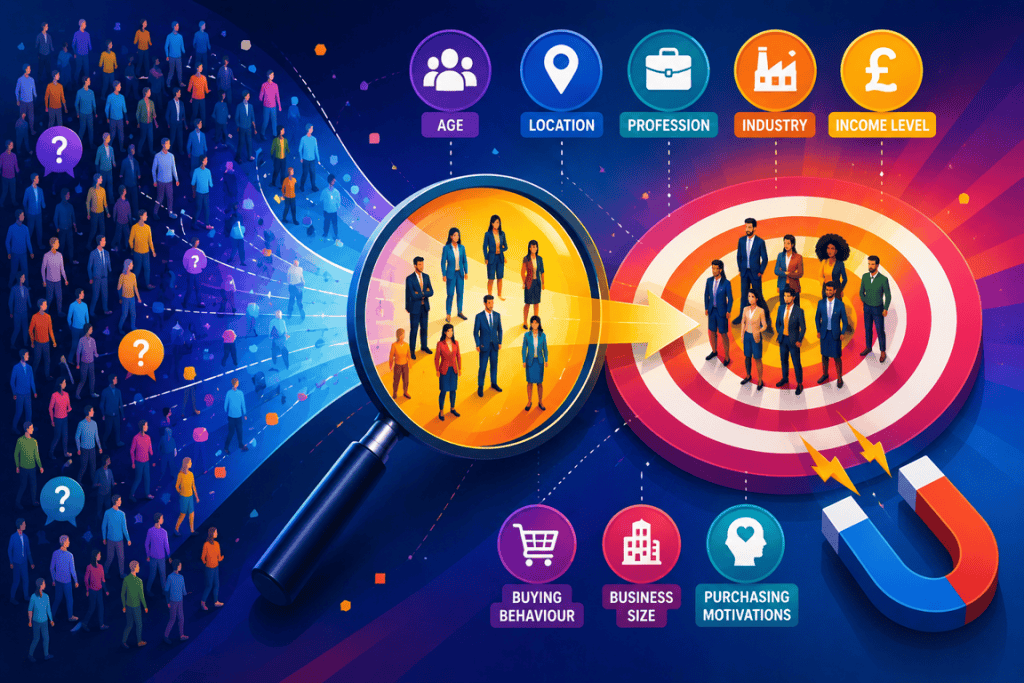
Assess market size, customer demand, economic conditions, buying trends and relevant regulatory influences. Identify segments that match the organisation’s capabilities and commercial ambitions rather than attempting to appeal to everyone.
Smaller target markets can appear restrictive, yet greater relevance often improves messaging, channel selection and conversion. The disadvantage is reduced reach, so the chosen segment must still offer sufficient commercial potential.
Analyse Direct and Indirect Competitors
Compare competitors’ positioning, services, pricing signals, proof points, content, customer experience and marketing channels. Direct competitors provide similar solutions, while indirect competitors solve the same problem through a different approach.
Competitor analysis should inform decisions rather than encourage imitation. The aim is to identify customer expectations, unaddressed needs and credible opportunities for differentiation.
Build Evidence-Based Customer Profiles
Use customer interviews, sales records, website analytics, search data, reviews and frontline knowledge. Document customer problems, priorities, objections, decision criteria and preferred information sources.
B2B purchases often involve several people. The user, decision-maker, influencer and budget holder may each require different information, so the process should address every important participant.
Step 4: Define Positioning, Value Proposition and Messaging
Clear positioning gives customers a reason to consider one business over another. Weak positioning forces marketing teams to rely on generic claims, price reductions or excessive promotion.
Establish a Defensible Market Position
Define who the organisation serves, what problem it solves and why its approach offers meaningful value. Strong differentiation should be relevant to customers, difficult to imitate and supported by credible evidence.
Claims such as “excellent service” or “high quality” rarely create distinction because almost every competitor uses them. More persuasive positioning may draw on specialist knowledge, methodology, speed, commercial outcomes or a clearly defined sector focus.
Create a Clear Messaging Framework
Develop a central value proposition supported by audience-specific messages, proof points and responses to common objections. Customer testimonials, case studies, data and practical examples strengthen credibility.
Apply the framework across website copy, sales conversations, proposals, campaigns and customer communications. Consistency builds recognition and trust, although messages should still reflect the context and needs of each audience.

Step 5: Map the Customer Journey and Marketing Funnel
A customer journey map shows how people move from recognising a problem to choosing, using and recommending a solution. It helps the business provide the right information at the right stage.
Define the Stages From Awareness to Retention
Map awareness, research, consideration, purchase, onboarding, retention and advocacy. Record the questions, concerns and decisions customers face at each stage.
Marketing should not end at the first sale. Onboarding, customer support, account development and referral activity can increase lifetime value while reducing dependence on continuous acquisition.
Identify Touchpoints, Barriers and Conversion Actions
List the search results, website pages, emails, social posts, calls, events, proposals and sales interactions that influence decisions. Locate barriers such as unclear next steps, unsupported claims, complicated forms or slow responses.
Assign a suitable action to each stage. Early-stage prospects may read a guide, while decision-ready prospects may book a consultation or request a proposal.
Step 6: Select the Right Marketing Channels and Activities
Channel selection should follow strategy, customer research and journey mapping. A platform is only valuable when it reaches the right audience and supports a defined commercial objective.
Choose Channels Based on Evidence
Assess where customers research solutions, whom they trust and how they prefer to engage. Relevant options may include organic search, LinkedIn, email, webinars, video, referrals, partnerships, events and paid media.
Running many channels can increase reach, but it spreads budget and attention. Concentrating on fewer channels usually improves quality and learning, although overdependence on one platform creates risk.
Create an Integrated Marketing Activity Plan
Give each channel a specific role. SEO and educational content may build awareness, email can nurture interest, webinars can demonstrate expertise and consultations can support conversion.
Coordinate messages, campaigns and sales follow-up around shared priorities. Customers should experience one coherent proposition rather than disconnected communications from different suppliers or departments.
Prioritise Resources and Budget
Rank activity according to expected impact, cost, capability and time to results. Include employee time, technology, content production, agency fees and management requirements when calculating the true cost.
Use controlled tests before committing heavily to unfamiliar channels. Testing reduces financial exposure, although budgets must still be large enough to produce meaningful evidence.
Step 7: Design the Marketing Workflow
A workflow turns the strategy into repeatable action. It should show how ideas move through research, briefing, approval, production, publication, lead management and review.
Document the Process From Idea to Review
Create standard campaign briefs, content templates, approval stages and reporting formats. Each brief should state the audience, objective, proposition, channel, budget, deadline and success measure.
Structured workflows improve consistency and make training easier. Excessive approval stages can slow delivery, so the process should remain proportionate to the organisation’s size and risk.
Assign Ownership and Accountability
Clarify who is responsible, accountable, consulted and informed at every stage. Define the roles of owners, directors, marketers, sales employees, agencies and freelancers.
Junior marketers may manage delivery but still require strategic guidance. Mentoring and regular reviews help them build commercial judgement, develop leadership skills and progress towards marketing management roles.

Step 8: Connect Marketing With Sales and Customer Service
Marketing cannot deliver its full value when sales and customer service operate separately. Shared information improves lead quality, conversion and the post-purchase experience.
Agree Lead Definitions and Handover Rules
Define enquiries, marketing-qualified leads, sales-qualified leads and sales opportunities. Set clear criteria for ownership, response times, lead scoring and follow-up.
Create a feedback route so marketing knows which leads converted, which were unsuitable and why opportunities were lost. Without this feedback, teams may optimise campaigns for lead volume rather than commercial value.
Use Customer Insight Across the Organisation
Sales objections, service enquiries, complaints and customer feedback should influence content and campaign planning. These sources often reveal information gaps that analytics cannot explain.
Promises made through marketing must match the experience delivered after purchase. Misalignment may generate short-term sales but damages retention, referrals and reputation.
Step 9: Establish Measurement, Reporting and ROI
Measurement should help people make decisions. Reports that contain large volumes of data but no interpretation create administrative work rather than commercial insight.
Select Meaningful Marketing KPIs
Use measures that reflect the customer journey and business objectives. Relevant indicators may include qualified enquiries, conversion rates, acquisition costs, sales revenue, retention and customer lifetime value.
Reach, impressions and clicks can reveal early-stage performance, but they should not be treated as proof of profitability. A balanced dashboard connects audience behaviour with commercial outcomes.
Build a Practical Reporting System
Create a concise dashboard showing targets, actual results, trends, expenditure and required actions. Weekly reviews may suit active campaigns, while monthly and quarterly reviews support broader strategic decisions.
Maintain consistent definitions and data sources. Changing measurement methods makes comparisons unreliable and can hide genuine performance problems.
Interpret ROI With Care
Calculate financial return wherever dependable revenue and cost data are available. Consider lead quality, sales-cycle length and repeat purchases alongside immediate sales.
Attribution will rarely be perfect because customers encounter several touchpoints. Treat the result as decision-supporting evidence rather than an unquestionable figure.

Step 10: Test, Learn and Improve the Process
No marketing process remains effective indefinitely. Customer behaviour, competition and business priorities change, so regular improvement must be built into the system.
Create a Continuous Improvement Cycle
State a clear hypothesis before testing an audience, offer, message or channel. Define the success measure and change one major variable at a time where practical.
Record results, lessons and next actions. A documented testing history prevents repeated mistakes and gives new employees or suppliers access to accumulated knowledge.
Know When to Continue, Adjust or Stop
Give activity enough time and data to receive a fair assessment. Equally, avoid defending ineffective work simply because money has already been spent.
Poor results may come from targeting, positioning, messaging, execution, follow-up or the underlying offer. Diagnose the cause before replacing the entire strategy.
Common Marketing Process Mistakes to Avoid
Frequent mistakes include starting with tactics, targeting an audience that is too broad, running too many channels and failing to assign ownership. Weak coordination between marketing and sales also causes promising enquiries to be lost.
Other problems include measuring activity without commercial context, automating a flawed workflow and changing direction before sufficient evidence is available. Technology can accelerate a strong process, but it can also make a weak process fail faster.
How a Marketing Consultant Can Strengthen the Process
An independent marketing consultant can assess performance, challenge assumptions and create structure where activity has become fragmented. This support is particularly useful for UK SMEs without an experienced marketing leader or with junior employees who need strategic mentoring.
A strategy-first consultant can conduct a marketing health check, develop the marketing roadmap, coordinate specialist suppliers and help the internal team interpret results. The business retains strategic control while gaining senior-level guidance without immediately recruiting a full-time marketing director.
Turn Marketing Into a Repeatable Growth System
Reliable marketing results rarely come from isolated campaigns. They come from a connected process that assesses the current position, sets objectives, researches the market, defines positioning, maps the customer journey, selects suitable channels and measures commercial performance.
Start with the most significant gap rather than attempting to rebuild everything at once. A clear, measurable and regularly reviewed marketing process gives UK SMEs stronger accountability, better control over expenditure and a more dependable route to sustainable growth.

Work With Opportunity Marketing
Opportunity Marketing helps UK SMEs replace disconnected marketing activity with a structured, strategy-first process focused on measurable results. Our independent marketing consultants can assess your current approach, identify performance gaps and develop a practical roadmap aligned with your commercial objectives. Contact Opportunity Marketing to discuss how a clearer marketing process could improve your decision-making, return on investment and long-term growth.
📩 Request a Free Consultation
Let’s talk about how we can help you stop reacting to agency ideas and start driving your marketing with purpose. Complete our quick inquiry form or give us a call; we’ll walk you through what’s possible and how to get started.
📍 Visit: opportunitymarketing.co.uk
📞 Call: 0333 320 4108
📧 Email: info@opportunitymarketing.co.uk


Ian Kirk
Founder at Opportunity Marketing
Ian is the founder of Opportunity Marketing marketing, with over 18 years of experience in successfully setting up marketing departments, creating marketing strategies and implementing these strategies across a wide number of SME companies in both the B2B and B2C sectors through a variety of channels.

A-Z OF MARKETING
A complete guide that simplifies the wonderful world of marketing.
 Download Now


