Skip to main content
Skip to footer
Skip to main content
Skip to footer

How To:, Marketing Strategy, The 7 P's of Marketing
A Step-by-Step Guide to the Marketing Conversion Process

How to Build a Marketing Conversion Process That Delivers Results
The marketing conversion process turns audience attention into enquiries, sales and long-term customer value. This step-by-step guide explains how UK businesses can map their conversion funnel, improve lead quality, remove purchasing barriers and measure marketing performance.
Generating website traffic, social media engagement and enquiries does not automatically produce sales. A business needs a structured marketing conversion process that moves potential customers from initial awareness towards a commercially valuable action.
That action might involve downloading a guide, joining an email list, requesting a quotation, booking a consultation or completing a purchase. Each conversion should take the prospect closer to becoming a profitable customer, while giving the business useful information about their interests and readiness to buy.
SME owners, company directors, marketing managers and sales teams can use the following process to identify conversion barriers, improve lead quality and generate a stronger return on marketing investment.
Opportunity Marketing’s Strategic Marketing Mastery course helps SME owners, directors and junior marketing professionals build a structured marketing strategy that connects audience insight, competitive positioning, messaging and conversion objectives. Participants learn how to map the customer journey, select suitable marketing activities, measure funnel performance and make commercially informed decisions that improve lead quality and marketing ROI. The course provides practical frameworks and expert guidance to help businesses replace disconnected tactics with a clear, measurable process for attracting, converting and retaining profitable customers. Contact Us: 0333 320 4108 or info@opportunitymarketing.co.uk.
What Is the Marketing Conversion Process?
A marketing conversion process is the structured sequence through which a potential customer discovers a business, considers its offer, makes an enquiry and completes a purchase. It also includes onboarding, retention and advocacy because commercial value rarely ends with the first transaction.
Conversions can be divided into two types. A micro-conversion is a smaller action, such as watching a video, subscribing to an email list or downloading a guide. A primary conversion directly supports a commercial objective, such as requesting a proposal, booking a consultation or purchasing a service.
A typical conversion path follows this sequence:
Awareness → Interest → Consideration → Enquiry → Qualification → Sale → Retention → Advocacy
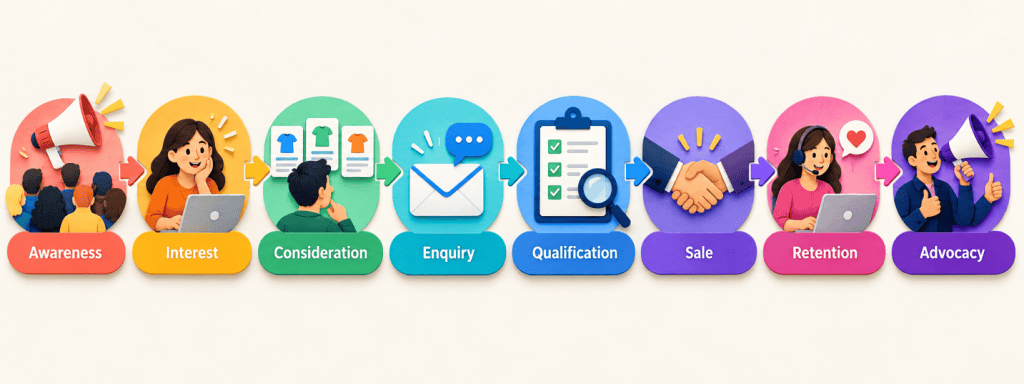
The process is rarely linear. A potential customer may visit a website several times, read reviews, speak to colleagues and compare competing providers before contacting the business. Higher-value B2B and professional services purchases often involve multiple decision-makers and longer consideration periods.
Marketing Funnel Versus Customer Journey
A marketing funnel measures how many prospects progress between defined stages and where they drop out. The customer journey examines the wider experience across search engines, social media, email, websites, telephone calls and sales conversations.
Both perspectives are valuable. Funnel data identifies where performance declines, while customer journey research helps explain why the decline is happening.
Build the Strategic Foundation Before Improving Conversion
Conversion problems frequently begin before a prospect reaches a landing page. Poor audience targeting, unclear positioning or an unsuitable offer cannot be repaired through cosmetic website changes alone.
A successful conversion strategy should connect business objectives, customer needs, competitive positioning, messaging, marketing channels, sales activity and customer retention. This strategy-first approach gives every marketing activity a defined commercial purpose.
Connect Conversion Goals to Business Objectives
Start with the commercial result the business needs to achieve. This might be £250,000 in new revenue, 20 new retained clients or 100 product sales.
Work backwards from that objective. If a business needs 20 new customers and converts 25 per cent of qualified enquiries, it needs approximately 80 qualified opportunities. If only half of its leads qualify, it will need around 160 initial enquiries.
These calculations expose whether the target, budget and timescale are realistic. They also turn marketing from a collection of activities into a measurable investment.
Define the Target Audience and Buying Problem
Identify the market segments most likely to need, value and purchase the offer. Avoid targeting everyone who could theoretically become a customer.
Document the audience’s problems, objectives, purchasing triggers, objections and decision criteria. B2B businesses should also identify users, influencers, financial decision-makers and final approvers because each person may require different evidence.
Customer interviews, sales records, website searches, enquiry forms and lost-opportunity reviews can reveal what matters most. Reliable audience insight allows the business to create messages that reflect genuine buying priorities.
Clarify the Value Proposition
A value proposition explains why a customer should choose one business instead of another. It should identify the customer problem, proposed solution, expected outcome and credible reason to believe the claim.
Generic statements such as “high-quality service” or “customer-focused solutions” rarely create meaningful differentiation. Stronger propositions connect expertise, service delivery, evidence and commercial value to a specific audience need.
Step 1: Set Clear Conversion Objectives
Every campaign, page and communication should have a defined purpose. Without one, the business cannot judge whether the activity is working.
Select one primary conversion for each campaign or landing page. A search advertisement targeting prospects ready to buy might direct them towards a consultation. An educational article aimed at early-stage prospects may use a guide download or email subscription as its next step.
Record current traffic, enquiries, qualified opportunities, sales and revenue before changing the process. This baseline makes later improvements measurable.
Responsibility also needs to be clear. Assign ownership for lead capture, qualification, sales follow-up, reporting and optimisation. Establish response-time standards so valuable enquiries do not sit unattended.
Step 2: Map the Customer Journey and Conversion Funnel
Map how prospects discover the business, research their options, compare providers, make contact and decide whether to buy. Include online and offline interactions such as organic search, referrals, events, email, telephone conversations and sales meetings.
Next, identify what the prospect needs at each stage. Early-stage visitors may require education, while consideration-stage prospects may need pricing guidance, case studies, testimonials or service comparisons.
Review stage-to-stage conversion rates to find funnel leakage. A high-performing advertisement followed by a weak landing page suggests a page relevance or usability problem. Strong enquiry numbers followed by poor sales results may point to low lead quality, slow follow-up or weak qualification.
Prioritise the leakage point with the greatest commercial effect rather than changing every stage at once.
Step 3: Match Content and Messaging to Customer Intent
Content should help the prospect make the next logical decision. Educational articles, videos and guides can build awareness, while case studies, demonstrations and comparison content support consideration.
Prospects approaching a purchase may require transparent service information, delivery timescales, consultations, proposals or trials. Asking an early-stage visitor to commit too soon can reduce conversions, but offering only general information to a purchase-ready prospect can create unnecessary delay.
Keep the core message consistent across advertisements, search results, landing pages, emails and sales conversations. Each channel may require a different level of detail, but the central promise should remain recognisable.
Credibility also matters. Support marketing claims with relevant experience, customer reviews, measurable outcomes, accreditations and clear service processes.
Step 4: Design a Strong Offer and Call to Action
A strong offer tells the prospect what they will receive, who it is for, how it addresses their problem and what happens next. Clear scope, pricing information or timescales can reduce uncertainty.
Calls to action should use direct language. “Book a Marketing Consultation” is clearer than “Learn More” when the intended outcome is an appointment. One dominant action usually performs better than several competing options.
Lower-commitment actions can support prospects who are not ready to buy. A useful guide, assessment or webinar may begin a lead-nurturing relationship, provided it connects naturally to the eventual service.
Ethical persuasion is critical. Genuine urgency, relevant evidence and transparent value can support decision-making. False scarcity, hidden charges and misleading countdowns may produce short-term responses, but they damage trust and customer retention.
Step 5: Create a Low-Friction Conversion Experience
The landing page should match the advertisement, email, referral or search query that brought the visitor there. A disconnect between the original message and the page content can cause immediate abandonment.

Present information in a logical order: customer problem, value proposition, benefits, evidence, offer and next action. Remove unnecessary distractions where they interfere with the primary conversion.
Forms should request only the information required at that stage. Lengthy forms can reduce completion, although higher-value B2B services may need more information for effective qualification. The correct balance depends on the offer and sales process.
Test forms, payment pages and booking systems across mobile and desktop devices. Review page speed, error messages, broken links, text readability and accessibility. Alternative contact options may also help audiences who prefer telephone or email.
Step 6: Capture, Qualify and Nurture Leads
Connect website forms, telephone enquiries, event contacts and referrals to a central customer relationship management system. Record the original source, campaign and area of interest wherever possible.
Define what constitutes a marketing-qualified lead and a sales-qualified lead. Useful criteria include need, suitability, purchasing authority, budget, urgency and expected timescale. Treating every enquiry as equal wastes sales time and distorts performance reporting.
Lead nurturing should reflect the prospect’s interests and stage of readiness. Relevant emails, resources, reminders and personal contact can maintain engagement until the timing is right. Excessive or generic communication is likely to increase unsubscribes and weaken trust.
Set clear rules for when a nurtured lead moves to sales, remains within marketing or is disqualified.
Step 7: Align Marketing and Sales
Marketing and sales should agree on lead definitions, handover information, follow-up times and reporting. Misalignment can cause delayed contact, duplicated communication and conflicting messages.
Sales conversations should reconfirm the prospect’s problem, priorities and decision criteria. The recommended solution must connect to commercial value rather than simply presenting a list of features.
Record why opportunities are won, lost, delayed or disqualified. Common objections may reveal unclear pricing, weak differentiation, unsuitable targeting or missing evidence. Marketing can then use this intelligence to improve content, campaigns and offers.
Staff development also plays an important role. Junior marketers need support in interpreting funnel data, while sales teams require training on qualification, value-led conversations and CRM discipline. Managers should translate the findings into clear decisions about budgets, channels and resources.

Step 8: Continue the Process After the Sale
The first purchase is not the end of the marketing conversion process. A poor onboarding experience can create buyer’s remorse, cancellations and negative reviews.
Confirm what the customer purchased, key contacts, delivery timescales and next actions. The service experience should match the promises made during marketing and sales.
Monitor satisfaction, repeat purchases, renewals, cross-selling, customer lifetime value and churn. Retaining suitable customers can improve profitability because the business gains more value from its original acquisition investment.
Satisfied customers can also support advocacy through reviews, testimonials, case studies and referrals. Ask at an appropriate point and obtain permission before publishing customer information or results.
Measure Marketing Conversion Performance
Conversion measurement should focus on commercial outcomes rather than impressions, clicks or engagement alone. Supporting metrics are useful, but they do not prove profitability.
Core calculations include:
- Conversion rate: conversions divided by visitors or leads, multiplied by 100.
- Cost per lead: marketing spend divided by leads generated.
- Customer acquisition cost: total acquisition costs divided by new customers.
- Lead-to-customer rate: new customers divided by total leads, multiplied by 100.
- Marketing ROI: attributable profit minus marketing cost, divided by marketing cost, multiplied by 100.
- Customer lifetime value: the expected value generated across the customer relationship.
Metrics must be interpreted together. A campaign with a low cost per lead may perform poorly if those leads rarely qualify. A more expensive channel may be commercially stronger if it generates larger purchases, better margins or longer customer relationships.
Create a simple monthly dashboard covering spend, traffic, leads, qualified opportunities, sales, revenue, conversion rates, acquisition cost and retention. Segment results by campaign, audience, channel, offer and device where the available data supports a reliable comparison.
Test and Improve the Conversion Process
Conversion optimisation should follow a repeatable cycle:
Measure → Diagnose → Prioritise → Test → Review → Refine
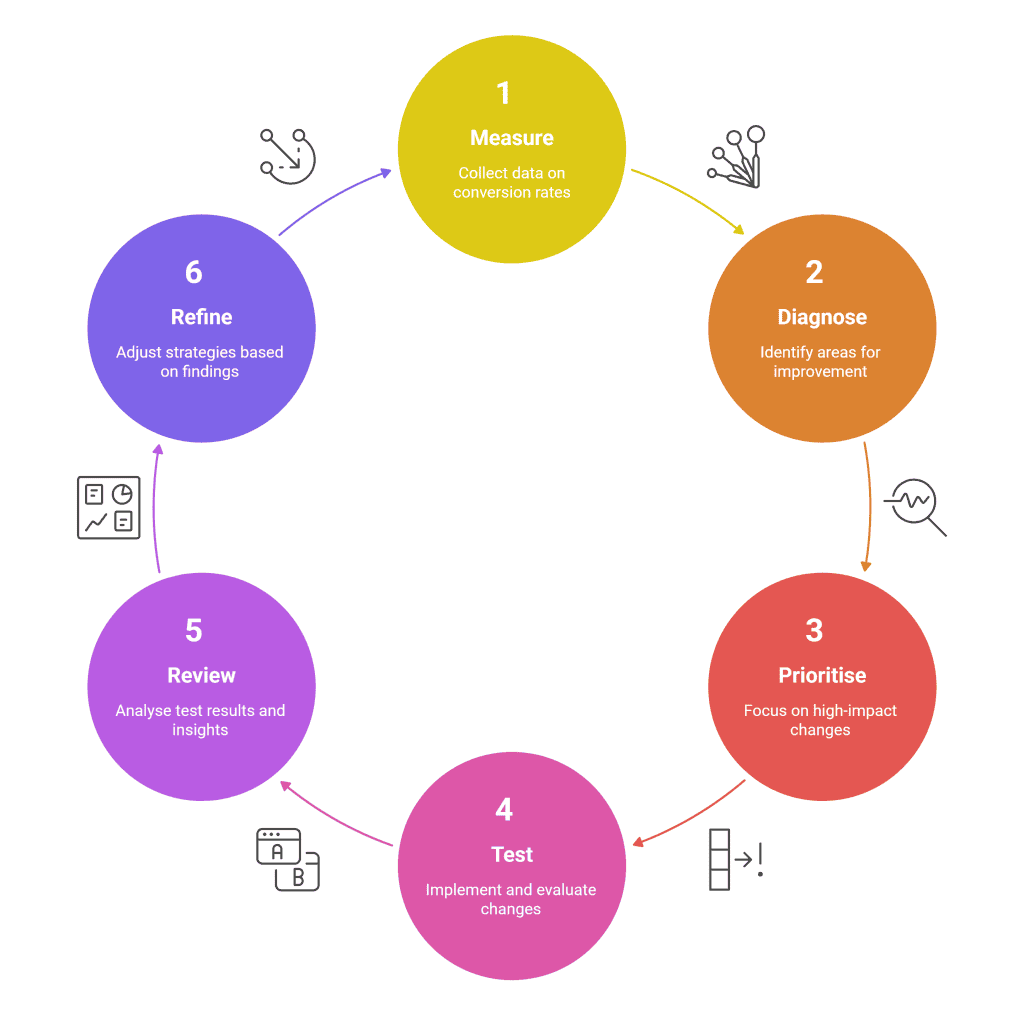
Test meaningful variables such as headlines, value propositions, offers, calls to action, forms, supporting evidence and follow-up timing. Change one major variable at a time where practical so the cause of any performance movement remains clear.
Allow enough time and volume before reaching a conclusion. Small samples can produce misleading results. Evaluate lead quality, sales value and profit rather than choosing a winner solely because it generated more responses.
Testing has advantages and limitations. It can expose customer preferences, reduce marketing waste and improve ROI. Poorly planned tests can consume time, fragment the customer experience and lead to false conclusions.
UK Legal and Ethical Considerations
UK businesses must manage personal data and electronic marketing in line with the UK GDPR, Data Protection Act 2018 and Privacy and Electronic Communications Regulations. Relevant requirements may cover lawful data collection, privacy information, cookies, marketing consent and unsubscribe options.
Advertising and sales messages should also comply with applicable consumer protection rules and the relevant advertising codes. Misleading claims, hidden charges, disguised advertising and manipulative interfaces create legal, reputational and commercial risk. Specialist advice should be obtained when the legal position is uncertain.
Build a Conversion System, Not a Collection of Tactics
A successful marketing conversion process connects strategy, customer insight, positioning, content, user experience, lead management, sales and retention. More website traffic will not repair a weak offer, unsuitable targeting or poor follow-up.
Start with baseline performance, then identify the most commercially significant point of funnel leakage. Make focused improvements, measure their effect and use customer feedback to guide the next decision.
Sustainable conversion growth comes from understanding why customers act, removing unnecessary barriers and making every stage accountable to a meaningful business result.

Work With Opportunity Marketing
Struggling to turn marketing activity into qualified leads and profitable customers? Opportunity Marketing helps UK SMEs build a strategy-first conversion process that connects audience targeting, positioning, messaging, lead generation and sales. Contact Opportunity Marketing to discuss how an independent, ROI-focused marketing consultant can improve your marketing performance.
📩 Request a Free Consultation
Let’s talk about how we can help you stop reacting to agency ideas and start driving your marketing with purpose. Complete our quick inquiry form or give us a call; we’ll walk you through what’s possible and how to get started.
📍 Visit: opportunitymarketing.co.uk
📞 Call: 0333 320 4108
📧 Email: info@opportunitymarketing.co.uk


Ian Kirk
Founder at Opportunity Marketing
Ian is the founder of Opportunity Marketing marketing, with over 18 years of experience in successfully setting up marketing departments, creating marketing strategies and implementing these strategies across a wide number of SME companies in both the B2B and B2C sectors through a variety of channels.

A-Z OF MARKETING
A complete guide that simplifies the wonderful world of marketing.
 Download Now