Skip to main content
Skip to footer
Skip to main content
Skip to footer

Marketing Strategy, Marketing Techniques, Marketing Tips
Why Marketing Strategy Must Come Before Spend

One of the most common causes of disappointing marketing is not poor campaign execution, but it is rushing into rolling out activity before having a clear marketing strategy in mind. Businesses tend to spend before they think.
SMEs are the most likely to be guilty of this. They will approve a website refresh, launch paid campaigns, start posting on LinkedIn, brief a designer, commission a brochure, hire an SEO firm, or sign off exhibition attendance before answering the most important questions first.
- Who are we trying to reach?
- What are we really selling?
- What makes us different?
- Why should anyone care?
- What result are we actually trying to create?
If those questions remain blurred, then the activity that follows is likely to be blurred too. Tactics without strategy rarely fail because they are badly rolled out. They generally fail because they were not built on clear foundations nor carefully though through.
Why businesses rush to marketing tactics
There are a couple of simple reason this happens.
Firstly, tactics feel productive. Strategy can feel slower, more abstract and less visible. Tactics, by contrast, feel like action. A campaign can be launched. A website can be redesigned. Content can go live. It gives the impression that progress is being made. For time-pressured business owners, that sense of movement can be hard to resist.
But movement and direction are not the same thing.
Without marketing strategy, tactics become disconnected acts of effort. Some may work by accident. The vast majority of activity will not. And because there is no clear strategic framework holding them together, the business struggles to understand why results are inconsistent – and will probably hold third party suppliers responsible.
To be fair, SMEs are not purely to blame for this frustrating situation. Too many marketing providers of specific activities are only too happy to take on projects without any strategic grounding beforehand. Only the rare few will actually suggest taking a step backwards first to maximise ultimate return on investment.
Secondly, getting the marketing strategy correct can require additional investment, in money as well as in time. More often than not, SME’s do not have the required internal skill set to clearly map out the correct marketing strategy for the business. This inevitably means bringing in outside expertise and resource, which at the time can feel like layering cost upon cost. However, in reality this process is an investment, in ensuring that the tactics are targeted to the the right people, at the right time, with the right messaging and ultimately delivering a positive return on investment.
Marketing strategy is what makes spend make sense
A proper marketing strategy does a few essential things.
- It defines the audience. Not “everyone”, but the right people.
- It clarifies the value proposition. Not a list of features, but a reason to choose you.
- It sharpens positioning. Not vague claims, but a credible place in the market.
- And it links marketing activity to business goals. Not “do more marketing”, but generate leads, increase conversion, improve retention, strengthen profitability, or support growth in a target sector.
Once all of those pieces are in place, spending decisions become easier because they can be tested against something more intelligent than instinct.
Opportunity Marketing’s whole proposition rests on this principle: build the strategic framework first, then decide what activity belongs on top of it.
The cost of getting the order wrong
When businesses spend first and strategise later, several problems tend to appear.
The first is inconsistency. Different channels end up saying different things because nobody has agreed the central message.
The second is weak targeting. Marketing is aimed too broadly because the business has not been disciplined enough about who it most wants to attract.
The third is wasted resource. Channels get funded because they are fashionable, not because they are commercially justified.
And the fourth is frustration. The business sees lots of marketing effort but little clarity on what is actually moving the needle.
This is why strategy is not a luxury or a theoretical exercise. It is a practical commercial tool. It reduces waste, improves confidence and gives tactical execution a clear job to do.
Segmentation, targeting and positioning are not academic
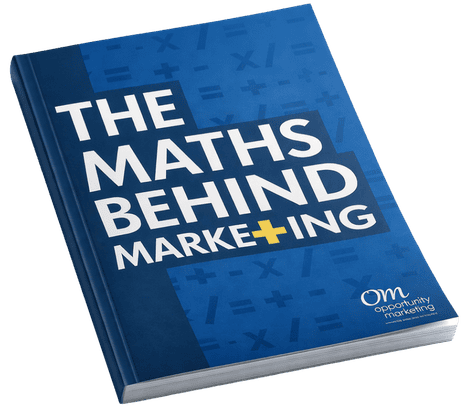
The Maths Behind Marketing ebook brings in segmentation, targeting and positioning as core strategic foundations, and that is important because SMEs often assume these are “big business” concepts. They is not true. They are simply the mechanics of making better choices.
Segmentation helps you understand the different groups within your market.
Targeting helps you decide which of those groups deserve the most focus.
Positioning helps you shape how you want to be understood by those people.
That is not corporate jargon. That is clarity.
A business that has done this work properly knows which prospects are most commercially attractive, what those people care about, and how to communicate in a way that feels relevant rather than generic. A business that has not done it is left trying to market everything to everyone and wondering why the results feel diluted.
Creativity still matters, but it needs a job to do
One of the persistent myths in marketing is that strategy somehow suppresses creativity. In reality, it does the opposite. It gives creativity real purpose.
Good creative work becomes more powerful when it is shaped by a clear audience, a strong value proposition and defined commercial intent. It stops being decorative and starts becoming persuasive. It has a clearer target, a clearer message and a clearer measure of success.
That is far more useful than simply producing something that looks good.
What marketing strategy-first looks like in practice
In practical terms, a strategy-first approach means pausing before spend and asking:
- What commercial result are we trying to create?
- Which audience matters most?
- What is their problem, pressure or motivation?
- What promise are we making?
- Which channels genuinely fit that audience and objective?
- How will we measure success?
Contrary to popular belief, those questions do not slow marketing down, they actually stop it from becoming expensive guesswork (and wasting time and money).
Once these questions are answered, activity can move much faster because the business is no longer improvising.
Large businesses can sometimes get away with a degree of inefficiency for longer, but SMEs usually can’t. Limited budgets create a different reality and there is less room for random experimentation, fewer resources to absorb poor decisions, and more pressure for every pound to justify itself
If your marketing has felt fragmented, inconsistent or overly tactical,, The Maths Behind Marketing will help you put strategy back where it belongs – before the spend, not after it.


Ian Kirk
Founder at Opportunity Marketing
Ian is the founder of Opportunity Marketing marketing, with over 18 years of experience in successfully setting up marketing departments, creating marketing strategies and implementing these strategies across a wide number of SME companies in both the B2B and B2C sectors through a variety of channels.

A-Z OF MARKETING
A complete guide that simplifies the wonderful world of marketing.
 Download Now