Skip to main content
Skip to footer
Skip to main content
Skip to footer

Marketing Strategy, Marketing Techniques, Marketing Tips
Stop Guessing: How to Build a Marketing Budget Backwards
There is a common ritual that plays out in businesses every year. Someone asks what the marketing budget should be. A number gets suggested, usually based on what was spent last year, what feels affordable, or what the business owner is willing to risk. Then marketing is expected to produce growth from that figure, whether it is sufficient or not.
It is an understandable habit, but it is also backwards.
The problem with budgeting by comfort level
Most marketing budgets are not really budgets in the strategic sense. They are spending limits.
They reflect caution, precedent or gut feel rather than a clear calculation of what the business is actually trying to achieve. That means the budget is often disconnected from commercial ambition from the outset, which means the consequence is predictable. Expectations remain high, but logic stays weak.
A business may want significant growth while allocating a budget that only supports modest activity. Or it may spend across too many channels without knowing how those investments relate to lead volume, conversion or profit.
When results disappoint, marketing gets judged as ineffective even though the original budget may never have been designed to meet the target in the first place. That is not a marketing performance issue, it is fundamentally a resource planning issue.
A better starting point: begin with the result
Reverse budgeting, or budgeting backwards, fixes this by changing the order of the conversation.
Instead of asking, “What can we afford to spend?” the business starts with a more commercially useful question: What are we trying to achieve?
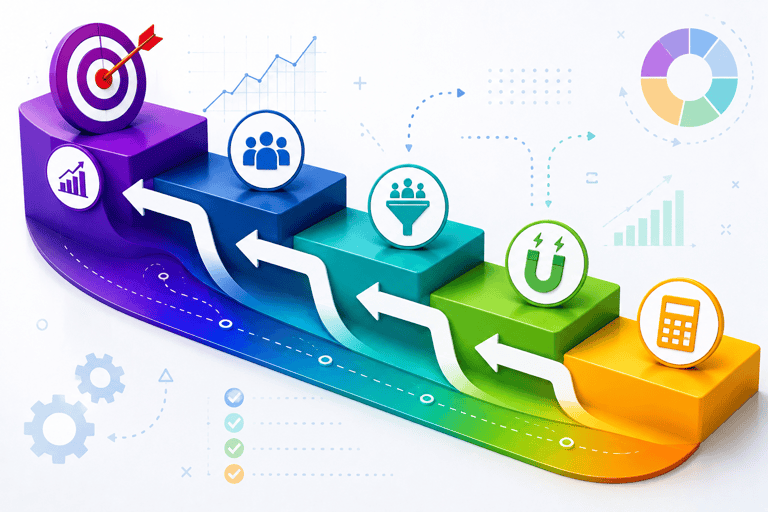
If the goal is to generate a certain level of revenue, profit or customer growth, then marketing can be planned backwards from there.
- How many sales are required?
- How many leads are needed to generate those sales?
- What does it typically cost to produce those leads?
- What level of investment does that imply?
Once you begin there, the budget stops being arbitrary and it becomes specifically tied to a target (based on factual data).
Why this feels so different
One reason this approach is powerful is that it forces realism into the room. Businesses often talk about growth in broad, optimistic terms. After all, many businesses are run by visionary entrepreneurial personality types who get energised by the possibilities. Reverse budgeting forces them to make that ambition concrete – translating aspiration into numbers. That can be uncomfortable for many, but it is far more useful than working from intuition and instinct.
For example, if a business wants to add £500,000 in revenue, the next question is not whether social media should be part of the mix. The next question is how many additional sales that target requires, and what those sales imply in terms of lead volume generation and investment.
This immediately improves the quality of decision-making.

The core numbers behind reverse marketing budgeting
A backwards marketing budget is not especially complicated, but it does rely on having a grip on a few key metrics within the business:
Revenue target : What are you actually trying to generate?
Average sale value : What is a typical customer worth in revenue terms?
Conversion rate : How many leads become customers?
Cost per lead : What does it cost, on average, to generate those leads?
Once those numbers are understood, marketing planning becomes more like forecasting and less like guesswork. This shift matters because it gives leadership a clearer view of whether the plan is realistic, whether capacity exists to handle the results, and whether modest improvements in conversion or lead cost could materially improve the commercial outcome.
Businesses don’t always need to generate more leads, sometime it is just a better quality of lead, which naturally then positive impacts conversion rates and cost per lead.
Why this builds better conversations internally
One of the hidden benefits of budgeting backwards is that it creates better alignment across the business. Histrocally there has always been a battle between Finance and Marketing within businesses, over marketing budgets and allocated or available spend.
However, when budgeting backwards based on factual information, Finance can see the commercial rationale. Sales can understand the lead volumes require and Marketing can plan around measurable outcomes rather than vague activity goals. Leadership can challenge assumptions with more confidence because the numbers are clearly visible.
That is a much healthier position than the usual debate about whether the business is “doing enough marketing”. The question now becomes more precise: Are we investing at the level required to support the growth we say we want?
If not, what has to change? The target? The budget? The conversion process? The channel mix?
These are undoubtedly productive conversations.
Where businesses usually get stuck
The biggest obstacle in all of this is not mathematics. It is mindset.
Many businesses are more comfortable approving spend that feels cautious than larger investment that is logically justified. They would rather choose a budget first and hope it works than discover what the real number needs to be and decide whether they are willing to back it.
That is why reverse budgeting often feels challenging. It removes the comfort blanket. But it also removes a great deal of waste, both in terms of resource, money and time.
When the budget is linked directly to target outcomes, it becomes easier to see when money is being spread too thinly, when expectations are unrealistic, and when certain channels or tactics do not deserve a place in the plan.
This is not about spending more for the sake of it
A common misunderstanding is that budgeting backwards automatically leads to bigger budgets. This is actually not necessarily the case.
Sometimes it reveals that the business does not need more spend. It needs better conversion, tighter targeting or a stronger offer. Sometimes modest improvements in the sales process reduce the level of investment required. In other cases, the exercise exposes that current budgets are simply being diluted across the wrong activities. So the real value is not just in increasing spend. It is in making spend make sense.
Marketing Planning with more confidence
The businesses that use this method well tend to become more confident, not because outcomes are guaranteed, but because the logic is stronger. They know what they are aiming for. They know what assumptions sit behind the numbers, and most importantly they understand which metrics matter. All of this means they can adjust the plan in “real-time” as those metrics improve or deteriorate.
That is far more commercially mature than deciding on a budget because it feels safe. It also strengthens marketing’s credibility internally, because spend is being discussed as part of a growth model rather than as a discretionary pot of money with fuzzy expectations attached to it.
Why this belongs in the Maths Behind Marketing ebook
This is one of the most useful chapters of The Maths Behind Marketing because it addresses a very practical frustration for SME owners: they know they need to market their business, but they often have no clear way of deciding what the budget should be.
Budgeting backwards provides a way to think. It replaces assumption with structure. It makes marketing feel less like a punt and more like a commercial plan. And quite frankly, that is what more businesses need.
If you are tired of setting marketing budgets by instinct and hoping they will be enough, The Maths Behind Marketing will show you how to build a budget from the result backwards, with far more clarity and confidence.



Ian Kirk
Founder at Opportunity Marketing
Ian is the founder of Opportunity Marketing marketing, with over 18 years of experience in successfully setting up marketing departments, creating marketing strategies and implementing these strategies across a wide number of SME companies in both the B2B and B2C sectors through a variety of channels.

A-Z OF MARKETING
A complete guide that simplifies the wonderful world of marketing.
 Download Now