 Skip to main content
Skip to footer
Skip to main content
Skip to footer

Marketing Strategy, Traditional Marketing
The Maths Behind Marketing Explained

Why Marketing Has a Credibility Problem
Why Numbers, Not Nonsense, Drive Real Marketing Success
Many SMEs across the UK continue to struggle with one critical question: “Is our marketing actually working?” Business owners, directors, and managers are frequently presented with reports showing impressions, clicks, likes, website traffic, and engagement figures, yet these numbers often fail to explain whether the business is generating profitable growth. Marketing has gradually developed a credibility problem because too much attention has been placed on activity and visibility rather than measurable commercial performance.
Marketing is often misunderstood as a creative department focused on design, branding, advertising, and social media activity. Although creativity plays an important role, profitable marketing relies heavily on mathematics, forecasting, financial analysis, conversion optimisation, and strategic planning. Businesses that fail to measure marketing commercially often waste significant amounts of money on disconnected activity with no clear direction or measurable return.
Download the free The Maths Behind Marketing ebook from the Opportunity Marketing Free Resources page to gain practical insight into how ROI, conversion rates, customer lifetime value, lead generation economics, and strategic marketing calculations influence real business growth. This resource is designed specifically for SME business owners, directors, marketers, consultants, and organisations looking to improve marketing accountability, reduce wasted spend, and make more commercially informed marketing decisions. The ebook breaks down complex marketing concepts into clear, measurable frameworks that help businesses build stronger strategies, forecast growth more accurately, and connect marketing activity directly to revenue and profitability. Contact Us: 0333 320 4108 or info@opportunitymarketing.co.uk.
Marketing as a Commercial Function
Marketing Should Be Treated as an Investment, Not a Cost
One of the biggest mistakes many organisations make is treating marketing as an operational expense rather than a commercial investment. When marketing budgets are viewed purely as a cost, spending decisions become reactive, defensive, and disconnected from business growth objectives. Marketing activity is then reduced or paused whenever financial pressure increases, often causing lead generation and sales performance to decline further.
Successful businesses take a different approach. They understand that marketing should contribute directly to commercial growth, customer acquisition, customer retention, and profitability. Marketing investment should therefore be measured in the same way as any other business investment. Directors expect measurable returns from machinery, recruitment, software systems, or operational improvements, and the same level of accountability should apply to marketing expenditure.
A structured marketing strategy allows businesses to connect investment directly to measurable outcomes. This includes analysing lead generation costs, conversion performance, customer acquisition costs, customer lifetime value, and return on investment. Once these figures are properly tracked, marketing becomes far easier to manage, forecast, and improve over time.
The Difference Between Creative Marketing and Commercial Marketing
Creative marketing focuses heavily on visual identity, branding, advertising concepts, design, and audience engagement. Commercial marketing focuses on profitability, customer acquisition, conversion rates, and measurable business growth. Effective marketing requires both elements to work together, but many businesses place too much emphasis on creative activity without properly analysing financial performance.
A business may produce highly creative advertising campaigns, receive strong social media engagement, and attract significant website traffic, yet still struggle to generate profitable sales. Visibility alone does not create sustainable growth. Marketing activity must contribute directly to commercial outcomes.
Commercial marketing asks much tougher questions:
- How many leads did the campaign generate?
- What was the conversion rate?
- How much revenue was produced?
- What was the customer acquisition cost?
- Did the campaign generate profit?
- Was the return on investment acceptable?
These are the questions leadership teams, directors, and finance departments care about most. Marketing teams that fail to answer them often struggle to gain trust at board level.
The Modern Role of the Marketer
The role of the marketer has changed significantly during the past decade. Modern marketers are no longer expected to simply produce campaigns or manage social media channels. Businesses now require marketers who understand commercial strategy, forecasting, analytics, customer behaviour, and financial performance.
Strong marketers now operate as:
- Strategic planners
- Commercial analysts
- Revenue contributors
- Growth advisors
- Customer acquisition specialists
This shift is particularly important for SMEs that operate with tighter budgets and smaller teams. Every marketing decision carries financial consequences, which means marketers must understand how activity contributes to profitability and long-term sustainability.
Opportunity Marketing’s strategy-first philosophy reflects this commercial mindset. Strategic planning, audience targeting, positioning, ROI analysis, and measurable outcomes form the foundation of effective marketing decision-making.
Understanding ROI: The Ultimate Marketing Metric
What ROI Really Means in Marketing
Return on Investment, commonly referred to as ROI, is the most important measurement in marketing. ROI measures whether marketing activity generated more money than it cost to deliver. Without ROI analysis, marketing performance becomes subjective and difficult to evaluate properly.
The core principle behind ROI is simple:
Profit = Revenue – Costs
If marketing activity generates more profit than it costs to run, the activity can be considered commercially successful. If marketing activity costs more than the revenue it produces, the business is losing money regardless of how much engagement or exposure the campaign receives.
Many businesses focus heavily on vanity metrics such as likes, followers, impressions, or clicks because these figures are easy to obtain. Unfortunately, these metrics rarely explain whether marketing activity contributes to profit.
ROI replaces assumption with measurable financial clarity.
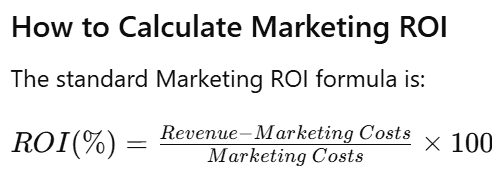
This formula calculates how much return the business receives for every pound invested into marketing activity.
For example:
- Marketing campaign cost: £10,000
- Revenue generated: £30,000
- Net profit generated: £20,000
The ROI would be 200%.
This means the business generated £2 profit for every £1 invested into marketing.
Businesses that consistently track ROI gain major advantages:
- Better budgeting decisions
- Stronger forecasting
- Reduced waste
- Improved accountability
- Better-performing campaigns
- Greater confidence when scaling activity
ROI also allows businesses to compare channels more effectively. Paid search, SEO, email marketing, LinkedIn advertising, webinars, and referral campaigns can all be compared based on measurable commercial performance rather than opinion.
ROI vs Vanity Metrics
Vanity metrics often create a false sense of success because they focus on visibility rather than profitability. High website traffic, strong engagement, or growing social media followers may look impressive, but these figures do not automatically translate into business growth.
A campaign that generates 50,000 impressions but produces no sales has little commercial value. A campaign generating fewer impressions but consistently delivering profitable enquiries is far more valuable to the business.
Businesses should prioritise metrics such as:
- Revenue generated
- Profit contribution
- Conversion rate
- Customer acquisition cost
- Cost per lead
- Customer lifetime value
- Retention rate
- Return on ad spend
These metrics provide genuine commercial insight and help businesses understand what is actually driving growth.
Marketing Funnel Maths Explained
Understanding the Marketing Funnel
The marketing funnel helps businesses understand how prospects move from initial awareness to becoming paying customers. Most funnels are broken down into three core stages:
- Awareness
- Consideration
- Conversion
Awareness refers to prospects discovering the business through channels such as search engines, social media, referrals, advertising, or content marketing. Consideration occurs when prospects begin evaluating the business, researching services, comparing competitors, or engaging with marketing material. Conversion happens when the prospect becomes a paying customer.
Each stage contains measurable data that can be analysed and improved.
Understanding Funnel Leakage and Drop-Off Rates

Many businesses lose large numbers of prospects throughout the customer journey. This is known as funnel leakage. Prospects may leave the funnel because of poor targeting, weak messaging, slow follow-up processes, unclear offers, or poor user experience.
Analysing funnel leakage allows businesses to identify where problems occur.
For example:
- 10,000 website visitors
- 1,000 enquiries
- 100 sales
This would indicate:
- 10% enquiry conversion rate
- 10% sales conversion rate
- 1% overall visitor-to-customer conversion
Even small improvements within the funnel can produce substantial financial gains. Increasing enquiry conversion from 10% to 12% or sales conversion from 10% to 15% can significantly increase profitability without increasing traffic levels.
This is why conversion optimisation is so valuable for SMEs.
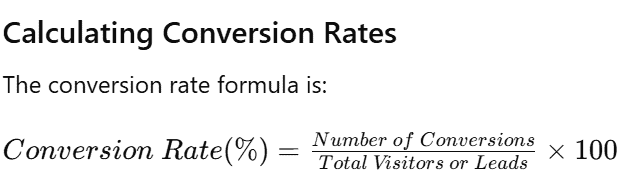
Businesses should calculate conversion rates across multiple areas:
- Website enquiries
- Landing pages
- Sales calls
- Proposal acceptance
- Email campaigns
- Paid advertising campaigns
Consistent conversion analysis allows businesses to identify weaknesses and improve performance incrementally over time.
Small Improvements Produce Large Financial Gains
Many SMEs incorrectly assume growth requires larger marketing budgets. Quite often, better performance comes from improving existing processes.
Areas that commonly improve conversion performance include:
- Faster response times
- Better lead qualification
- Clearer messaging
- Improved targeting
- Stronger calls-to-action
- Better sales follow-up
- Improved landing page design
Small conversion improvements compound throughout the funnel and often produce dramatic increases in profitability without major increases in expenditure.
Customer Lifetime Profit Value (CLPV)
Why Long-Term Customer Value Matters

Too many businesses focus solely on the first sale rather than the long-term profitability of customer relationships. Customer Lifetime Profit Value, often shortened to CLPV, measures the total profit generated from a customer during the entire relationship with the business.
This shifts marketing thinking away from short-term transactions and towards sustainable long-term growth.
A customer may only spend £500 initially but generate £10,000 profit over several years through repeat purchases, upselling, renewals, or referrals. Businesses that fail to understand CLPV often underinvest in marketing because they underestimate customer value.
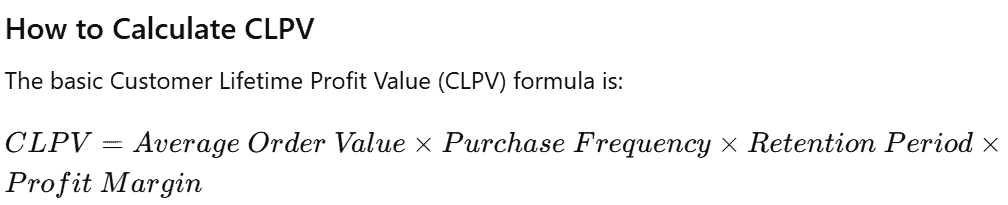
For example:
- Average order value: £200
- Purchase frequency: 5 purchases annually
- Retention period: 4 years
- Profit margin: 25%
CLPV calculation:
£200 × 5 × 4 × 0.25 = £1,000
This means the average customer contributes £1,000 profit throughout the relationship.
Once businesses understand CLPV, acquisition budgeting becomes far more strategic.
Improving Customer Lifetime Profit Value
Several factors influence customer lifetime profitability:
- Customer retention
- Upselling
- Cross-selling
- Pricing strategy
- Service quality
- Customer experience
- Loyalty programmes
- Subscription models
Retention is particularly powerful because retaining existing customers usually costs far less than acquiring new customers. Even modest retention improvements can substantially increase profitability.
Businesses that improve customer retention frequently achieve:
- Lower acquisition pressure
- Higher profit margins
- Greater forecasting accuracy
- More stable recurring revenue
- Improved customer loyalty
Opportunity Marketing regularly incorporates CLPV analysis into strategic planning because long-term customer value plays a major role in sustainable business growth.
Lead Generation Economics
Why Lead Generation Must Be Financially Measured
Lead generation sits at the centre of most SME marketing activity. Without a consistent flow of qualified leads, businesses struggle to maintain predictable revenue growth. Despite this, many organisations still measure lead generation poorly, focusing on lead volume alone without properly assessing lead quality, acquisition cost, or profitability.
Generating hundreds of low-quality leads rarely produces sustainable growth. Large enquiry volumes may initially appear positive, but weak conversion performance often reveals that the marketing activity is attracting the wrong audience. Poor targeting, unclear positioning, or ineffective messaging frequently create this problem.
Financial measurement brings clarity to lead generation performance. Businesses that understand lead generation economics can identify which channels generate profitable enquiries, which campaigns waste money, and where improvements are needed. This allows marketing investment to become more strategic, predictable, and commercially focused.
Understanding Key Lead Generation Metrics
Several core metrics allow businesses to evaluate lead generation performance properly.